





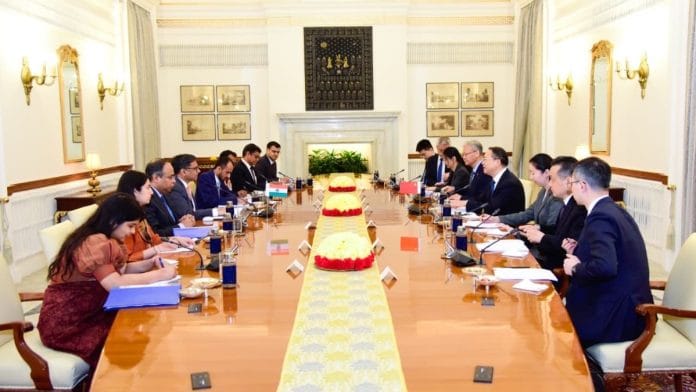



New Delhi: India and China held their first “strategic dialogue” Tuesday as part of another step toward “gradual normalisation” of ties. The dialogue was led by India’s Foreign Secretary Vikram Misri and China’s Executive Vice Foreign Minister Ma Zhaoxu in the Indian national capital.
The discussions focussed on “reviewing” the trajectory of ties till date, including discussing regional and global issues, a person familiar with the matter told ThePrint. The discussions are “one more step in the gradual normalisation of ties,” the person added.
China’s Ma is in India for the first BRICS Sherpa meeting under New Delhi’s chairship. The three-day Sherpa meeting commenced Monday and is seeing the participation of all 11 member-states of the organisation.
“Both sides reviewed the positive momentum in bilateral relations and discussed ways to further advance ties by enhancing people-to-people exchanges and addressing concerns on sensitive issues. They exchanged views on the global and regional situation and multilateral issues,” Randhir Jaiswal, the official spokesperson for the Ministry of External Affairs, said in a statement on X.
Foreign Secretary Vikram Misri held the India-China Strategic Dialogue with Executive Vice Foreign Minister of China Ma Zhaoxu, who is in India to participate in the BRICS Sherpa Meeting.
Both sides reviewed the positive momentum in bilateral relations and discussed ways to… pic.twitter.com/ZlON9Cq88G
— Randhir Jaiswal (@MEAIndia) February 10, 2026
The India-China “strategic dialogue” focussed on taking stock of the steps undertaken over the past year—confidence-building measures including the resumption of direct flights between the two countries and the Kailash Mansarovar Yatra last summer, said the person quoted earlier.
Ties between India and China have seen positive momentum since the end of 2024, when Prime Minister Narendra Modi met with President Xi Jinping on the margins of the BRICS leaders’ summit in the Russian city of Kazan in October of that year. The October 2024 meeting between Modi and Xi was the first between the two leaders since ties nosedived following the clashes in eastern Ladakh in the summer months of 2020.
On 21 October 2024, Foreign Secretary Vikram Misri announced an agreement had been reached between India and China to disengage at the friction points across the Line of Actual Control (LAC). New Delhi has been pushing Beijing to start discussions on de-escalation at the border.
The positive momentum in ties has been underlined by the two special representatives on boundary question mechanism talks held in China and India respectively at the end of 2024 and last August. National Security Adviser (NSA) Ajit Doval is India’s special representative, while China’s Foreign Minister Wang Yi is Beijing’s.
Misri has also been engaged in the Foreign Secretary-Vice Minister mechanism of dialogue, with two such engagements in 2025, in Beijing and New Delhi, respectively. Chinese Foreign Minister Wang Yi travelled to India last August, where Beijing agreed to a number of further measures to normalise ties including easing of export restrictions on critical minerals.
Modi travelled to the Chinese city of Tianjin for the Heads of States summit of the Shanghai Cooperation Organisation at the end of August last year. The gradual resumption of ties witnessed India issuing tourist and business visas for Chinese nationals beginning in July 2025, and airline companies resuming direct flights between both countries.
For India and China, the gradual normalisation of ties is partly motivated by the current geopolitical situation that has transformed global trade equations. China remains India’s largest source of merchandise imports, while the US is the most important destination for Indian exports.
India’s imports from China crossed $100 in the 2024-2025 financial year and in the current financial year till November 2025, imports from Beijing stood at $84.2 billion. India’s exports to China also increased, touching $12 billion between April 2025 and November 2025, according to data published by the Ministry of Commerce and Industry.
A number of Chinese delegations are expected to visit India this year.The Communist Party of China’s international liaisoning department travelled to India last month and met with a number of political leaders including leaders from the Bharatiya Janata Party (BJP) and its ideological parent the Rashtriya Swayamsevak Sangh (RSS).
(Edited by Amrtansh Arora)
Also Read: Amid expiration of New START, US says China held ‘covert’ nuclear test days after 2020 Galwan clash