





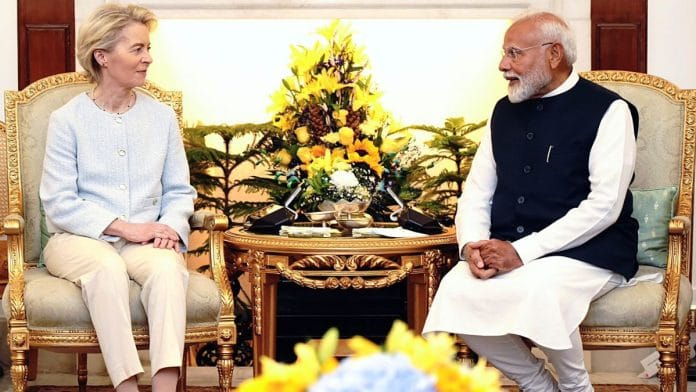



New Delhi: India and the European Union (EU) are set to announce the conclusion of negotiations for the Free Trade Agreement (FTA), sign a security and defence partnership, as well as launch negotiations for an information-sharing agreement next week at the EU-India summit, as Brussels continues to grapple with geopolitical challenges emanating from the US and China.
An EU official speaking on condition of anonymity highlighted that the FTA and the security and defence partnership are the two most “visible” deliverables expected from the summit that is to be held on 27 January, while a comprehensive agenda for the next half decade is also set to be announced.
“To sum up, we are looking to a summit that is very timely with clear messages from two global actors, two democracies of the world. More trade, more cooperation in security and defence and holding up international law,” the EU official said.
The EU official added: “The security and defence partnership enhances our possibility to discuss with India all threats to our region and compare views on challenges we both face, and translate this into operations. We believe that it is all the more important to enter a substantial dialogue on security threats that makes us understand in both directions what the concerns of the others are.”
The EU-India summit to be held in New Delhi will see the participation of Prime Minister Narendra Modi along with European Commission president Ursula von der Leyen and European Council president Antonio Costa.
The summit comes at a time when the EU is grappling with the US, especially over the future of Greenland, the semi-autonomous territory ruled by Denmark, an EU-member state. US President Donald Trump has threatened to impose tariffs of up to 25 per cent if there is no deal on Greenland’s sovereignty between the two Western powers.
The EU is also dealing with its dependence on China, which has made the FTA with India a necessity as it would give European businesses “predictable” access to the Indian market of 1.4 billion people. However, the visit will likely see the announcement of the “conclusion of negotiations” for a deal that first began in 2007, the EU official said.
While 20 of 24 chapters have been closed, substantial differences remain in areas such as agriculture and sustainable trade practices—the Carbon Border Adjustment Mechanism (CBAM). Despite asking for clarity on the inclusion of agriculture in the deal repeatedly, the EU official refused to answer the question, pointing out that the “negotiations are still ongoing”.
India has maintained that “sensitive agricultural issues” are outside the ambit of the deal, mirroring public comments made by EU officials last week. However, the scope of agriculture in the deal is still unclear.
IMEC, mobility & comprehensive joint agenda
Apart from a joint statement, the two sides are set to unveil a comprehensive joint agenda to deepen the relationship over the next half decade, including exploring the participation of India in the flagship Horizon Europe programme—the EU’s key funding initiative for research and innovation.
The comprehensive agenda is set to cover over 100 areas of future cooperation including in areas such as sustainable development, green energy and technologies, mobility, irregular migration, research and development, the EU official said.
He added that a “mobility framework covering students, researchers, workers and high-skilled labour” is also to be announced, while ensuring that the agreement would not change the “competences” of individual member-states to set their own immigration targets.
Immigration is a hot topic within the EU, with a number of member-states and political parties calling for a reduction of migration into the continent, especially from countries in the ‘Global South’.
A key outcome of the summit according to the EU official is an added momentum to kick-start work on the India-Middle East-Europe Economic Corridor (IMEC) that was first announced in September 2023.
“Progress on this project has been impacted by the happenings in the Middle East. Preparatory work is advancing. Working groups have met, (are) going to do feasibility studies. It’s not at a standstill. There are some political considerations bearing on the speed of work of initiative,” another EU official said.
The summit will also see discussions on regional and global issues including the Russia-Ukraine war. The EU and India differ on the war—as New Delhi maintains a close partnership with Moscow—which Europe has declared an “existential threat” to its safety and security.
“Antonio Costa (European Council President) will, during the summit, emphasise that this war (Russia-Ukraine) poses an existential threat to Europe and has consequences in the Indo-Pacific. The EU has been urging Russia to accept an unconditional ceasefire and allow for engagement in peace negotiations… It is important to encourage India to leverage its ties with Russia for peace efforts,” the first EU official said.
They added: “There is political will on both sides to work closely. We do not see eye to eye on everything but share a set of core interests, including the upholding of international law.”
However, even if the FTA negotiations are concluded, there is no timeline yet on when it will come into force. Any such agreement has to pass through the European Parliament, which earlier this week delayed the passing of another landmark trade deal that the EU signed recently with the South American member-state Mercosur.
(Edited by Viny Mishra)
Also read: The world’s biggest trade deal is in the making. India and EU must close it now