





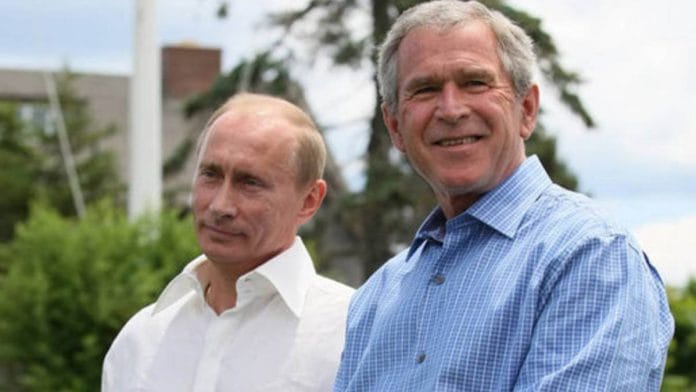



New Delhi: Former US President George W. Bush and Russian President Vladimir V. Putin shared a warm camaraderie in the early years of their relationship, with the American leader once quipping that the Russian leader is one who he’d like in the ‘foxhole’ with him.
The warm ties are tangible in the transcripts of conversation between the two between 2001 and 2008. The conversations were recently released by the National Security Archive at the George Washington University, which has a record of interaction between the two—from the inane to the serious, like expanding the agenda for cooperation between the US and Russia.
The agenda which began with anti-missile treaty negotiations expanded to include their cooperation in curbing Iran’s nuclear ambitions, North Korea’s nuclear programme, dealing with the Taliban and Osama bin Laden as well as the enlargement of the North Atlantic Treaty Organisation.
This is how Bush opened his first meeting with Putin at the Brdo castle in Slovenia in 2001: “I won’t say so publicly, but this is the most important meeting of the trip. Everybody is watching. The Europeans with whom I met told me that respect was important. I read your book. I know you keep a cross.”
Putin went on to describe the “miracle” cross that was a gift from his mother and which had survived a fire, setting the stage for a warm relationship between the two leaders. Putin had come to power as Acting President of Russia at the end of 1999, before winning the elections in 2000. Bush had come to power in January 2001, setting the stage for the two potentially rewriting US-Russia ties in the aftermath of the Cold War.
“You’re the type of guy I like to have in the foxhole with me,” Bush quipped to Putin in their first meeting in 2001. Russia had emerged as one of the strongest backers of the US war on terror that began in the aftermath of September 2001 terrorist attacks. However, by 2007, Putin had pivoted to criticising the US and its allies in NATO for their eastern enlargement.
The three transcripts released by the National Security Archive cover three meetings between the two–2001, 2005 and their last meeting in 2008. Months after the 2008 summit, Russia waged war with Georgia, backing the separatists in Abkhazia and South Ossetia, which eventually culminated with the current impasse between Washington and Moscow on the ongoing war in Ukraine.
On NATO and Ukraine
In their first meeting with one another, Putin had raised the potential membership of Russia in NATO or at least as a bilateral ally with the US, indicating that it was in their interest to prevent a clash between the nuclear armed powers.
“Russia is European and multiethnic, like the United States. I can imagine us becoming allies. Only dire needs could make us allied with others. But we feel left out of NATO. If Russia is not part of this, of course it feels left out. Why is NATO enlargement needed?” Putin told Bush in 2001.
He added: “In 1954, the Soviet Union applied to join NATO. I have the document… NATO gave a negative answer with four specific reasons: The lack of an Austrian settlement, the lack of a German settlement, the totalitarian grip on Eastern Europe, and the need for Russia to cooperate with the UN Disarmament process. Now all these conditions have been met. Perhaps Russia could be an ally.”
There was no response from Bush regarding Putin’s comments. However, in their last meeting together in Sochi, Russia, in April 2008, the Russian President had starkly changed his views on NATO enlargement.
Putin warned of a “long-term field of conflict” between the US and Russia due to the potential accession of Ukraine to the Western-led military alliance, pointing out that Kyiv’s history is “complex.”
The conversation highlights Putin’s views on Ukraine that have since become a part of Russia’s casus belli for ongoing full-scale war launched by Moscow against Kyiv in February 2022. In 2008, Putin described Ukraine as an “artificial” country built by the Soviet Union.
“Following World War II Ukraine obtained territory from Poland, Romania and Hungary, that’s pretty much all of western Ukraine. In the 1920s and 1930s, Ukraine obtained territory from Russia, that’s the eastern part of the country. In 1956, the Crimean peninsula was transferred to Ukraine. It’s a rather large European country built with a population of 45 million. It’s populated by people with very different mindsets,” Putin told Bush in 2008.
Warning against the accession of Ukraine to NATO, Putin pointed out that such a move would bring the threat of “new military bases and new military systems” deployed in the “proximity” of Russia. Questioning the need for Ukrainian accession, the Russian President attempted to highlight that such a move would split the Eastern European country due to the internal divergent views.
“Seventy percent of the population is against NATO. Condi [Condolezza Rice] told me in Slovakia and Croatia the population was opposed at first and they’re now in favour. What we are against is Ukraine’s accession to NATO, but in any case we should wait until a majority of the population is in favor, then let them accede, not vice versa,” Putin said.
(Edited by Viny Mishra)
Also read: ‘Pakistan a junta with nuclear weapons,’ a wary Putin told Bush in 2001, wanting West to do more