





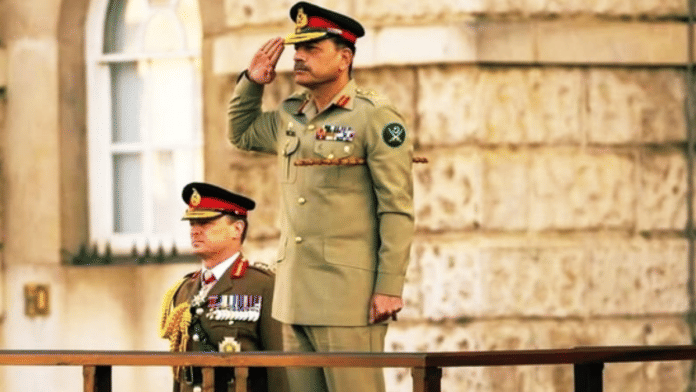



New Delhi: Field Marshal Asim Munir has officially taken over as Pakistan’s first Chief of Defence Forces (CDF), marking Pakistan’s biggest military overhaul since the 1970s with him firmly entrenched as its supreme head.
Munir’s tenure is now extended up to at least 2035.
On Thursday, President Asif Ali Zardari approved Munir’s appointment as both CDF and Chief of the Army Staff (COAS) for a five-year term, ending days of speculation over the delay in issuing the notification. Earlier, Prime Minister Shehbaz Sharif had forwarded a summary recommending the role for Munir to the Presidency.
The failure to issue the notification immediately, particularly after the abolition of the chairman joint chiefs of staff committee (CJCSC) post 27 November, coinciding with Gen Sahir Shamshad Mirza’s retirement—triggered widespread speculation.
The absence of confirmation on 29 November, the date Munir’s earlier three-year term would have ended, intensified rumours of behind-the-scenes negotiations over upcoming four-star appointments, including the Commander National Strategic Command (CNSC) and a possible vice-chief of the army staff.
While the army clarified that no Vice-COAS position was being created, the amended law ties both CNSC and any VCOAS appointments to recommendations from the CDF.
Meanwhile, the new position consolidates operational, administrative and strategic authority under a single office created through the 27th Constitutional Amendment, which revised Article 243 of the Pakistan Constitution. Under the amendment, the President—acting on the Prime Minister’s advice—must appoint an army chief who will simultaneously serve as CDF.
Alongside Munir’s appointment, President Zardari also approved a two-year extension for Air Chief Marshal Zaheer Ahmad Babar Sidhu. The extension will take effect after the completion of Sidhu’s current five-year term next March, allowing him to serve until March 2028.
The changes also abolished the post of chairman joint chiefs of staff committee (CJCSC), effectively dismantling the tri-service coordination system in place since 1976 and transferring joint command responsibilities to the CDF. General Shamshad Mirza, the CJCSC, had retired 29 November.
A tenure reset & supreme powers
Government officials dismissed reports of tensions, attributing the delay to procedural requirements and the prime minister’s travel schedule. Shehbaz Sharif had travelled to London for personal health reasons and returned Monday.
The delay in notification was attributed to the clearance of ‘finer details’.
To reflect the constitutional reorganisation, the government amended the Pakistan Army Act of 1952. A new provision in Article 8A states that for the first appointment to the combined COAS–CDF role, the tenure begins from the date of notification, effectively restarting Munir’s term. His initial appointment as COAS took place 29 November 2022.
Changes introduced in 2024 had extended the tenure of all service chiefs from three to five years and allowed reappointments or extensions of up to five years. Under the updated framework, the COAS-plus-CDF could potentially remain in office until December 2035.
According to local reports, Law Minister Azam Nazeer Tarar confirmed that the defence ministry is preparing a new organogram, or an organisational breakdown structure outlining command channels between the CDF, service chiefs and the newly established strategic command. A draft has already been shared with the Prime Minister’s Office.
(Edited by Tony Rai)
Also Read: Asim Munir’s power is undisputed in Pakistan. Social media stories are just gossip