





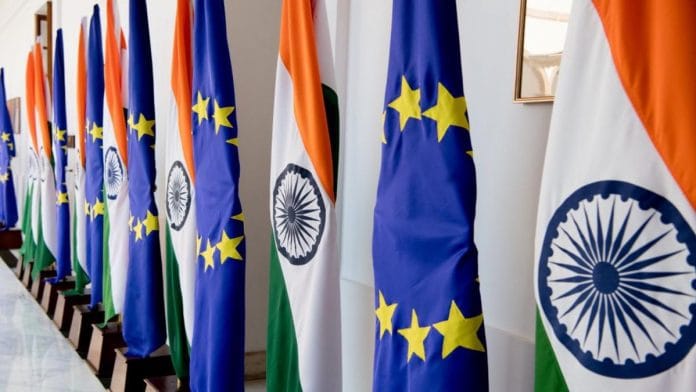



New Delhi: The long-negotiated India-European Union (EU) free trade agreement (FTA) is set to be inked on 27 January during the 16th summit between the two partners in the national capital. Leaders of the EU—European Commission President Ursula von der Leyen and Council President Antonia Costa—will travel to India between 25 and 27 January.
Cyprus, which currently holds the rotating presidency of the Council of the EU, may also be part of the delegation to witness the signing of the FTA.
Costa and von der Leyen will be the chief guests for India’s Republic Day celebrations.
For India, the FTA will give it better access to an EUR 18 trillion market with over 400 million people. For the 27 member states of the EU, a trade agreement with India would see reduced tariffs and greater access to the world’s largest market—1.4 billion people with one of the fastest growing large economies.
The two sides may have another round of negotiations ahead of the EU leaders’ visit, Commerce Secretary Rajesh Agarwal said Thursday, as negotiators rush to close the remaining chapters of the agreement before 27 January. Commerce and Industry Minister Piyush Goyal travelled to Brussels on 8 and 9 January for the 15th round of talks.
Agarwal further said Thursday that 20 of 24 chapters have been closed. Trade in goods, specifically agriculture and other issues surrounding sustainable practices such as the Carbon Border Adjustment Mechanism (CBAM) remain.
“We were already in the last and most arduous leg of negotiations with the EU in the last three months. We have closed 20 out 24 chapters. Few issues remain and negotiations are ongoing virtually. We are planning to meet as well,” Agarwal said Thursday while briefing the media on India’s trade data.
Government sources have confirmed that “sensitive agricultural issues on both sides are off the table” while New Delhi continues to seek carve outs on contentious issues such as CBAM. The CBAM kicked into effect on 1 January and will cover sectors such as steel, cement, aluminium, fertilisers, electricity and hydrogen, with further sectors expected to be added in at a later date.
“CBAM will remain a top challenge. This agreement covers non-core trade areas like environment, sustainability and labour issues. They want India to make specific commitments in these areas. India is not ready for that and wishes to limit chapters to the best endeavor clauses,” Ajay Srivastava, founder of the Global Trade Research Institute (GTRI), explained to ThePrint.
He added: “CBAM is a tariff barrier. Post FTA and without resolving the CBAM issue, European goods will enter India at zero tariffs, while our goods will face barriers due to CBAM. We should remember, today, the EU CBAM covers six product sectors but in the next few years, the EU will include all industrial products under the mechanism. For this reason, if we do a FTA without resolving the CBAM issue, the FTA will be imbalanced.”
However, there is political will on both sides to have the agreement pushed through. As one European diplomat described the situation—trade agreements are the EU’s “love language”. For an organisation founded in the aftermath of World War II to ease trade issues amongst the six original member-states—France, West Germany, Italy, Luxembourg, Belgium and the Netherlands—the trading group has expanded.
Today the EU is a single-market that allows for the free movement of goods, capital and labour within the borders of the member-states. However, the EU, with trade at its core, does not allow for member-states to strike bilateral trade agreements with third countries, thus requiring New Delhi and Brussels to negotiate the deal.
The EU is India’s single-largest trading partner when exports and imports with all 27 member-states are calculated. For the two sides, the deal has been almost two decades in the making, with the first round of negotiations for a trade agreement opened in 2007. However, they were suspended before restarting negotiations in 2022.
“India’s merchandise exports to the EU stands at around $76 billion (in FY2025), and we export more than we import ($60.7 billion) from them. There is an import duty pattern followed by most developed countries. They keep overall tariff low but keep tariffs on labour intensive goods, the main products of developing countries at higher levels,” Srivastava explained.
He added: “A developing country doing an FTA with the EU will see tariff reductions also in labour intensive goods and therefore gain a competitive advantage. For example, the EU has average tariffs ranging from 6 to 20 per cent on textiles, garments and leather products. Vietnam that has an FTA with the EU has hence access to the EU market at zero tariffs on textiles. Similarly Bangladesh gets zero tariff access to the EU market through the Generalised System of Preferences (GSP) scheme as it is a Least Developed Country. The FTA through zero tariff access to Indian textile, and garment exporters, will allow them to compete with these countries.”
Also Read: Thank you Donald Trump, again. India now has reason to shed fear of trade deals and risky reform
The year that led to this point
In the last year alone, there have been five rounds of negotiations, while expert groups have been in touch through virtual modes. In the last round held in October, the two sides mostly agreed to the investment portions of the trade deal, concluding the chapter on sanitary and phytosanitary standards (SPS), while identifying compromise packages on issues such as automobiles and pharmaceuticals.
Substantial divergences were noted in the chapter on investment, no agreement or compromises on exceptions to the trade deal, while India has spent the last three months deliberating on the EU’s compromise package on the movement of capital.
However, challenges regarding the tariff reductions on trade in goods and differences in the rules of origin remained, which have been under active discussions intersessionally. Notably, India has been able to conclude negotiations with other developed countries like the UK and New Zealand in 2025, which indicates there exists a number of compromises on the table to see this through.
The dairy sector is likely to have been excluded from the deal, which is a part of India’s red-lines, along with negotiations over agriculture products. The exceptions for dairy for example have raised issues internally within the EU.
The necessity of a deal
Nevertheless, for both India and the EU, the deal is considered necessary. For the EU, a deal with India would allow it to remain one of the architects of the modern trading regime that has come under severe strain following efforts by the US led by President Donald Trump to reorder the flow of trade. Furthermore, China’s increasing economic power has allowed it to reshape the trading regime in its own favour, leaving the EU adrift.
China’s trade surplus hit a record $1.19 trillion in 2025, with its exports to the EU growing by 8.4 per cent. For the EU, caught between two competing global economies, better access to Indian markets would offer its firms a competitive advantage. The EU’s share in global manufacturing has been on a consistent decline since the start of this century.
A policy brief released by the European Commission almost a decade ago – 2018 – indicated that its total global share in manufacturing fell from 27 per cent in 2000 to roughly 16 per cent in 2014 and the negative trend is more pronounced for high-technology value chains. The EU’s competitiveness has been widely criticised.
The Mario Draghi Report on EU’s competitiveness identified areas where the EU had to focus on evolving its industrial competitiveness to remain a major player in global economic growth. From reducing the innovation gap to linking decarbonisation with one of competitiveness and reducing dependence on other countries for European security are some of the key points of the Draghi report.
All of this brings the deal to the finishing line, with an expectation of negotiations continuing on key differences even after the main discussions are concluded.
(Edited by Gitanjali Das)
Also Read: India-EU agenda can fundamentally alter global geopolitics—if Europe stands up to Trump