





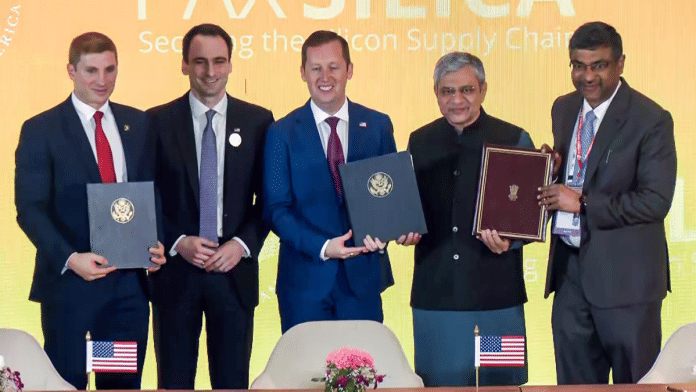



New Delhi: Underlining that the US does not want anyone to be buying Russian oil, American envoy here Sergio Gor Friday said India has made a “commitment on Russian oil”.
His comments came at the signing ceremony of the US-led Pax Silica, described by Gor as “strategic” with New Delhi’s entry “essential”. India has now become a member of the US-led initiative.
Speaking to the media, Gor said, “On the [Russian] oil there is an agreement…We have seen India diversify on their oil. There is a commitment. This is not about India. The United States does not want anyone buying Russian oil.”
“We have a great relationship. I think it comes down to multiple things. The first thing is the great friendship between our President and your Prime Minister. The signing [of the trade deal] will happen very soon. In fact, even this week, we have both teams talking to each other and actively getting to a place where both will be able to sign,” said Gor at the press briefing after India’s formal entry to Pax Silica.
Earlier this month, the two countries issued a joint statement on the broad contours of an interim trade deal, which sees India’s overall export tariff rate to the US cut to 18 per cent from 50 per cent, while New Delhi has promised to reduce a number of tariffs on American goods.
“We overcame friction points that had held us back for far too long. That agreement wasn’t just about trade flows or tariff schedules. It was about two great democracies saying we will build together, not just buy from one another, and now today, we take the next step,” said Gor, while speaking at the Pax Silica signing ceremony.
India was invited to join Pax Silica – the US-led AI and critical minerals initiative – on 12 January, a couple of days before Gor presented his credentials to President Droupadi Murmu.
Interestingly, India was earlier left out. The non-binding declaration has been signed by a number of countries including Australia, Greece, Israel, Japan, Qatar, South Korea, Singapore, the United Arab Emirates and the United Kingdom.
“What struck me most wasn’t just India’s scale, although that is breathtaking, but India’s resolve, the determination to chart your own course. I keep talking about the limitless potential between our two nations, and I truly mean it, from the trade deal to Pax Silica to defence cooperation, the potential for our two nations to work together is truly limitless, and I aim to fulfill that over the next three years that I’m here,” said Gor at the signing ceremony on the margins of the AI Impact summit in the national capital.
“Leads in a strategic coalition which is designed to secure an entire silicon stack from the mines where we extract critical minerals, to the fabs where we manufacture chips, to the data centers where we deploy frontier AI,” said Gor.
India joins Pax Silica 🇮🇳🤝🇺🇸
Securing silicon supply chain, advancing semiconductor manufacturing. pic.twitter.com/5I117ZPfHs
— Ashwini Vaishnaw (@AshwiniVaishnaw) February 20, 2026
The invitation to Pax Silica was one of the first initiatives announced by Gor, as India and the US worked on mending the differences that existed on trade.
Gor added, “It’s a coalition of capabilities that replaces coercive dependencies with a positive sum alliance of trusted industrial bases. Pax Silica will be a group of nations that believe technology should empower free people and free markets…India’s entry into Pax Silica isn’t just symbolic, it’s strategic. It’s essential.”
Also Read: Pax Silica: Multi-nation semiconductor & AI supply chain ecosystem is born, but India is kept out
The Russian oil question
The US has maintained that India has committed to stop additional purchases of Russian oil as a part of the deal struck between the two countries on trade.
India, however, has maintained that any purchases of Russian oil is a business decision for its firms, without clarifying if any political commitment was made to Washington.
With effect from 7 February, the US removed the 25 per cent punitive tariffs imposed on India for the purchase of Russian oil, while the remaining 25 per cent reciprocal tariff is set to be cut to 18 per cent in the coming few days.
“Look, the reality is there’s tens of thousands of points. We’re not dealing with a small country. This is one of the biggest economies. So we’re thrilled that the interim deal is done. You have a few tweaking points that are left to do but it’s done. So the signing will happen sooner than later,” said Gor on when the agreement will be signed.
Ties cratered between New Delhi and Washington last year following repeated claims by US President Donald Trump that he mediated an end to the 87-hour India-Pakistan conflict in May 2025. India has rejected the US’ description, asserting that the cessation of hostilities was arrived at bilaterally with Pakistan at the appropriate level.
The US has pushed India to purchase Venezuelan oil instead of the ongoing deals with Russia. In January, the US captured Venezuelan President Nicolas Maduro in a late-night raid on Caracas and the current regime has been perceived as more willing to push closer ties with Washington to ensure the flow of its oil globally.
“I don’t want to get into that, some of that aspect has not been announced yet, but there are active negotiations, the Department of Energy is speaking to the Ministry of Energy here and so we’re hoping to have some news on that very soon. You’re ahead of the curve,” said Gor at the press briefing.
Gor described the growing partnership with India as one of a trusted partner, promising to share AI technology with New Delhi, as one of the major sectors of cooperation going forward.
To a question after the Pax Silica declaration ceremony, he said India is “ahead of the curve” on purchasing Venezuelan oil.
“We can share trusted AI technology with the world, and especially with partners like India. And critically, India brings strength. Peace doesn’t come from hoping adversaries will play fair. We all know they won’t. Peace comes through strength. India understands this. India understands strong borders. India understands this part of the world, that strength, that sovereignty, is exactly what Pax Silica,” said Gor.
(Edited by Ajeet Tiwari)
Also Read: India-US cooperation on critical-mineral recycling can reduce dependence on China