





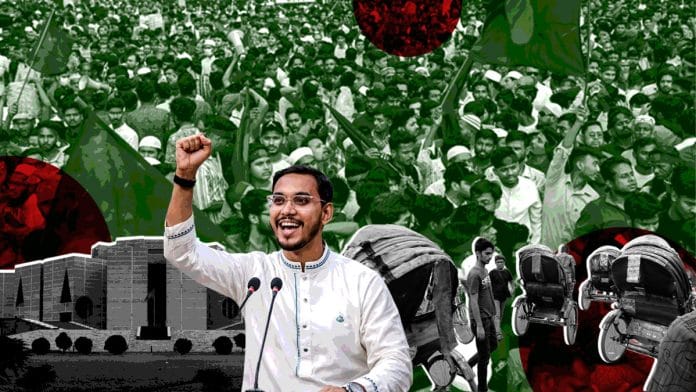



Dhaka: In a modest house in Dhaka, seated on the floor, Abdul Hannan Masud rejects the word that many use for the movement that reshaped his country. “This was not a peaceful movement, it was a revolution,” he says quietly. “Guns were blazing, but we stood undeterred, people gave their lives—that is a people’s revolution.”
At 26, elected from Noakhali-6 as a candidate of the newly-formed National Citizen Party (NCP), Masud has become Bangladesh’s youngest Member of Parliament. It is history of a kind he once dreamed of as a child growing up in Hathia, a remote island upazila nearly 420 kilometres from the capital—where poverty, land erosion, climate vulnerabilities and a literacy rate hovering around 34 per cent shape daily life.
But for Masud, the milestone is less about age and more about translating what he calls a “people’s revolution” into structural change. He speaks of a politics that had gone into “ICU,” then “coma,” before people “woke up” in 2024. He speaks of campuses hollowed out, of student wings turned caricatures, of a generation that believed “politics as a notion was over”.
And yet, from that disillusionment emerged Chhatra Shakti, then a new party, and then an election in which rickshaw pullers and CNG drivers slipped money into his pocket because he did not have the finances to fund a campaign. “You have to win, we will give our lives, but you have to win,” some told him, he says.
Out of thirty candidates, six won. Masud was one of them, securing 91,899 votes and defeating his nearest rival BNP’s Mohammad Mahbuber Rahman.
For a young man who grew up as the seventh of eight brothers in a strict schoolteacher’s household—“the most unliked son” he says, half-smiling—the oath-taking ceremony felt “surreal”.
Now, he insists, the task is consolidation and mobilisation—ward level, district level, youth by youth. “People placed their faith in us,” he says. Not in dynasties, not in the old establishments, but in a promise of “daye o dorod er rajneeti”—a politics of responsibility and empathy.
History, the 26-year-old believes, is only the beginning.
In 2006, Masud saw riots following the end of BNP’s term in office, with violence on the streets sparked by disputes between the Bangladesh Nationalist Party and the Awami League over the appointment of a chief adviser. “The visuals still are in my mind,” he recalls. “It had an impact on me.”
Student politics in Bangladesh
For Masud, politics in Bangladesh effectively ended in 2018. “Politics as a notion was over,” he says. “The elections that took place were used by all political parties—Awami League, BNP, Jamaat too. They were in ICU, went in coma and would sometimes show some movement to put hope in people that there might be some sort of a change. This is the coma these people woke up from in 2024.”
On 5 October 2023, Masud and around 30 others formed the Chhatra Shakti. Their stated aim was audacious: To engineer “a people’s revolution” within 15 years that would unseat the government and restore democracy.
Events would outpace their timeline. Masud took an active part in the quota reform protests that shook the country and led to the fall of the Sheikh Hasina-led government. Then the work began. The students formed a new party.
Their manifesto spoke of building a bridge between student activism and national leadership. “The student group manifesto was akin to a national party,” he says. “We always wanted to do it.”
“Our party was formed after seeing how people accepted us and to work for them,” Masud says of the NCP. “We are no longer just student leaders, we are the leaders of the people and that is how they see us.”
Out of 30 candidates, 24 lost. Six won. The prominent faces are Nahid Islam, Abdullah Hasnat and Masud, himself.
For someone who won even without big money, this was huge. “I did not even have money to finance my campaign,” he says. “The rickshaw wala, the CNG wala would put money in my pocket.”
On India, his tone is careful. “We were never against Indians,” he says. “A lot of students (in India) supported us during the movement.” But he insists on sovereignty.
“Not just India—we will oppose any hegemonic state—Pakistan, US, India, China. Always against it.”
What we want now is Bangladesh-led policies and governance, he says. When asked why he feels this was not the case earlier, he says: “Hasina led an India-first agenda mostly, and look how she fled there at the first chance.”
Hasina’s extradition, he says, will be an NCP agenda item in the Parliament but there is a long way to go.
(Edited by Viny Mishra)