





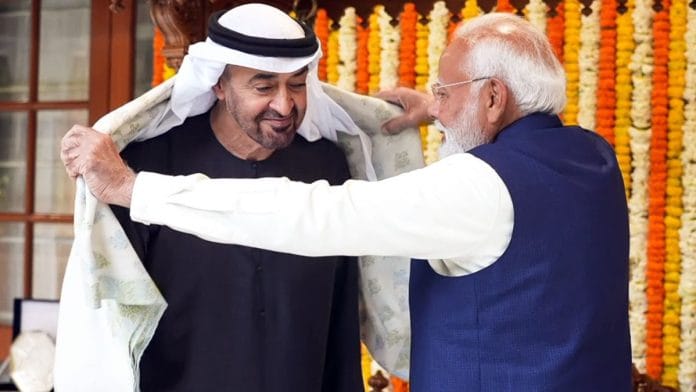



New Delhi: Amidst the churn in West Asia because of the geopolitical rivalry between Saudi Arabia and the United Arab Emirates, Emirati President Mohamed bin Zayed Al Nahyan made a last-minute, two-hour whirlwind visit to the national capital Monday. The two countries also announced their intention to conclude a “framework agreement” for a strategic defence partnership.
The visit also comes as US President Donald Trump seeks to establish his Board of Peace in Gaza, which has a member of the Emirati government in the executive board, with India invited to be a part of the potential international organisation. Prime Minister Narendra Modi welcomed the Emirati President at the airport, with discussions being held in the car ride together to 7, Lok Kalyan Marg (the Prime Minister’s residence).
India and the UAE announced a raft of agreements in strategic sectors such as civil nuclear cooperation, advanced manufacturing and long-term energy contracts. Tensions between Abu Dhabi and Riyadh have increased in the last month, with the coalition in Yemen fracturing over both countries backing different organisations in the war-torn West Asian nation.
Foreign Secretary Vikram Misri announced that a “letter of intent” had been signed by the India and UAE to conclude negotiations for the framework of a strategic defence partnership. The agreement could include co-manufacturing along with the research and development of defence platforms.
The strategic defence partnership comes months after Saudi Arabia signed a strategic mutual defence agreement with Pakistan—a move that India had said at the time it was “aware of”.
“Our involvement in the defence and security front with a country from the region does not then necessarily lead to the conclusion that we will get involved in particular ways in the conflicts of the region. There is already a great deal of content in defence cooperation and engagement in the defence front between India and the UAE,” said Misri at a special briefing on the visit, highlighting that the framework does not indicate New Delhi’s change in posture in West Asia.
Misri added: “In last April, starting almost a year ago, the UAE Defence Minister and the Crown Prince of Dubai visited India… We then elevated the institutional framework of defence dialogue between the two countries to the level of secretaries, vice ministers of two countries, our air assets have been regularly participating in the Dubai air show… It’s really building on this very broad basis and considerable experience in the defence and security cooperation field that the letter of intent was signed today.”
India’s Foreign Secretary confirmed that the regional situation in West Asia was discussed by Prime Minister Narendra Modi and President Mohamed bin Zayed Al Nahyan. The discussions which were meant to be about an hour long, went beyond the scheduled time limit.
Energy, infrastructure & advanced manufacturing
Misri announced that a long-term agreement for the supply of 0.5 million metric tonnes of LNG (liquified natural gas) per annum was also concluded during the visit. Abu Dhabi is the second largest source of LNG for India.
“On LNG, this is a sale and purchase agreement between Hindustan Petroleum Corporation Limited and the Abu Dhabi National Oil Company Gas (ADNOC Gas) and it is a long term agreement providing for the purchase of 0.5 million metric tonnes of LNG by HPCL from ADNOC Gas over a period of 10 years, starting from 2028,” explained Misri.
This builds on the already existing agreement between ADNOC Gas and GAIL India announced in 2024 for similar amounts of LNG procurement per annum. The energy sourcing agreement comes at a time when India has been curtailing its purchase of Russian crude and gas following pressure from the US. US President Donald Trump sanctioned Rosneft and Lukoil—two of Moscow’s largest energy companies last year.
Abu Dhabi also signed a letter of intent to participate in the development of Dholera—the special investment region in Gujarat, that would authorise Emirati businesses to eventually bid for and construct infrastructure in the region including energy, airport, pilot training facilities, railway connectivity and ports.
The idea is to eventually establish Dholera as a node part of the India-Middle East-Europe Economic Corridor (IMEC), which envisions the linking of India’s West Coast to Europe, via the West Asian region, a person familiar with the matter explained to ThePrint.
The two countries also announced their intention to collaborate in advanced manufacturing sectors such as super computing and data centres, while also agreeing to explore a future partnership in civil nuclear cooperation.
“The leaders also welcomed the enactment of the Sustainable Harnessing and Advancement of Nuclear Energy for Transforming India (SHANTI) law, noting that it creates new opportunities for enhanced civil nuclear cooperation. The two sides agreed to explore partnership in advanced nuclear technologies, including development and deployment of large nuclear reactors and Small Modular Reactors (SMRs), as well as cooperation in advanced reactor systems, nuclear power plant operations and maintenance and nuclear safety,” the joint statement issued Monday said.
In space, the two sides agreed to explore opportunities to build launch complexes and cooperate in areas such as fabrication of satellites, which is important signalling for the future terms of the strategic partnership between India and the UAE.
“The two leaders agreed to deepen cooperation in space sector. In this context, they welcomed the understanding reached to collaborate on a joint initiative aimed at driving commercialisation of the sector through the advancement of space sciences and technologies. This initiative aims to produce an integrated space ecosystem with end-to-end infrastructure and a strong industrial base. It aims to enable India–UAE joint missions, expand global commercial services, create high-skilled employment and start-ups and strengthen bilateral investment through sustainable business models,” said the joint statement.
(Edited by Viny Mishra)
3 hour trip – just for this? I am sure something more is cooking. Perhaps Swasti Rao can explain?