





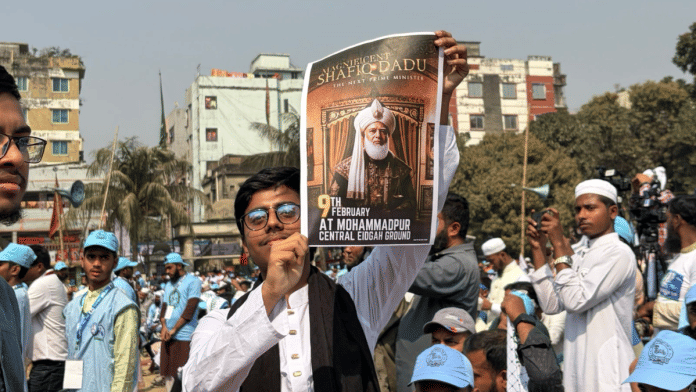



Dhaka: As Tarique Rahman made his stump speech in Kola Bagan, his words echoed through the lanes of Dhanmondi, where voters gathered not just to listen but weigh this moment against years of political upheaval.
Tarique’s message reverberated near Dhanmondi 32, once the residence of Bangladesh’s founder Sheikh Mujibur Rahman. Before August 2024, barricades restricted movement here. It is now open to all.
Food stalls have come up, and the area around Dhanmondi lake is buzzing with activity. “We want Tarique bhai. The way he saved the country, the way he speaks, no one does that,” says 23-year-old Moni. The Bangladesh Nationalist Party (BNP) chairman cannot be blamed for not being in the country for 17 years, she adds. “How could he? These people would not let him.”
On his part, Tarique in a televised address to the people later in the day said Bangladesh is at a “historic turning point in its democratic transition”.
“…the fallen, defeated, and expelled fascist clique had snatched away the ownership of the state from the people. They had seized all democratic political rights of the people. Finally, through a long struggle and movement, at the cost of thousands of lives, the moment has arrived to return the ownership of the state to the people,” said the 60-year-old son of former prime minister Khaleda Zia, who died in December last year.
Aliya Khatoon agrees with Tarique. She wants the Bangladesh of Khaleda Zia back. “The country she died for is the one we want back. She suffered so much but did not leave the country.” A resident of Khulna, Aliya made the four-hour journey to Dhaka to see the charred remains of Dhanmondi 32.
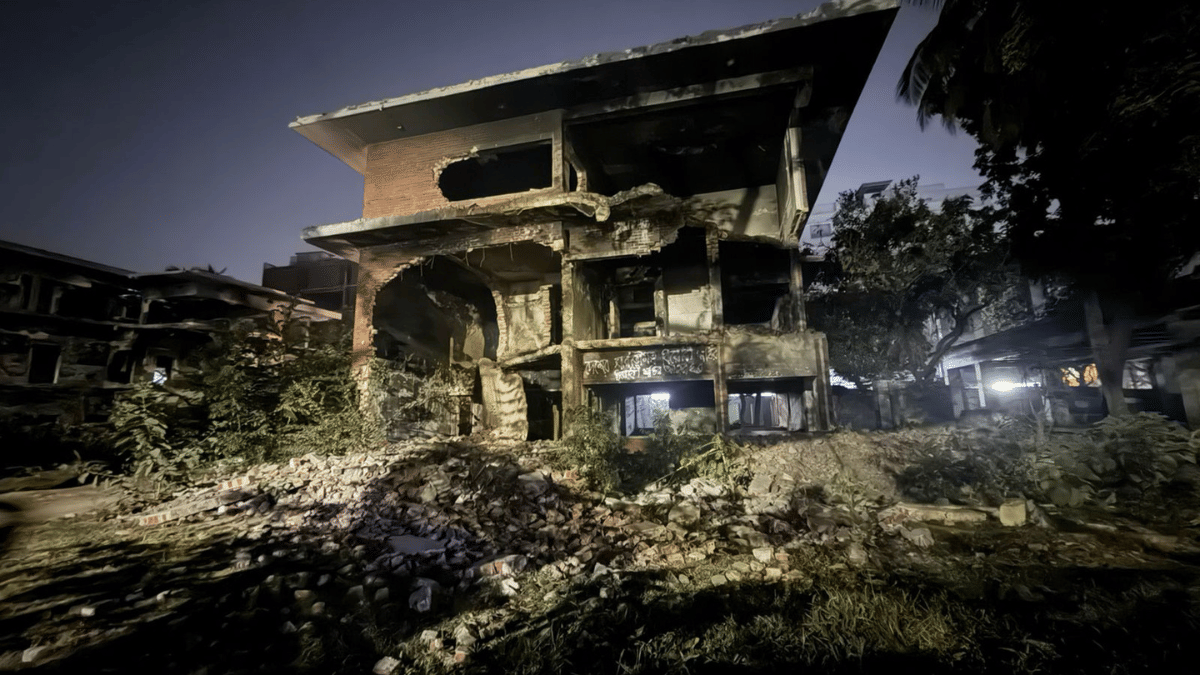
“I have come to see the pichash’s [demon’s] house who when in power gave us sleepless nights,” she says, pointing to the house which was turned into a museum by Mujib’s daughter and former prime minister Sheikh Hasina.
Hasina’s Awami League has been barred from contesting the general election scheduled for 12 February.
Hasan Ali, the 35-year-old who owns a tea stall opposite Dhanmondi 32, is in agreement with Aliya about which way the wind is blowing. “Tarique Zia is the answer because no one else can do the reforms. He is now a changed person and measures his words carefully,” he says.
Where Hasan and Aliya differ is their view of Sheikh Hasina. “She did great work but her attitude towards the students led to her downfall,” says Hasan, adding that there is not even a remote possibility that the Awami League would return to power in Bangladesh anytime in the next 10 years.
He is also critical of mobs attacking Dhanmondi 32 and setting the historic building ablaze. “The fire continued for days. Who gained from it?”
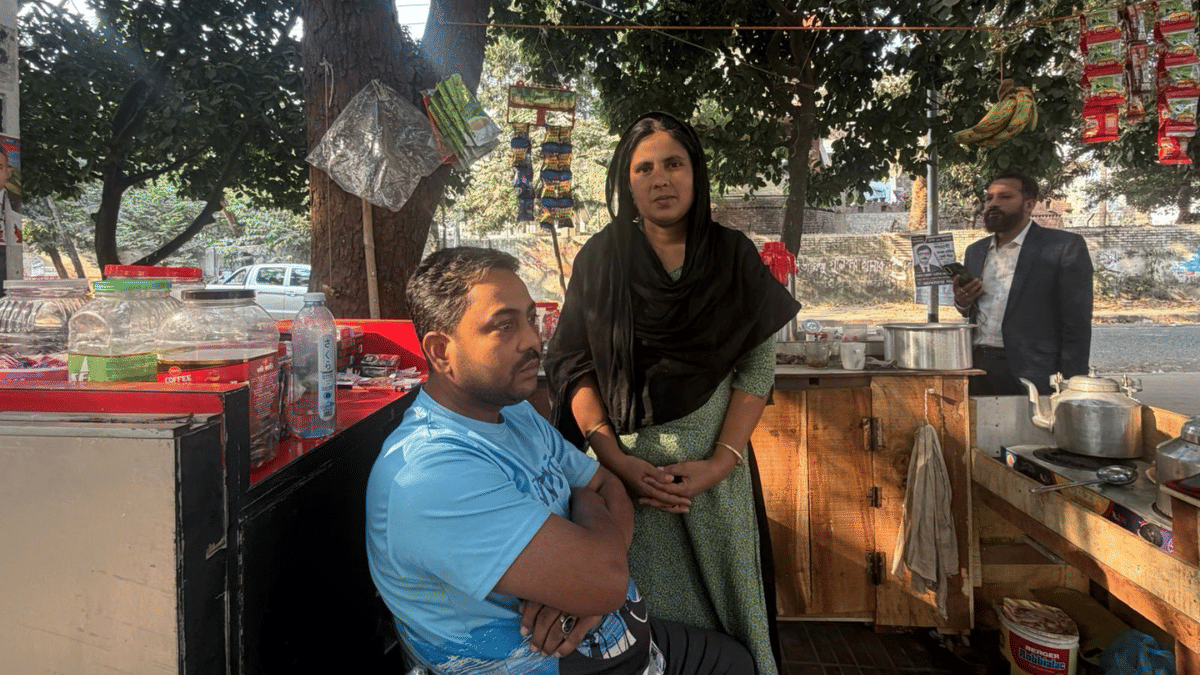
A card-holding BNP member, Hasan explains the dilemma many voters in Bangladesh will face come polling day. “Had Hasina not gone against the students, no one would have been able to unseat her for at least the next 100 years. She did help the country grow economically but what I have realised is, when it is your time to go, even Allah cannot help you.”
Also Read: A day in poll-bound Bangladesh: Mobile phone ban, then a U-turn & Jamaat’s ‘cockpit’ offer for Nahid
Word on the street
In the streets of Dhaka, BNP appears to have an edge. Tarique is the clear choice, Jamaat has a few takers, while National Citizen Party (NCP) has none. Floated by students who led the anti-Hasina stir, the NCP is in a pre-poll alliance with Jamaat. But that hasn’t lent either credibility.
“Jamaat does not act on what it says, the actions don’t meet the words,” says Hasan Ali. As for the NCP, its role in the anti-Hasina stir didn’t necessarily translate into a groundswell of support.
“It was not the party that led the July movement,” says 42-year-old Zamanuuddin. “It was the people of the country.”
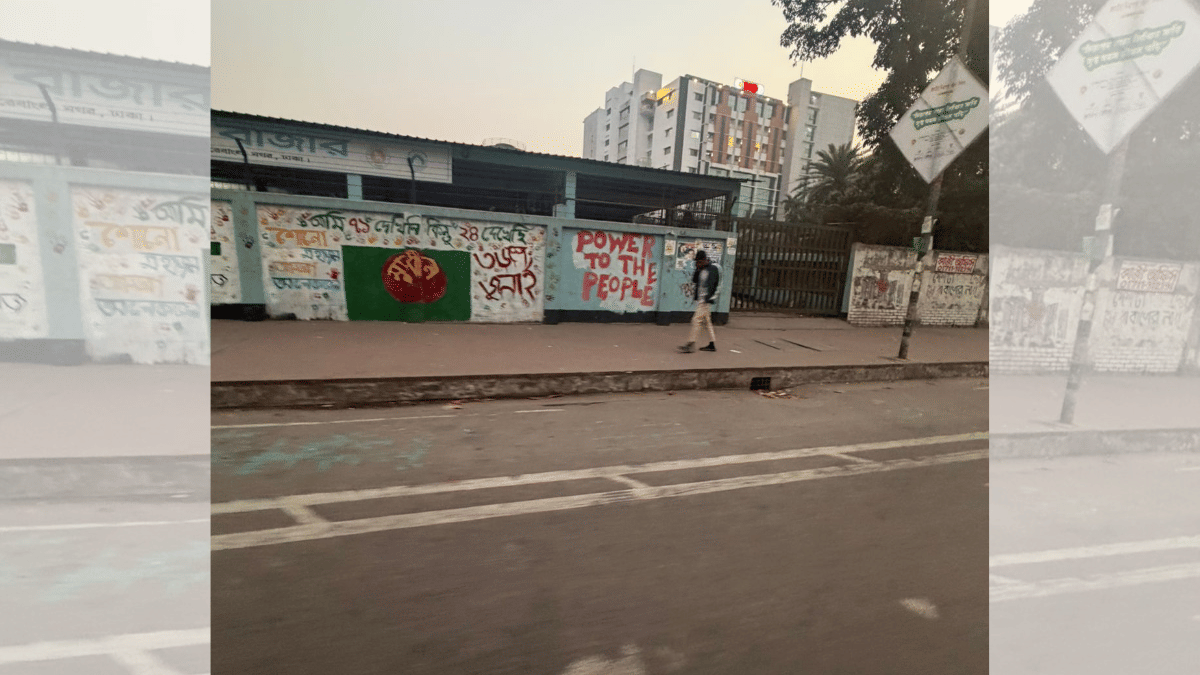
Pointing to the street around him, he adds, “The rickshaw pullers you see here were part of the movement. I am a labourer—I was part of it. If a party claims it did everything, how will it ever be accountable to the people?”
For him, all that matters is peace in the country. “It is like a game of football. One will win, one will lose but one party will go to the Parliament. Whichever party comes to power, let there be peace.”
Zamanuuddin does not blame Hasina. Speaking in Bangla, he says, “She did what was possible for her. Whoever comes next should govern well.”
On the streets of Dhaka, the conversation between BNP supporters and others largely revolves around Tarique’s poll promises.
He has promised to build a medical college in Nilphamari, says a BNP supporter. Nilphamari has had a medical college since 2019, the other replies. The BNP supporter doubles down. Tarique will commemorate the 2009 Pilkhana massacre as Shaheed Sena Diwas (day of martyred soldiers). But the Yunus-led interim government had already declared 25 February as the day to honour army officers massacred during the revolt. Tarique, the BNP supporter continues, has promised to build an export processing zone (EPZ) in Cumilla. The other side responds: Cumilla already has an EPZ which was set up in 2000 and employs nearly 50,000 people.
Dilawar, a Dhaka-based attorney who also runs a non-profit called Manusher Pashe foundation (people’s foundation), says voters seek peace and justice. Compared to the others, he is more skeptical about placing his trust in Tarique Rahman. Khalida Zia’s death gained him a lot of sympathy but now the BNP leader must put himself to the test, he adds.
“He [Tarique] had multiple cases against him,” Dilawar says. “Why would he want to come back? He was living a comfortable life in the UK. Now that Hasina is gone, of course he wants the position.”
Would he vote for Jamaat instead? “We have voted for two parties for so long. Why not a third this time?” He elaborates a metaphor: “If you already have a cup full of tea, would it be wise to put another cup on top of it?”
BNP, according to him, is the extra cup.
He is quick to add, “If they [Jamaat] come to power and do not perform, we’ll throw them out. The people of Bangladesh know how to do it. We can go hungry for days but we don’t let anyone toy with our dignity. We showed Pakistan earlier what we can do. Every party knows and remembers that.”
Dilawar does, however, disagree with Jamaat’s position on women’s rights. “They need to reform themselves,” he says. “But they are not bad.”
‘We don’t want rise of Jamaat’
Outside the National Parliament building, Noorzhat, a legal consultant with the Manobodhikar Shongskriti Foundation, says rights activists had formed a human chain to protest comments made by Jamaat’s chief who in a now-deleted social media post referred to working women as “prostitutes”.
The atmosphere in Bangladesh, she says, remains tense. “Violence against minorities has increased. There have been forced conversions. For minorities, it is a fearful environment—there is no denying that.”
At its core, she says, Bangladesh, is a secular country. “We don’t want the rise of Jamaat so that the essence of Bangladesh is maintained.”
She adds that women, too, felt vulnerable. “But, we are hopeful,” she says.
“Elections are a celebration in this country,” Noorzhat says. “For the last 16 years, we have not seen a proper and fair election. Whoever comes to power must govern well and remember that women and minorities are not just electoral tools—they are human beings with rights.”
Seventeen-year-old Abdullah Anjum, a student at New Model Degree School, says education reform is what matters most to him.
“I am tired of the country’s education system,” he says. “Whichever party comes to power should fix it.”
On references to Sheikh Mujibur Rahman being removed from textbooks during the tenure of the interim government led by Muhammad Yunus, he says, “It was too much anyway.”
“It’s good that we learn about the July revolution too. That will shape the nation and our consciousness going forward.” Abdullah says he did not have a favorite leader but hopes Tarique would “act as well as he speaks”.
Back in Dhanmondi, 14-year-old Mohammed Amin is selling water bottles to the thousands who come to see the charred remains of Hasina’s ancestral home. Amin says he and five other children went inside Dhanmondi 32 to collect scraps and valuables, or what was left of them, after the fire.
All they saw, according to Amin, were bodies of victims.
“I know everyone seems worried about which party will come to power; all I want is that no one be killed in a fire again,” he says. Not far from where Amin is selling water bottles for a living, a children’s park is packed with visitors. On the adjoining road, BNP workers are taking out a rally to a soundtrack not too unfamiliar to the Indian ear—Trinamool Congress’s ‘Khela Hobe’. The only difference: BNP has replaced Trinamool Congress in the lyrics.
(Edited by Amrtansh Arora)
Also Read: ‘Constructive’ ties with India, no mention of Pakistan—inside Bangladesh Jamaat’s poll manifesto