





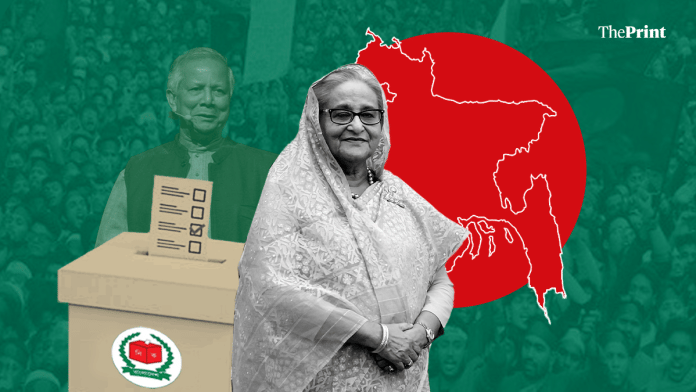



New Delhi: Sheikh Hasina, the former Prime Minister of Bangladesh, has hit out at the exclusion of the Awami League from the February 2026 polls, calling the move “authoritarianism dressed up as transition”.
Looking back at the 2024 student protests in an exclusive interview with ThePrint, Hasina commented that she “regrets” every life lost. With that said, she blamed Bangladesh Chief Adviser Muhammad Yunus for curtailing the judicial inquiry into the violence.
Starting as an anti-quota stir and escalating into protests against the Hasina government, the violence, according to the interim government, left roughly 1,400 people dead.
Hasina also slammed the Yunus administration for suspending the activities of her party. Awami League was in control from 2009 to 2024, with Hasina at its helm. Banning it, she said, “disenfranchises tens of millions of Bangladeshis who simply will not vote” in the coming elections.
Banning Awami League disenfranchises tens of millions of Bangladeshis who simply will not vote in the coming elections.
On Bangladesh going to polls on 12 February, she posited, “Elections held under such conditions cannot be considered free, fair or legitimate. Voters must be free to elect the party of their choosing and not be excluded from participating or coerced by door-to-door activists into voting for the BNP or Jamaat under threats of violence or destruction.”
“The interim government knows that if we were allowed to contest these elections, we would command overwhelming support. That is why we have been banned. Let us not forget that Yunus himself has never received a single vote from the people of Bangladesh, and yet he has rewritten our country’s legal framework to legitimise his unlawful actions.”
Yunus himself has never received a single vote from the Bangladeshi people and yet has re-written our country’s legal framework to legitimise his unlawful actions.
“You cannot ban the country’s oldest and most popular political party and then claim democratic legitimacy. That is not reform; it is authoritarianism dressed up as transition,” she added in a written interview.
You cannot ban the country’s oldest and most popular political party and then claim democratic legitimacy. That is authoritarianism dressed up as transition.
Muhammad Yunus has maintained that the Awami League is not banned but “suspended from political activities”. Hasina, however, countered, saying he had made “a distinction without meaning”. She emphasised that her party is “effectively banned” since it “can not campaign, organise or contest elections”.
Bangladesh now looks to grapple with a future without Hasina or the Awami League—the primary political force leading the struggle for Bangladesh’s liberation from Pakistan in 1971.
Amid the violence on 5 August 2024, Hasina—whose father Sheikh Mujibur Rahman has long been considered ‘Father of the Nation (Jatir Pita)’—fled Dhaka for Delhi. She has since been in India, a major flashpoint in India-Bangladesh ties now.
Since her ouster, the International Crimes Tribunal-Bangladesh (ICT-B) has sentenced Hasina to death for crimes against humanity. The tribunal has cited her government’s suppression of the student protests between June and August 2024 in its verdict.
A call for impartial inquiry
Reflecting on the 2024 violence, Hasina defended her government’s actions, asserting they were “guided by the instinct to protect” Bangladesh’s institutions and “prevent any loss of life”. However, the violence increased in the days leading up to 5 August, when Hasina eventually fled her prime ministerial residence, Ganabhaban, her 15 years in power coming to an ignoble end.
“We welcomed the legitimate protests led by the students and allowed them to proceed peacefully. We listened to their demands, and we addressed these, overturning the public sector job quotas that were the source of their frustration,” Hasina noted.
We welcomed the legitimate protests led by the students…what we could not have foreseen was the turning point when extremist elements hijacked the protests.
“What we could not have foreseen was the turning point when extremist elements hijacked the protests. This was no longer a spontaneous and peaceful student movement, but a violent mob organised and directed by Yunus that sought violence, attacked police stations and destroyed state infrastructure. Like any legitimate government, our actions were guided by the instinct to protect our country’s institutions and prevent any loss of life,” she added.
With the Yunus administration, Hasina’s “principal frustration” is that it dissolved the judicial inquiry she had set up to look into the deaths of protesters, almost immediately after he became chief adviser.
“My principal frustration is that Yunus dissolved that inquiry immediately upon taking power, no doubt because he knew that it would expose the meticulous plan he orchestrated. That decision alone raises serious questions as to the motivations behind the protests and his seizure of power, including the matter of foreign involvement. Those questions deserve impartial investigation,” she wrote to ThePrint.
Also Read: Brother of slain student activist Osman Hadi appointed second secretary at Bangladesh mission in UK
Law & order now
With respect to her country, Hasina called for a quick return to “constitutional governance”, with “free, fair elections held with the participation of all parties” to prevent any further deterioration in law and order.
“Law and order cannot be maintained through fear or selective enforcement,” she wrote.
The former leader’s comments come barely a month after the country witnessed two days of violence, following the death of Sharif Osman Hadi, a political aspirant shot by assailants in Dhaka.
Hadi’s death on 18 December led to mass protests across Bangladesh, eventually spiralling into violence. The violence included the burning down of the offices of Bangladesh’s well-known media outlets, Prothom Alo and The Daily Star.
“The violence we are witnessing is the direct result of an unelected administration that lacks any popular mandate and has allowed our politics to be usurped by extremist factions. Instead of delivering ‘reform’, the interim government has elevated radical groups to positions of power, established rule by mob justice, and suppressed legitimate political voices,” wrote Hasina.
Instead of delivering ‘reform’, the interim government has elevated radical groups to positions of power, established rule by mob justice, and suppressed legitimate political voices
“In Bangladesh today, there is no semblance of law and order. The Yunus government has routinely failed to act decisively against violence. Indeed, it has actively emboldened extremists who seek to spread their hardline ideology through daily acts of brutality, repressing any trace of pluralism in our society and dismissing any diversity of thought by labelling any dissenting voice as a political enemy,” she added.
The December violence witnessed the public lynching of a Hindu man, Dipu Chandra Das, in the city of Mymensingh, leading to protests in India.
New Delhi has been wary of seemingly growing violence against minorities in Bangladesh since Hasina’s ouster. India has repeatedly called on Dhaka to do more to ensure minorities’ safety and security.
Hindus make up around eight percent of the country’s population.
Yunus, around this matter, has repeatedly defended the interim government’s track record. He has said the violence is “not communal” but rather “political” or related to “criminal activities”.
He went a step further Monday, highlighting that out of the 645 incidents of violence against minorities in 2025, 71 had “communal elements” while the remaining were assessed to have been “non-communal”.
A perceived radicalisation
Regardless of the number of communal incidents—repeatedly highlighted by India in its statements through 2025—a broader perception has taken hold that Bangladesh has drifted away from the secular foundations enshrined in its 1971 Constitution.
“Bangladesh was founded on secularism, pluralism and democratic values. The rehabilitation of Jamaat-e-Islami and other extremist factions threatens the very fabric of our nation. When radical groups are allowed back into mainstream politics, they do not moderate the state. They seek to reshape it in their own image and remove any trace of pluralism,” wrote Hasina.
The Awami League leader highlighted “a deeply concerning trajectory” for Bangladesh, “one that risks fragmenting our society and isolating us from our international allies who will not sit by while minorities are persecuted and mob violence rules our country”.
“This is not a theoretical concern. It is already visible on our streets,” she added.
She further highlighted that with the rise of the Jamaat, there had been a “deliberate erosion of historical truth”—revisionism. The old house of Sheikh Mujibur Rahman in Dhanmondi 32 has been repeatedly vandalised and then demolished, as people have seemingly sought to rid themselves of the Awami League.
According to Hasina, “what we are seeing today is the deliberate erosion of historical truth. Extremist and revisionist forces have tried hard to dilute the reality of our hard-won independence from Pakistan in 1971, blurring the distinction between victim and aggressor. This truth may be inconvenient to the interim government, who wish to paint the Awami League as enemies of the state, but it is a truth nonetheless.”
She added: “A nation that forgets the price of its freedom becomes vulnerable to those who once denied it. Preserving the truth of our Liberation War is not about politics. It is about safeguarding our identity and sovereignty.”
The Jamaat has made a return in mainstream Bangladesh politics after Yunus removed the ban on their activities. Its student wing, Bangladesh Islami Chhatra Shibir, has emerged victorious in university polls on various campuses over the last few months.
February will be crucial in shaping what lies ahead.
(Edited by Madhurita Goswami)
Also Read: China’s Bangladesh envoy visits Teesta for technical assessment close to ‘Chicken’s Neck’