








New Delhi: At a time when Canadian Prime Minister Mark Carney is on an official visit to India, New Delhi Monday firmly rejected allegations of participation in transnational violent crimes. This came hours after Canadian media reports citing intelligence sources claimed that Indian diplomatic officials were linked to the June 2023 killing of Sikh separatist Hardeep Singh Nijjar.
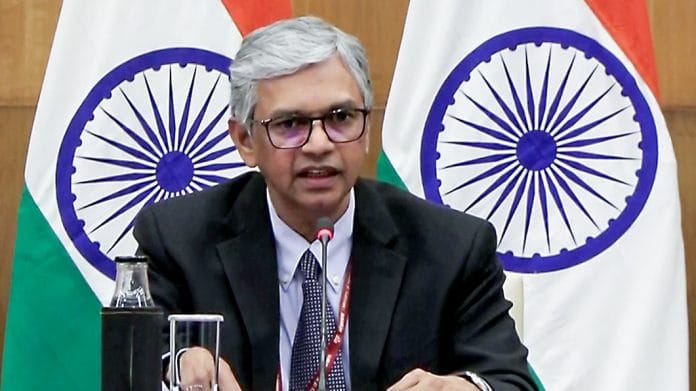
“India categorically rejects allegations of involvement in transnational violence or organised crime. These claims are baseless, politically motivated and unsupported by credible evidence despite repeated requests. India believes that concerns of this nature must be addressed through credible law enforcement and judicial processes. Not through public or politicised narratives,” P. Kumaran, Secretary (East) in the Ministry of External Affairs said at a special press briefing on Carney’s visit.
Canadian daily newspaper The Globe and Mail Monday reported that two Indian officials in its consulate in Vancouver were allegedly involved in gathering information that could have aided in the killing of Nijjar.
Nijjar, an Indian designated terrorist, was killed outside a gurdwara in Surrey, British Columbia in 2023.
Canadian authorities have arrested four Indian nationals who are currently awaiting trial as per their established legal procedures. Kumaran was clear that India is “committed” to aiding the judicial process.
Carney is on a four-day visit to India that began on 27 February in Mumbai. He met with Prime Minister Narendra Modi Monday in the national capital before departing for Australia.
Ties between India and Canada cratered in September 2023, following allegations made by then Canadian Prime Minister Justin Trudeau of links between Indian officials and the killing of Nijjar.
New Delhi called the allegations at the time “absurd and motivated.” Carney, a former central banker with the Bank of England and the Bank of Canada, assumed power last March and has since sought to recast ties with India.
Carney’s visit to India is the first bilateral visit by a Canadian PM in eight years. For Ottawa, India has become a key partner in its strategy to diversify its dependence on the American markets for its merchandise exports. India and Canada Monday announced the opening of negotiations for a comprehensive economic partnership agreement with the goal of concluding them before the end of 2026.
As a part of its intention to become a stable supplier of goods for India, especially energy products, a long-term uranium supply deal worth $2.6 billion was signed during Carney’s visit to the national capital.
Furthermore, the two leaders made no mention of Sikh separatism or transnational repression in their respective statements. The belief in Ottawa under Carney is to ensure dialogue channels between the national security advisers and law enforcement agencies is the appropriate fora for discussions of such matters.
At the highest of political levels the focus is to increase the economic engagement, with the goal to reach $50 billion in trade by 2030. Kumaran, pointed out that Ottawa’s keenness to deepen ties should be understood in the context of the ongoing “geopolitical turbulence”.
“Canada sees value in cooperating with India at this time…We are keen to diversify our energy sources, especially all kinds of renewable energy sources,” said India’s Secretary (East).
India and Canada also launched a strategic energy partnership during Carney’s visit, as Ottawa searches for global markets for its energy resources. The country is rich in energy from LNG to oil and increasingly looking to build its own renewable energy sector.
The Canadian PM during a joint press statement with Modi earlier Monday highlighted that Ottawa’s solar goals is a sector where India could help contribute to building.
India and Canada have also sought to normalise diplomatic presence in the respective missions. In 2023, India sought the removal of 41 Canadian diplomats to ensure parity. Now through a step by step approach, the two countries are expanding their diplomatic presence, explained Kumaran.
The two countries appointed high commissioners last August and since then the diplomatic staff has slowly grown. For India, the normalisation has led to a “structured expansion in ties” said Kumaran. The two sides also announced a defence dialogue Monday as they seek to strengthen the overall strategic partnership.
(Edited by Gitanjali Das)
Also read: India, Canada agree to cooperate in fight against ‘terrorism, extremism’ as Modi, Carney reset ties