





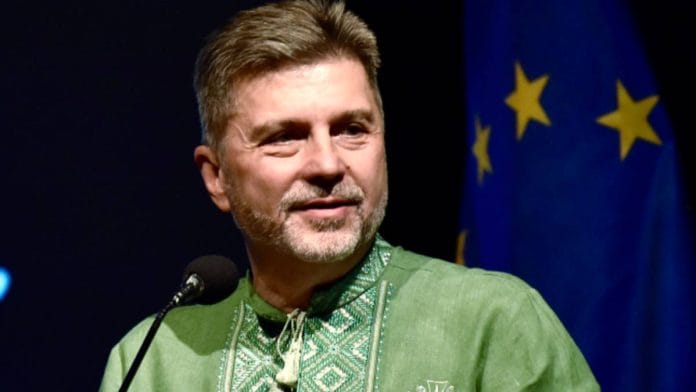



New Delhi: Ukraine’s efforts to deepen ties with India, so far, have been “unilateral” with a not very “positive” response from New Delhi, Oleksandr Polishchuk, the Ukrainian Ambassador to India, told ThePrint in an exclusive interview Tuesday.
Polishchuk, in his written communication on four years since Russia began full-scale military operations against Ukraine, highlighted that the “historic visit” by Prime Minister Narendra Modi to Kyiv in August 2024 set the stage for a deeper partnership in areas such as culture and technical military cooperation, as agreed with Ukrainian President Volodymyr Zelenskyy. However, a number of institutional mechanisms since agreed to by the two leaders are yet to materialise.
On the Joint Statement announced by Modi and Zelenskyy, following the former’s visit to Kyiv, the envoy said: “For me, as a person who professionally deals with strategic and operational planning, this document serves as guiding instructions from the political leadership of the state. Therefore, with a view to implementing the leaders’ bilateral agreements, Ukraine prepared an appropriate roadmap for the step-by-step achievement of this strategic objective.”
“Its content was developed on the basis of the outcomes of discussions in working groups on deepening sectoral partnership, whose meetings took place over the course of recent years.”
“Unfortunately, thereafter, as you rightly noted—a period of lull set in. The Ukrainian side’s efforts to maintain momentum in the relationship have been largely unilateral and have not met with a positive response from our Indian partners,” he added.
On 24 February, 2022, Moscow launched a full-scale military effort to seize Ukrainian territory, specifically the five eastern provinces, collectively referred to as the Donbas region. The war has ground on for four years. Ukraine still maintains control of large swathes of areas claimed by Russia.
Kyiv has come under pressure in the last few months with flagging support from the US and difficulties within the European Union (EU) to ensure adequate funding for Kyiv’s efforts at the appropriate time. Since late last year, a 90-billion-euro package for Ukraine announced by the EU has been stuck due to opposition from Hungary, who has sought to maintain energy ties with Russia.
India has maintained that “dialogue and diplomacy” are the only answer to the four-year war, while keeping strong economic ties with Russia, particularly through the import of Russian crude, which has, however, seen a dip in recent months following American sanctions on Russian oil firms Rosneft and Lukoil. Russian President Vladimir Putin made a visit to India in December 2025 for the annual bilateral summit.
While the India-Russia bilateral mechanisms have continued to be maintained annually, New Delhi and Kyiv have been unable to convene the seventh session of the Ukraine-India Intergovernmental Commission (IGC) at the end of 2024.
The Ukrainian Culture Festival, which “should have been held in the fourth quarter of 2025” in India, according to the ‘Programme of Cultural Cooperation’ inked by New Delhi and Kyiv for 2024-2028, did not materialise either, Polishchuk said.
“This was partly because Ukrainian artists did not receive visas to visit India at a time when President Putin was in India on a visit,” the Ukrainian ambassador said, adding that “I am not inclined towards conspiracy theories or to see Moscow’s hand behind every action or inaction on the Indian side. The reasons for a certain stagnation in implementing the leaders’ political will may be quite routine.”
The other sector where lack of clarity remains from the Indian side is in military-technical cooperation. Apart from ship engines, Ukraine has developed a large defence-industry complex out of necessity in the last four years, along with innovative use of technologies such as unmanned aerial vehicles and unmanned underwater vehicles. Kyiv has the ability and capacity to produce around six million unmanned vehicles a year, according to reports.
“We have sufficient potential to implement joint bilateral defence-cooperation projects with India. We are ready to discuss these matters within the framework of the Indian-Ukrainian Joint Working Group on Military-Technical Cooperation—of course, once the date of its meeting is agreed, as envisaged in the Joint India-Ukraine Statement of August 2024,” said Polishchuk.
The ambassador added a word of caution: “Of course, this is provided that the Indian side’s priorities in military-technical cooperation have not changed following President Putin’s visit to India in December 2025.”
Also Read: India’s strategic future tied to easing Russia-Europe standoff
India-Ukraine trade
As India’s economic engagement with Russia grew over the last four years to being worth over $60 billion in two-way merchandise trade, New Delhi and Kyiv saw a decrease, partly due to sea routes being blocked during the early months of the war.
“Before Russia’s full-scale invasion, the volume of trade between Ukraine and India reached $3.45 billion. Over the past two years, we have seen a gradual recovery in trade volumes. By the end of 2025, bilateral trade reached $2.61 billion,” said Polishchuk.
“Following the meeting of the Working Group on Trade and Economic Cooperation held on 15 May, 2024, the sides jointly identified practical areas for further mutually beneficial economic cooperation. The next step now lies with the Intergovernmental Commission (IGC), which is to endorse the Working Group’s proposals at the intergovernmental level and give the ‘green light’ to begin implementation.”
Between April and November 2025, India’s overall exports to Ukraine stood at around $141 million, while its merchandise imports from Kyiv were worth around $549 million, according to the Ministry of Commerce and Industry.
Another area where India could step in more, Polishchuk said, is humanitarian aid.
China, which has long enabled Moscow’s war-machine, provided roughly $13 million worth of humanitarian aid since 2022 to Kyiv, with over 600 diesel generators sent to Ukraine in December 2025 alone, as the country’s energy infrastructure was repeatedly targeted by Russia, he said.
“Today, India ranks fourth in the world in terms of economic development and, in the near future, will become the world’s third-largest economy. Clearly, given this—and taking into account India’s traditions of humanism—India could provide more humanitarian assistance to Ukraine. It has all the necessary material and technical capabilities to do so. All that is needed is political will,” said the Ukrainian ambassador.
The road to peace
The question about the ending of the four-year Russia-Ukraine war remains. The US under President Donald Trump has pressured Kyiv over the last year to accept terms for a ceasefire with Moscow that includes the swapping of territory.
A 28-point draft peace plan first shared by the US at the end of 2025 seemed to support a number of “maximalist” demands made by Russia, including a demilitarised zone within the province of Donetsk, despite Kyiv still holding around a quarter of the total province.
“I would like to emphasise that Ukraine is a sovereign and independent, democratic, social and—I stress—rule-of-law state. This fundamental principle is enshrined in Article 1 of the Constitution of Ukraine. Article 2 of our Constitution states that the territory of Ukraine within its existing borders is integral and inviolable. Any issues concerning changes to the territory of Ukraine may be decided exclusively by an all-Ukrainian referendum, as stipulated in Article 73 of the Constitution of Ukraine,” stated Polishchuk.
“In light of this, issues of territorial integrity cannot be a subject of bargaining with the Russians or of pressure. So far, the only positive outcome of the ongoing talks has been the exchange and release of prisoners of war. On all other matters, the Russians are attempting to conduct negotiations in an ultimatum mode, putting forward conditions that are unacceptable in advance for achieving a ceasefire.”
The ambassador maintained that Moscow has “no grounds” for its repeated claims to Kyiv’s territory, especially with the high military costs: the deaths of approximately 1,000 soldiers a day.
“The President of Ukraine has repeatedly emphasised that a ceasefire regime could be achieved immediately, provided there is political will on the part of the Kremlin. So far, we do not observe such will. Putin does not want to end this war and continues to issue criminal orders to strike Ukraine’s civilian critical infrastructure, killing innocent civilians,” he said.
Trump had promised in 2024 that he would end the war within 24 hours of assuming power at the White House. A year into his second term, he faces a situation where the war continues, with increasing intensity in some directions across the battlefield.
External Affairs Minister S. Jaishankar in July 2024 had asserted that India’s “endeavour” is to see Kyiv and Moscow move to the negotiating table. However, in the year since, Modi and Zelenskyy held a telephone conversation but did not meet in person. The two leaders were scheduled to meet on the margins of the G7 summit last June in Canada. However, the meeting had to be postponed.
(Edited by Nida Fatima Siddiqui)
Also Read: ‘Optics, ideology, economics’ — why China’s playing mediator, from Palestine to Ukraine