





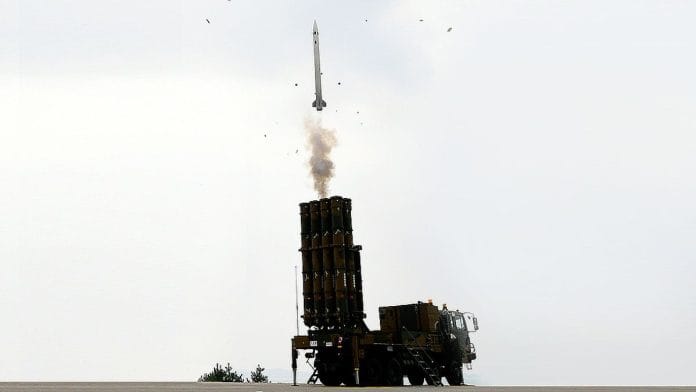



New Delhi: The war in West Asia has seen South Korea’s burgeoning defence industry stand out, with the success of the Cheongung-II air defence system the highlight of the East Asian nation’s push to become a global defence manufacturer.
The Cheongung-II air defence system, which plays a similar role to the vaunted US-made Patriot air defence systems, is not only cheaper, but has reportedly seen a 96 per cent interception rate in the 60-odd interceptors used by the United Arab Emirates (UAE) against Iranian missiles and unmanned aerial vehicles.
Although the role of the Cheongung-II is minimal in comparison to other defence platforms in the ongoing conflict, the air defence system has nonetheless won praise, and led to a massive rise in the stock prices of LIG Nex1, the maker of the system since the end of February.
LIG Nex1’s stock price has climbed up by over 40 per cent since the beginning of the conflict, while Hanhwa Aerospace’s stock has grown by over 10 per cent during the same period. Hanhwa makes components for the air defence platform.
The UAE is reported to have sent transport aircraft earlier this month to South Korea for more interceptor missiles, indicating its preference for the cheaper option over the more expensive Patriot PAC-3 missiles, according to the South China Morning Post (SCMP).
Every missile used by the Cheongung-II battery costs around $1.1 million whereas the Patriot PAC-3 missiles cost about $3.7 million each. Further, the Patriot missiles take about six weeks to assemble, with a lead time of around three years to obtain all the required components, according to the New York Times.
A number of components for the PAC-3 come from China. Lockheed Martin in 2024 for the first time built over 500 PAC-3 missiles, with the goal of reaching 650 by 2027. LIG Nex1 is looking to quickly expand its own capacity to produce more missiles within the next nine to 12 months, according to The Financial Times.
Also Read: US considers diverting Patriot, THAAD systems intended for Ukraine to West Asia conflict
What is Cheongung-II?
The missile system, which has never been used in conflict before, has apparently succeeded in its first major test. It is built to bridge the gaps between high- and low-altitude air defence systems. In comparison the Patriot and Lockheed Martin’s Terminal High Altitude Area Defence system (THAAD) are more capable at handling faster missiles at longer ranges, notes the New York Times.
The system is designed to easily slot into NATO’s defence systems, with South Korea the second largest arms exporter to Europe after the US, between 2021 and 2025, according to the Stockholm International Peace Research Institute (SIPRI).
A Cheongung-II battery consists of a radar, control station and four transporter-erector launchers. While LIG Nex1 is responsible for the entire system, the radars are built by Hanhwa systems, while the launchers are built by Hanhwa Aerospace. The Cheongung-II, roughly translates to ‘Heaven’s Bow’
The maximum range of the system is around 40 km and can engage with targets at altitudes below 15 km, the SCMP reports. The systems are designed to intercept aircraft, apart from just missiles and unmanned aerial vehicles (UAVs).
The system is designed with the ability to simultaneously engage multiple-targets. The interceptor missiles themselves are extremely mobile through the existence of side jet thrusters, along with enhanced stability through the usage of canards, LIG Nex1 notes on its website.
The system is capable of multiple launches, simultaneous launches and vertical launches. LIG Nex1 has been exporting Cheongung-II systems to West Asia since 2021. It has long-term contracts with Iraq, Saudi Arabia and the UAE. The Emirates had signed a contract for 10 batteries, of which two have been delivered as per schedule. Abu Dhabi has requested expedited delivery of the batteries, the SCMP reports, after the interception figures emerged during the early days of the ongoing conflict.
For South Korea’s defence industry, Poland in Europe has emerged as one of its largest customers in the continent. Warsaw has sought land-based systems, including tanks, from South Korean producers as it looks to expand its military, especially since the war between Russia and Ukraine began in 2022.
India has also purchased South Korean defence platforms. The K9 Vajra self-propelling howitzer produced by Larsen and Toubro Limited (L&T) is an example of South Korean technology in use by the Indian armed forces. L&T had signed a transfer of technology agreement with Hanhwa to produce the howitzers domestically.
(Edited by Nardeep Singh Dahiya)