





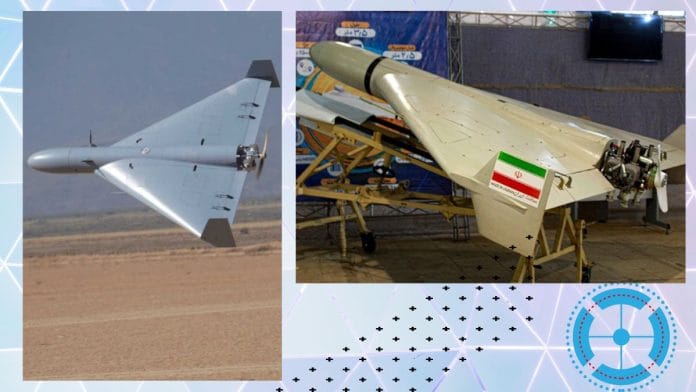



New Delhi: When Iran fires waves of one-way attack drones at US and Israeli air defences, the problem is not purely military—it is economic. Expensive interceptors must chase cheap munitions, and the ledger rarely balances. The United States has responded with LUCAS, the Low-Cost Uncrewed Combat Attack System, described as modelled on the very Iranian drone it is designed to counter and deployed for the first time in the West Asia conflict.
What is the Shahed family of drones?
Shahed drones occupy a distinct class: cheap, expendable strike systems designed for mass, repeated use rather than individual precision. Classification of the family has oscillated between loitering munition and kamikaze drone, but in operational use, the drones function as something closer to a disposable strike platform—pre-programmed, launched in salvos, and intended to saturate air defence zones through volume as much as accuracy.
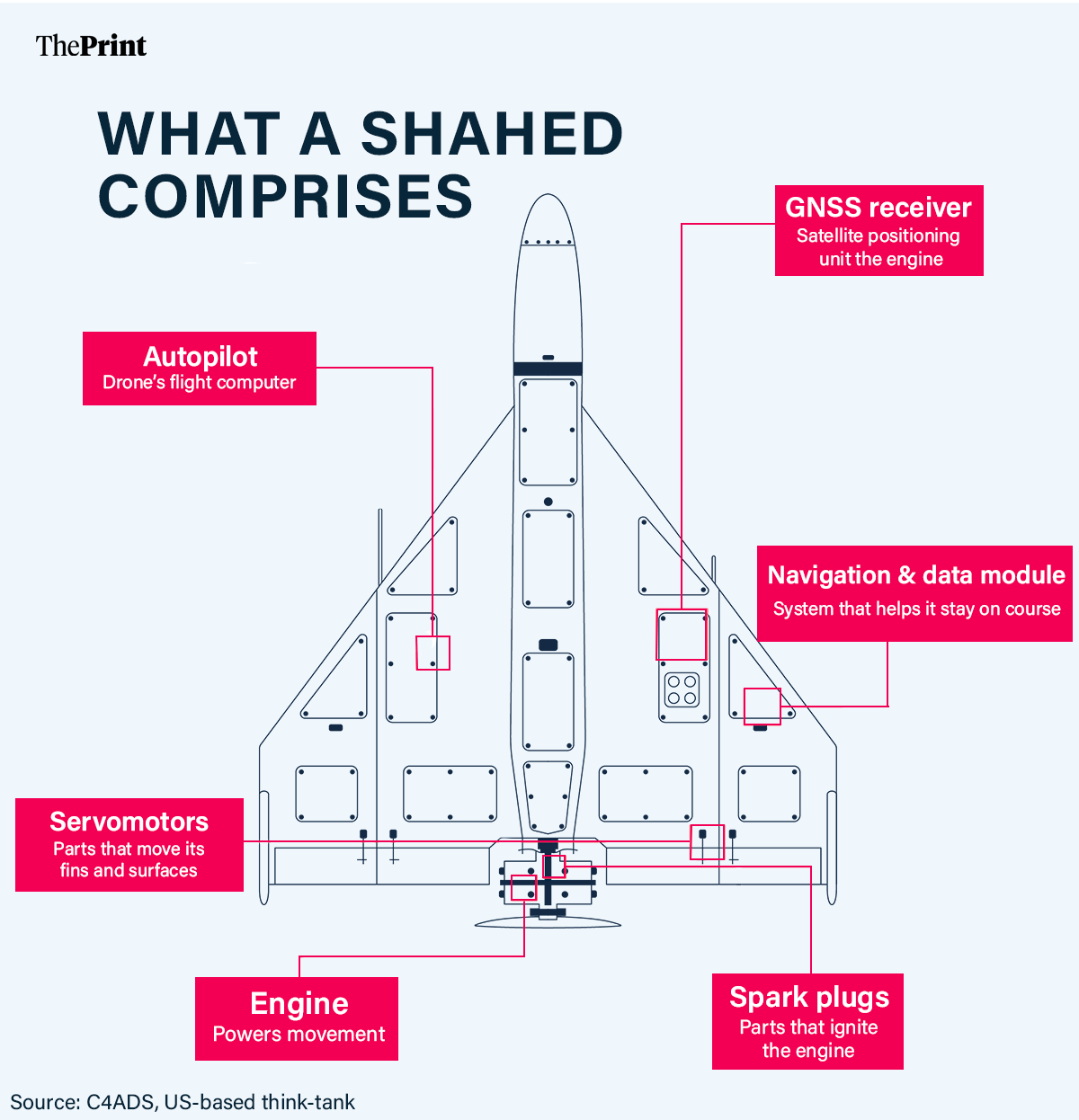
The Shahed-136, the family’s best-known variant, embodies this philosophy in its design. It uses off-the-shelf commercial avionics, a basic guidance system, and a two-cylinder, four-stroke engine that gives it a range of roughly 1,500km at relatively low cost.
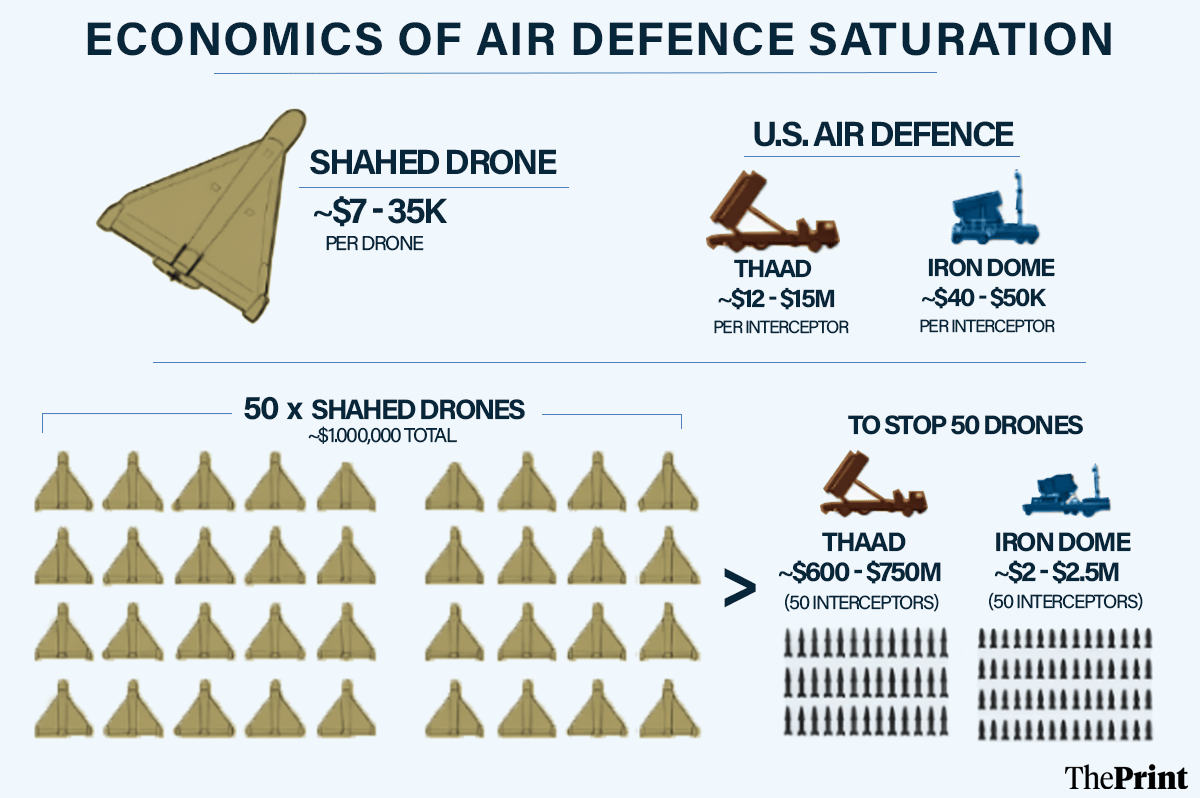
Simple construction keeps production and maintenance demands modest, reduces reliance on specialised components, and allows manufacture at scale with losses replaced quickly. Even when intercepted, the drones impose costs on defenders: each one destroyed requires an interceptor that is typically orders of magnitude more expensive.
Battle-tested in Ukraine
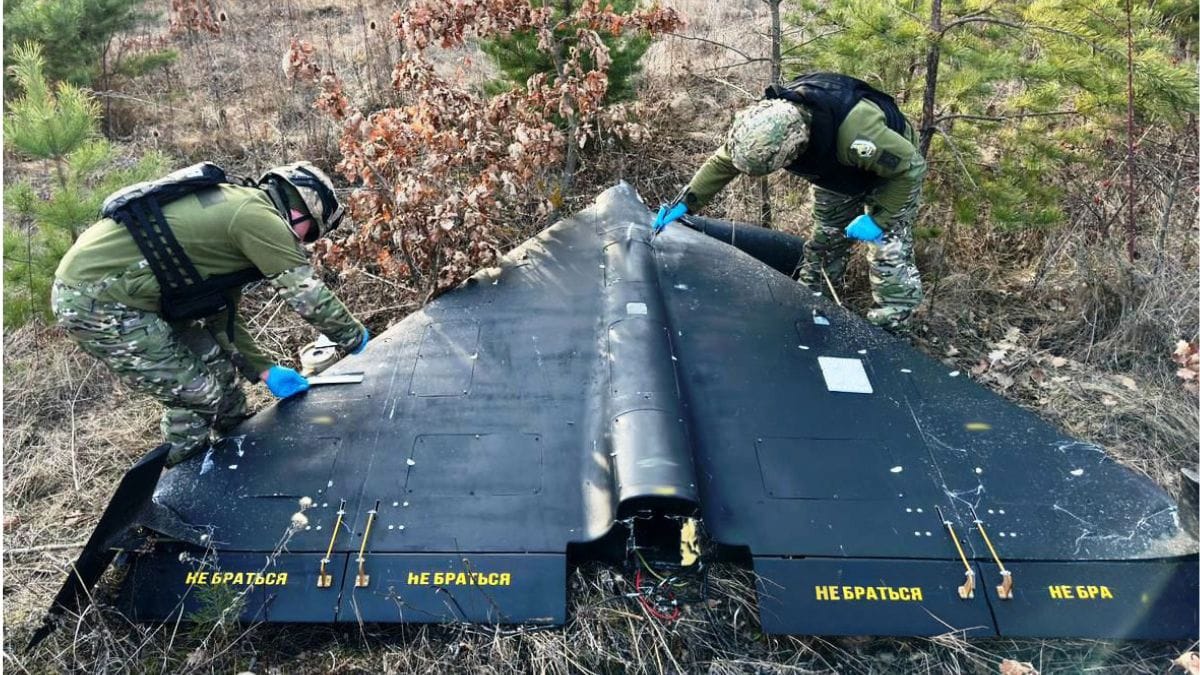
The Shahed’s operational logic was refined in the Russia-Ukraine war, which began in 2022. After Ukraine initially seized the drone initiative, Russia deployed Shahed variants—tying Ukraine’s air defences for extended periods to conventional countermeasures: interceptor missiles, anti-aircraft guns, man-portable air defence systems (MANPADS), and electronic warfare measures such as spoofing and jamming.
Russia simultaneously began localising the platform. It rebranded the Shahed-131 as the Geran-1, the US-based think-tank Center for Advanced Defense Studies (C4ADS) noted in its 2025 report Airborne Axis.
Leaked records, reported by C4ADS, show that Iranian and Russian defence organisations then collaborated to produce a local version of the Shahed-136 under the name Geran-2. Subsequent variants were further improved using Chinese components, culminating in Geran-5—used as recently as January this year, according to the Ukraine military.
From Shahed-136 to Shahed-238
In the US-Israel and Iran conflict, Tehran is deploying Shahed-136 alongside missiles to overwhelm air defences. More capable variants are also now in the field.
The Shahed-238 marks a significant step forward: it is powered by a turbojet engine rather than a piston engine, incorporates thermal imaging and can switch targets in flight—a capability Shahed-136, with its pre-programmed trajectory, did not have, according to Ukrainian military analysts.
LUCAS: Inspired or reverse-engineered?
The US’s answer to Shahed was LUCAS, publicly described by the US Central Forces Command (CENTCOM) as Shahed-inspired drones.
Spektreworks, the American maker of FLM136 LUCAS, characterises the drone as “reverse engineered for authentic threat emulation”.
At the physical frame level, the resemblance with Shahed-136 is deliberate.
Where LUCAS departs significantly from its apparent template is in software, communications and navigation. CENTCOM has said that the drone is designed to operate autonomously. Unlike Shahed-136’s fixed flight path, LUCAS can switch targets mid-flight.
It can carry different payloads, and can be launched from multiple platform types such as catapults, rocket-assisted takeoff, and mobile ground and vehicle systems.
On guidance, public sources do not authoritatively confirm whether LUCAS uses M-code GPS—a more jam-resistant, encrypted military GPS signal—or DSMAC (Digital Scene Matching Area Correlator), an optical terrain-matching system that compares preloaded terrain features against live imagery to maintain course when GPS is denied.
But US strike systems such as the Tomahawk missiles have long incorporated terrain-reference and scene-matching guidance, which analysts suggest LUCAS may also have. The LUCAS developer has not confirmed either capability.
LUCAS also integrates satellite communications options, including Viasat’s MUSIC system and SpaceX’s Starshield. These Low Earth Orbit satellite constellations allow faster position triangulation than traditional alternatives.
But these capabilities come at a trade-off, the US appears to have sacrificed range for heavier electronic warfare payloads. LUCAS has a range of approximately 1,000km, compared with Shahed-136’s 1,500-plus km, according to an estimate by news agency Reuters.
The cost arithmetic
Though it is estimated that Shahed costs around $35,000, analysts focused on Iran’s defence economy dispute this. A heavily sanctioned Iran, they argue, is unlikely to sustain production at that price. In their view, if a significant share of components has been indigenised, the true per-unit cost may be closer to $7,000.
LUCAS, by contrast, has been officially priced at $35,000.
If the lower Iranian cost estimate holds—and accounting for the unverified likelihood that Iran supplements production with imports from Russia and China—Tehran could theoretically field up to four Shahed units for every LUCAS unit that the US deploys.
Implications
What the Shahed demonstrated—and what LUCAS appears designed to confirm—is that the future of drone warfare may not entirely depend on technological elegance. It could include the capacity to combine affordability, adaptability and production depth at speed.
The strategic lesson is not that advanced militaries abandon their sophistication, but that sophistication alone may not be sufficient. In the age of attrition strike systems, the side that learns fastest how to combine software, scale and acceptable loss may hold the decisive advantage.
Adurthi Ashwin Swarup is an alum of ThePrint School of Journalism, currently interning with ThePrint.