








New Delhi: 2025 was a year that tested not just the operational readiness of the Indian armed forces but also battle-hardiness and technological prowess of its weapons systems.
Amidst a doctrinal shift towards joint theaterisation and greater synergy between the different arms of the forces, the Indian Army in 2025 moved further towards its stated mission of building a “modern, agile, adaptive, technology-enabled, and self-reliant future-ready force” as part of its Vision@2047.
Technological absorption and operational digitisation were prioritised by the Army in 2025 in a visible effort to induct niche technology into its wider apparatus. Structural changes were aimed at technological integration and making the Army future-ready.
ThePrint looks at some major milestones for the Army in 2025.
Test of readiness: Op Sindoor
The operational readiness and deterrence abilities of the Indian armed forces were showcased in May 2025 during Operation Sindoor, which was a calibrated response to the Pahalgam terror attack perpetrated by Pakistan-backed terrorists.
Planning and command of the operation was spearheaded by the Army, with the entire operational planning carried out at its military operations branch, which played a pivotal role in the execution of Operation Sindoor as well as in countering Pakistan’s retaliatory strikes and enhanced infiltration attempts along the LOC. Nine terrorist camps across the border were destroyed, with seven of them neutralised by the Army itself.
Drone attacks by Pakistan, involving Turkish-origin Songar and YIHA drones (developed jointly by Turkey and Pakistan), aimed at both military and civilian assets were foiled, demonstrating the effectiveness of Army air defence units as well as integrated counter-UAS (unmanned air defence systems) and layered air defence systems.
Along the LoC, the Army successfully destroyed terror launchpads using its ground-based weapons and disrupted infiltration routes and terror logistics networks.
Firepower with precision
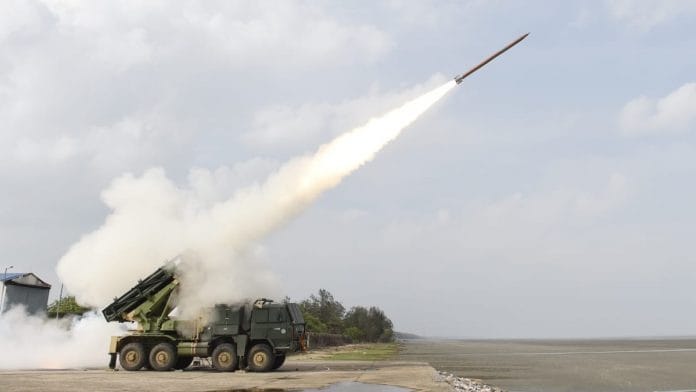
The Army also highlighted its enhancement of long-range firepower and precision strike capabilities in 2025, as evidenced by advancements in its Brahmos missile variant and the indigenous Pinaka rockets.
In December, a combat missile launch under simulated battle conditions, involving a BrahMos unit of the Southern Command with elements of Andaman & Nicobar Command, validated its high-speed flight stability and terminal accuracy, besides reinforcing the long-range precision strike readiness of the supersonic cruise missile.
The Army affirmed India’s push for longer reach and quicker ‘sensor-to-shooter’ cycles by undertaking extended-range BrahMos development and testing.
Operationalisation of two additional Pinaka regiments in June, followed by the successful test of the Pinaka Long Range Guided Rocket (LRGR) with a reported range of around 120 km in December, served as a testament to the potent mix of firepower and precision.
Also, work is underway on the longer-range 300 km-class Pinaka variants for future deep-strike options.
Aviation edge
The Indian Army, after much delay, is making headway with its aviation induction plan, as it received the delivery of the final tranche of three remaining AH-64E Apaches in December, as part of the 2020 deal, following the initial delivery of three of the world’s most advanced multi-role combat helicopters in July.
This enables Army’s plan of operationalising its six-fleet Apache squadron based in Jodhpur.
Innovations and battlefield structures
Additions in 2025, such as Bhairav Battalions and Ashni Platoons, signal a visible shift from concept to field capability as the Army adapts to the changing nature of warfare.
There are also plans to operationalise 25 Bhairav light commando battalions on an accelerated timeline, and to raise Ashni drone platoons across infantry for intelligence, surveillance, and reconnaissance and precision effects.
The Army, in its quest for technological modernisation and to enhance its combat effectiveness for next-generation warfare, has inducted new structures, such as the Shaktibaan regiments and Divyastra batteries, equipped with unmanned aerial vehicles, including loiter munitions for hybrid precision attacks.
These changes are part of the Army’s ‘Decade of Transformation’ (2023 to 2032), as announced by Chief of Army Staff General Upendra Dwivedi on Vijay Diwas (26 July).
Procurements and indigenisation
The Indian Army notes that it observed the last two years as ‘Years of Tech Absorption’, aiming to move from technology adoption to integration and embedding new technologies.
This year also saw the Army making major procurements and initiating capability-building initiatives, as seen by the major AoNs (Acceptance of Necessity) and acquisition signals.
In addition to the induction of 6 Apache helicopters, the Indian Army achieved a remarkable 91 percent indigenisation of its ammunition in 2025. In light of drones revolutionising modern warfare, and the Army having to contend with their increased usage by adversaries, the Army in 2025 inducted a wide plethora of UAS in its arsenal. This includes various types of drones, including about 3,000 RPAs, about 150 tethered drones, swarm drones, logistics drones for high altitude areas and Kamikaze drones, etc.
The Defence Acquisition Council (DAC) in August granted approval for a variety of items like thermal imager-based driver night sight for BMPs (Army) and Medium Altitude Long Endurance (MALE) remotely piloted aircraft systems for triservice surveillance/strike roles.
On 29 December, the DAC, reflecting lessons from modern conflicts and recent operational experiences, showcased a visible tilt towards unmanned systems, counter-UAS and precision fires.
Innovation and indigenisation were also supported by the Army in 2025 by initiatives like the 2025-26 edition of Inno-Yoddha, to foster bottom-up innovation and Atmanirbhar capability creation.
Joint exercises
The year also saw the Army participate in joint exercises, despite the Pahalgam attack and Operation Sindoor. Its participation in key bilateral exercises in 2025 helped improve interoperability, readiness for counter-terrorism operations and regional partnerships.
Some examples include Yudh Abhyas with the US in Alaska in September; Ajeya Warrior-25 between India and UK in November in Rajasthan; and Desert Cyclone-II with the UAE in Abu Dhabi in December.
Sushovan Chakraborty is an intern with ThePrint
(Edited by Viny Mishra)