





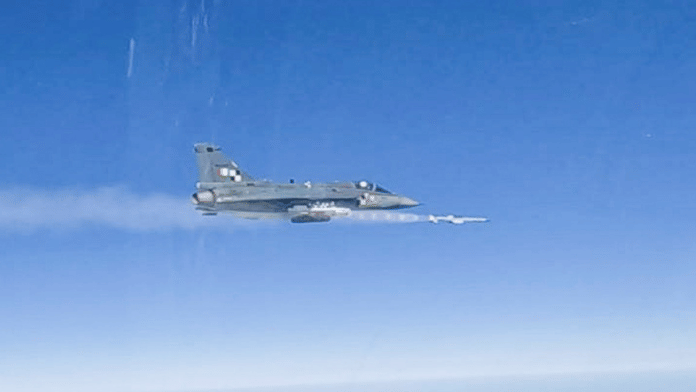



New Delhi: The defence ministry Monday cleared planned procurement proposals worth an estimated Rs 79,000 crore including those for Astra MK2—the over 200-km range air-to-air missile—and the 120-km range guided rockets for the Pinaka multi-barrel rocket launcher.
The Defence Minister Rajnath Singh-led Defence Acquisition Council (DAC) in its year-end meeting has accorded Acceptance of Necessity (AoN) for various proposals of the three Services. AON is the first formal step towards procurement.
For the Indian Army, AoN was approved for procurement of loiter munition system for artillery regiments, low-level light weight radars, long-range guided rocket ammunition for Pinaka Multiple Launch Rocket System (MRLS), and integrated drone detection & interdiction system Mk-II.
Among these, the most significant is the long-range guided rocket ammunition, a proposal worth around Rs 2,500 crore.
While Pinaka’s guided rockets currently have a range of about 80 km, the new one to be procured will have an extended range of 120 km. The system is being developed by the Defence Research and Development Organisation and the first testing is scheduled for 2026.
The defence ministry in a statement said loiter munition will be used for precision strike of tactical targets, whereas low-level light weight radars will detect and track small size, low flying unmanned aerial systems.
“Long-range guided rockets will enhance the range and accuracy of Pinaka MRLS for effective engagement of high value targets. Integrated drone detection & interdiction system MK2 with enhanced range will protect the vital assets of the Indian Army in tactical battle area and hinterland,” it said.
For the Indian Air Force, AoN was approved for procurement of automatic take-off landing recording system, Astra MK2 missiles, full mission simulator and SPICE-1000 long-range guidance kits, etc.
Induction of the automatic take-off landing recording system will fill the gaps in the aerospace safety environment by providing high definition all-weather automatic recording of landing and take-off.
The full mission simulator for Light Combat Aircraft (LCA) Tejas will augment pilots’ training in a cost-effective and safe manner, while SPICE-1000 will enhance long-range precision strike capability of the IAF. Spice 1000 was used by IAF in the 2019 Balakot operation.
One of the most significant developments for the IAF is the sanction to procure Astra MK-2 missiles. The IAF plans to procure at least 700 of them which will be integrated with the Sukhoi and the Tejas. This missile will come with enhanced range of over 200 km, longer than the European Meteor integrated with the Rafale aircraft.
The initial plan was to have a 160 km-range Astra MK2, but the plan has been tweaked to ensure higher capability of over 200 km. The missile will be a counter to the PL-15 in use by both Pakistan and China. Sources said the Astra MK2 will undergo its first test firing in 2026 and the plan is to eventually take it over 300 km in subsequent versions.
For the Indian Navy, AoN was accorded for procurement of Bollard Pull (BP) tugs, High Frequency Software Defined Radios (HF SDR) manpack and for leasing High Altitude Long Range (HALE) Remotely Piloted Aircraft System (RPAS).
Induction of BP tugs will assist Navy ships and submarines in berthing, unberthing, and maneuvering in confined waters/harbour.
The HF SDR will enhance long-range secured communication during boarding and landing operations, whereas HALE RPAS will ensure continuous Intelligence, Surveillance and Reconnaissance and credible Maritime domain awareness over the Indian Ocean region.
The Indian Navy already operates two Sea Guardians on lease and the AON is for leasing of two additional Sea Guardians as well as continued leasing of the earlier two.
(Edited by Viny Mishra)
Also read: Defence Secretary spells out big procurement push, overhaul of system