





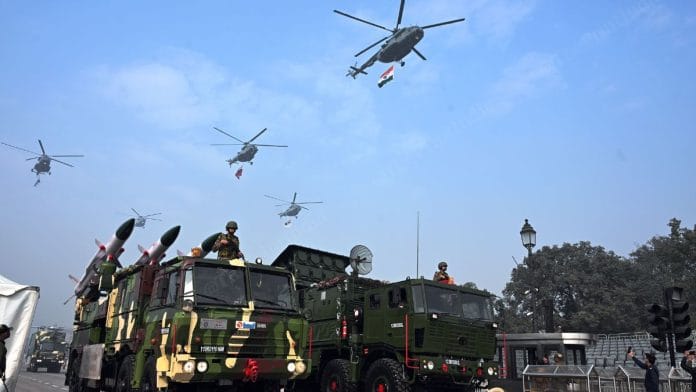



New Delhi: The 77th Republic Day Parade, scheduled to be held at Kartavya Path Monday, will showcase an unprecedented combat-oriented display of India’s military strength, technological self-reliance and synergy in the armed forces.
In a press briefing in the national capital, presided over by Major General Navraj Dhillon, Chief of Staff, Delhi Area, he outlined the overall structure, scale and distinctive features of the Republic Day Parade and the Beating Retreat ceremony for 2026.
Major General Dhillon detailed key ceremonial and operational elements of the parade, highlighting the emphasis on integrated combat formations, indigenous military platforms and inter-service coordination that will define this year’s celebrations.
The Chief of Staff was accompanied by Air Commodore Manish Sabarwal, from Headquarters, Integrated Defence Staff, along with other senior officers and contingent commanders who will be participating in the parade.
The Republic Day Parade will commence at 10.30 am and will last approximately 90 minutes. The ceremonial procession will move from Raisina Hill, Vijay Chowk, proceed along Kartavya Path, pass India Gate, continue via Tilak Marg, and culminate at the Red Fort.
As per tradition, the Prime Minister will begin the day by paying homage to fallen soldiers at the National War Memorial. This will be followed by the arrival of the President of India, who will take a 21-gun salute.
This year’s chief guests are Ursula von der Leyen, president of the European Commission and António Luís Santos da Costa, president of the European Council.
The EU leadership will be accompanied by a ceremonial contingent led by officers of colonel rank, and by four flag bearers.
First-ever battle array formation
For the first time, the Republic Day Parade will feature a live battle array formation, depicting an integrated, offensive combat grouping of the Indian Army.
The formation will showcase the Army’s readiness, resilience and responsiveness, reflecting modern warfare driven by intelligence, surveillance, reconnaissance and network-centric operations.
The battle array will demonstrate close coordination among mechanised forces, aviation elements, special forces and artillery, supported by long-range surveillance drones, autonomous platforms and unmanned ground vehicles, reflecting the evolving nature of modern warfare.
Indigenous artillery systems, surface-to-surface rocket launchers and strategic missile platforms will form a key component of this combat depiction, highlighting India’s growing emphasis on Atmanirbhar Bharat (self-reliant India) and technologically advanced military capabilities.
Air defence coverage within the formation will be ensured by short- and medium-range surface-to-air missile systems, underscoring the Army’s layered defensive framework, while the rear elements will showcase logistics, automation and specialist animal units, reflecting operational preparedness in challenging and high-altitude terrains.
Command and participation
The parade will be commanded by Lieutenant General Bhavnish Kumar, AVSM, VSM, with Major General Navraj Dhillon serving as the second-in-command. Around 6,050 personnel will participate, of whom 514 will be women.
Decorated war heroes, including Param Vir Chakra and Ashok Chakra awardees, will participate. Among them are Subedar Major (Honorary Captain) Yogendra Singh Yadav, Subedar Major (Honorary Lieutenant) Sanjay Kumar, along with senior officers accompanying Ashok Chakra awardees.
Military hardware and new units
Several formations and equipment platforms will make their first public appearance at the Republic Day Parade, marking a significant milestone in the Army’s ongoing modernisation efforts.
These include newly raised units such as Shaktibaan Artillery Regiments, specialised in drone and loitering munition warfare; Divyastra Batteries, hybrid units integrating conventional artillery with precision drones; and Bhairav Light Commando Battalions, agile formations designed for specialised, rapid-strike and high-risk operations.
The mechanised columns will feature frontline combat platforms, including T-90 Bhishma tanks, Arjun main battle tanks, BMP-2 Sarath infantry combat vehicles and advanced reconnaissance systems. A range of key weapon systems will also be on display, such as the Advanced Towed Artillery Gun System (ATAGS), Dhanush artillery, universal rocket launcher systems, BrahMos cruise missiles, and Akash and MR-SAM air defence systems.
In addition, a wide array of futuristic platforms will be presented, with robotic dogs, kamikaze drones, unmanned ground vehicles, micro-surveillance drones and rugged terrain transport systems mounted on combat vehicles, underscoring the parade’s distinctly combat-centric theme and emphasis on emerging military technologies.
Aviation and special forces
The aerial component will feature the Dhruv advanced light helicopter, the Apache AH-64E, and the Light Combat Helicopter (LCH), operating in battlefield-shaping roles. Special Forces detachments, a small, highly trained, and specialised team typically part of the Army’s Special Forces (SF) battalions, capable of operating independently behind enemy lines or in high-risk environments, will be showcased in operational configurations using all-terrain vehicles and remotely piloted aircraft systems
In total, 20 aircraft, including fighters, transport aircraft and helicopters, will participate in multiple formations during the flypast.
Marching contingents & animals
The parade will feature 18 marching contingents, including those from the Army, Navy, Air Force, paramilitary forces and Delhi police. The Bhairav Light Commando Battalion and Ladakh Scouts will make prominent appearances. A total of 12 military bands and eight pipe bands will perform during the ceremony.
Highlighting the continued relevance of animal power in high-altitude and glacier warfare, the parade will feature Bactrian camels, Zanskar ponies, raptors, and Indian and foreign breeds of dogs, including the Mudhol, Rampur, and Rajapalayam hounds. Specialist logistics platforms, including those supporting glaciers and drone maintenance vehicles, will also be displayed.
Tableaux and cultural performances
Thirty tableaux from states, Union territories, ministries and defence services will roll down Kartavya Path. These include tableaux from the Indian Navy, a veterans’ tableau and a Tri-Services tableau presented by the Headquarters Integrated Defence Staff.
The Tri-Services tableau is themed ‘Operation Sindoor: Victory through Jointness’, depicting integrated air, land and missile operations, precision strikes and indigenous defence systems, highlighting India’s operational synergy and self-reliance.
A 10-minute cultural programme, featuring nearly 2,500 artists, will present India’s ancient heritage, cultural diversity and natural splendour.
Beating Retreat
The Beating Retreat ceremony will be held 29 January at Vijay Chowk, featuring massed military, pipe and drum bands from the Army, Navy, Air Force and central armed police forces.
Indian compositions will be presented in innovative musical arrangements, marking the formal conclusion of Republic Day celebrations.
Senior officials noted that the 2026 Republic Day Parade reflects India’s growing military capability, indigenous innovation and joint operational doctrine, reinforcing the message of a confident, self-reliant nation.
(Edited by Viny Mishra)
Also read: 2025 was Indian Army’s year. New battalions & platoons, embracing next-gen warfare