





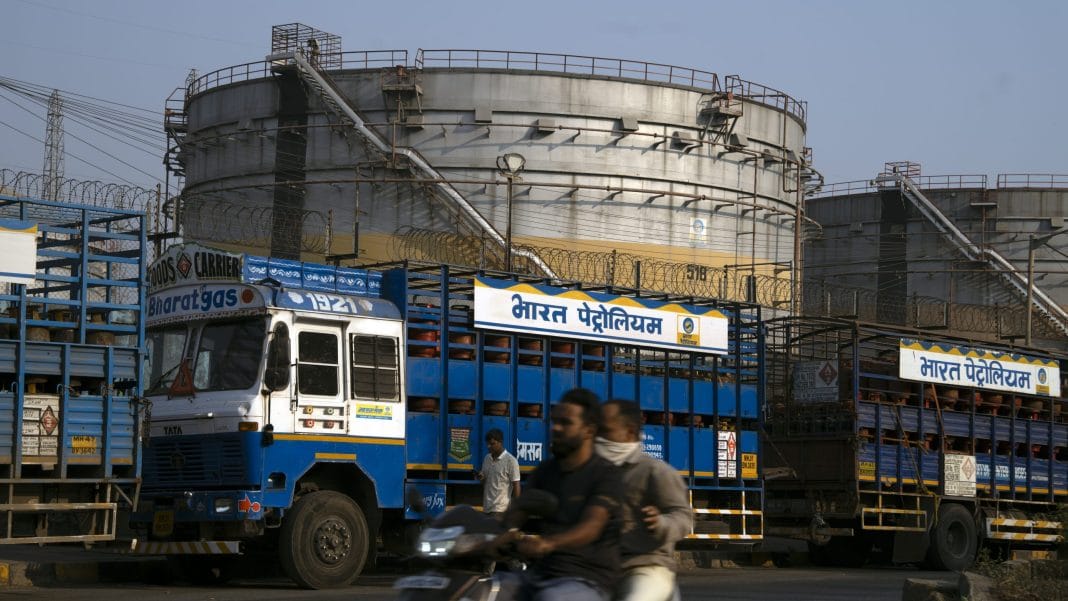



While most students check their bank balance to see if they can afford a weekend brunch at a good restaurant, I check my balance to see if a drone strike miles away just spiked the price of my LPG cylinder. My morning routine has become a three-step ritual: turning off my alarm, checking if the Strait of Hormuz is still open and shaking my LPG cylinder to check if it feels heavy enough to make my heart feel light. Students staying out and managing the burden of their own expenses know the importance of tracking Iranian tankers with the same intensity we used to track Zomato deliveries. Young women may relate to me when I say that mood swings are more reliant on LPG, than PMS.
Amidst the ongoing tussle, India is facing backlash for playing a critical role that isn’t clicking with the intellectuals. Let me reveal this interesting role from my point of view. India is actually playing the role of a confused ex-partner, in which the West wants India to ‘right-swipe’ every sanction, while the East is expecting India to remember ‘all the good old times’.
Meanwhile, the heart of India, New Delhi, is leaving everyone on ‘seen’. Now, this is the best way to handle any toxic situation while maintaining your own mental peace and growth, and on the side, enjoying the drama.
This ‘backbencher’ attitude of India is the best that the country can do other than pretending to be “oversmart” in the Global South. Our country is more concerned about whether we’ll be able to afford our grains next month rather than being the overly concerned neighbour worrying about all the ideological crusades. The pragmatist approach suits us best. We’ll choose being “cool” rather than being a Bollywood hero.
Now that I’ve defended India’s stand at the global front, the biggest kick falls straight on the faces of the middle-class citizens of the country. Who are these middle-class citizens? These citizens are just like India’s character in the global arena, these people are neither poor nor rich—no subsidies, no luxuries and no sympathy. These citizens bear the responsibility of the dreams of the 1.4 billion people, even if that responsibility burns their pockets or, even worse, burns down their clothes. Therefore, one can support war when he/she has endless power and wealth or has nothing to lose. But India has too much that it cannot afford to lose.
Similarly, the middle-class citizens are biting down on whatever they have and are praying their hearts out to make this war end, because if they break, the middle bridge of society will collapse and the corruption that rules over the states can never lift the broken.
Let’s set the war scenario aside and look into the interesting condition of the middle-class citizens in our country. With the 5-6 percent rise in inflation and volatile jobs, the savings of these citizens have evaporated into thin air. These people are prisoners of EMI; they aren’t building wealth, they’re servicing debt, and, icing on the cake, they are paying twice, once through taxes and again through private spending. Forget about medical inflation, they’re not even allowed to fall sick. The jobs that these people work in treat them like donkeys and, now, even the lifeless AI is pointing guns to shoot at them any moment.
Now, if I bring in the war scenario, the ‘Indian Kitchen War’ is no less than the Global South chaos. About 90 percent of LPG shipments pass through the Strait of Hormuz, leading to a jump in the prices of domestic cylinders being sold in the markets. Although the government is prioritising households, the struggle remains with the students and the common people who depend on food outside their own kitchens. The “ripple-effect” of this black market in some way or another hits the middle-class, be it through a posh restaurant or a small roadside tea stalls.
Hence, the middle path is not necessarily a place of comfort. It’s a place of constant friction. India needs to be more strategic with its internal policies before it tries to show its “smartness” with its external policies. The Indian middle class cannot continue to foot the bill for global instability while their own jobs are at stake. This year, the strongest diplomatic statement that India can make is ensuring that its own citizens are not collateral damage of a world at war.
Shristy Ghosh is a Masters of Arts (Indian Philosophy and Religion) student at Banaras Hindu University. Views are personal.
Also Read: The geography of power: Unveiling the invisible crisis of spatial injustice