





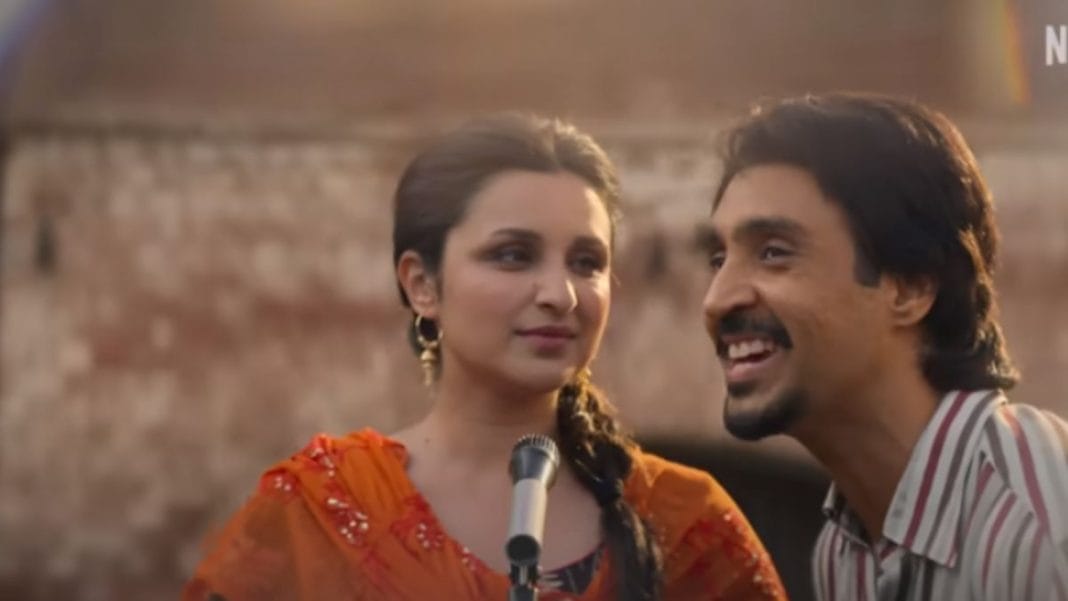



Amar Singh Chamkila was shot dead in 1988, and a film made by Imtiaz Ali forces us to revisit the horrors of his death.
Chamkila was a legendary singer among the masses in Punjab and later became an international sensation. His popularity and style earned him the epithet of ‘Elvis of Punjab’.
However, on 8 March 1988, he and his wife, Amarjot, were brutally murdered in broad daylight. The motive behind their murder was the ‘vulgarity and obscenity’ portrayed in his songs. The murderer remained at large.
Imtiaz Ali’s film ‘Amar Singh Chamkila’ makes us contemplate censorship as a tool. The question of who decides what people want to hear? Is it the courts, religious leaders, censor board, or the people themselves? Violent expression of public morality, in the form of murder, can be explained through Jungian psychology. Every society has a ‘shadow’ which consists of brutal social realities that the society refuses to acknowledge. When an artiste like Chamkila talks about his shadow elements through his songs, the society, as a result, experiences discomfort.
By murdering Chamkila, the society metaphorically kills the parts of itself that it finds shameful.
Chamkila’s murder also highlights the paternalistic nature of society, which views censorship as protection. The so-called ‘deciders of art’ do not censor art because they are offended; they censor art as they believe that the audiences are emotionally fragile and it would be difficult for them to consume such ‘filth’.
Another argument presented by Chamkila’s critics was that his songs were polluting the culture of Punjab, whereas the irony is that the culture of ‘boliyan’ is an integral part of Punjabi weddings. Boliyan are songs sung by the women of the bride’s side dedicated to the groom’s family. These songs often include playful, cheeky and sometimes even ribald humor. So the question is, which culture are these ‘deciders’ trying to protect?
In Chamkila’s case, the theory of system justification plays a major role. As a Dalit artiste, he sang about the raw and often uncomfortable realities of life, which made the sanitized upper-caste uneasy, and his rise caused a threat to social hierarchy. By labelling him ‘vulgar’, critics were defending a culture of elite art over street art.
Chamkila’s murder was not merely a crime; it unraveled something deeper in the Punjabi society. It proved that when society’s ‘mask’ is threatened by the mirror of art, the instinct to censor often turns into the instinct to destroy. In the end, Chamkila’s legacy is a reminder that art doesn’t create filth in society; it prohibits people from looking away.