




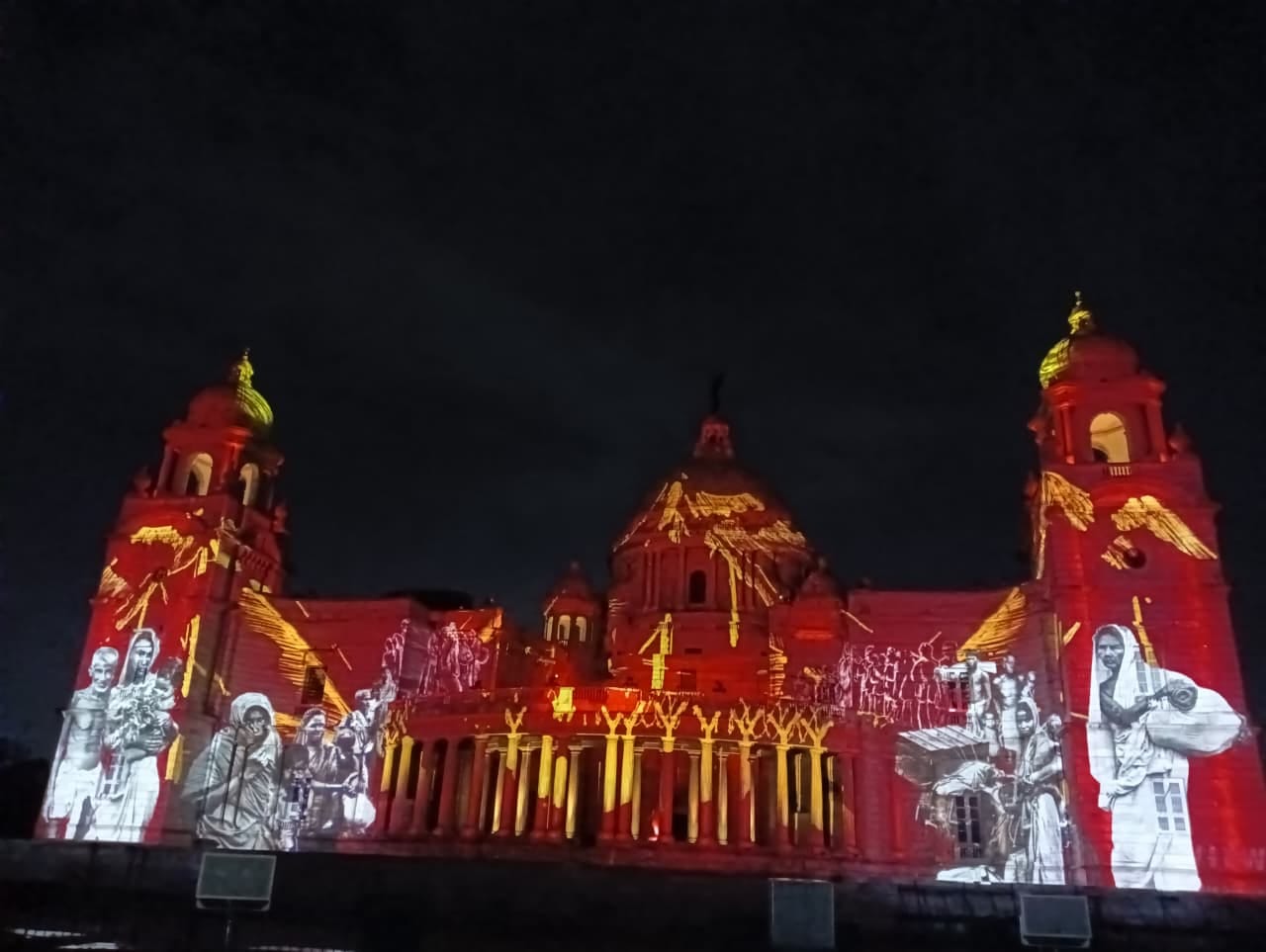
Debojyoti Mishra gives a new dimension to many of historical monuments like Victoria Memorial, Khajuraho temple, Agra Fort through his light and sound initiatives
Light and Sound at Ramappa Temple
Debojyoti Mishra has created his latest work for the Light and Sound show at Ramappa Temple.The presentation at Ramappa Temple in Telangana stood apart — a radiant dialogue between stone and silence. It didn’t just light up the monument; it awakened its soul.Here, the South didn’t speak — it sang.
Masters like Kumaresh Ramgopal and Ambi Subramaniam on violin, Rajhesh Vaidhya on veena, and S. Sekhar on mridangam and ghatam joined me in this remarkable collaboration.
Their percussions and strings blended veena, violin, ghatam, and mridangam into one luminous harmony.
For the first time, Debojyoti created an entire soundscape born of the South — an homage to its musical soul.

Khajuraho: A Symphonic Journey
Khajuraho was not merely a project; it was a monumental symphony that brought history to life. This journey was made possible under the creative direction of Himaanshu Sabrewal, the driving force behind Tri-Color, who envisioned and led groundbreaking light and sound projects across India. His unwavering passion and leadership inspired me to compose a score that captured the timeless sensuality and spirituality of Khajuraho.
The music featured a hundred-piece string orchestra accompanied by a grand live choir, creating a breathtaking auditory experience. Indian instruments such as the tabla, sitar, and shehnai seamlessly blended with the orchestra, while the rhythmic energy of Indian percussion added depth to the narrative. This composition was a profound exploration of art, devotion, and heritage, leaving an indelible mark on my creative journey.
Agra Fort: The Eternal Echo
Following Khajuraho, I embarked on the Agra Fort project, another masterwork under the creative direction of Himaanshu Sabrewal. The soundscape for Agra Fort needed to resonate with its grandeur and legacy, and I envisioned a blend of regional authenticity and universal appeal.
A diverse ensemble brought this vision to life. The bansuri, dholak, and sarangi intertwined with Western strings, creating a harmonious dialogue between Mughal heritage and classical elegance. Regional vocal harmonies further enriched the narrative, making it an immersive experience that celebrated the fort’s enduring legacy.
Victoria Memorial: The Turning Point
A significant turning point came with the Victoria Memorial project, spearheaded by Himaanshu Sabrewal and Tri-Color. Introduced to this project by Jayanta Sengupta, then-Director of Victoria Memorial, I had the opportunity to explore new dimensions in sound design. This project marked my formal entry into the world of light and sound, setting the stage for future milestones.
From Gandhi Bhavan to Chanderi Fort
Each project became a stepping stone in my journey. At Gandhi Bhavan, I captured Assam’s struggles, resilience, and aspirations, crafting a soundscape steeped in raw emotion.
At Chanderi Fort, the challenge was to evoke its historical grandeur. This project allowed me to experiment with a blend of traditional and contemporary musical elements, bringing its stories to life through a unique sonic experience. These projects deepened my understanding of how music can bridge the past and present.
Collaboration Across Borders
A recurring theme in my journey has been collaboration. Working with artists across India, from regional vocalists to instrumental virtuosos, enriched my compositions. These collaborations bridged traditional Indian music with modern symphonic structures, creating soundscapes that celebrated India’s cultural diversity and artistic heritage.
Debojyoti Mishra said, “My journey into the realm of light and sound began with the legendary Salil Chowdhury. As his music assistant on the Fort William project, I witnessed his mastery in storytelling through sound. This early exposure laid the foundation for my exploration of this unique art form.
Later, while working on projects like Khajuraho and Agra Fort, I was inspired by sound designer Pratik Biswas, whose innovative techniques and creative insights shaped my approach to soundscapes. Pratik’s work pushed me to experiment further, blending traditional elements with modern frameworks to create evocative compositions.” He added, “I owe my deepest gratitude to Himaanshu Sabrewal for his creative direction and belief in my work. I am also thankful to Jayanta Sengupta for introducing me to the Victoria Memorial project and to sound designer Pratik Biswas for inspiring me with his innovative approach.
Finally, I am immensely grateful to my wife, Jonaki Mukherjee, whose historical insights illuminated many of my compositions, ensuring they remained rooted in authenticity.A dear friend once said, “When planes fly over Kolkata, let your sound resonate through the skies as the lights below dazzle.” This vision inspires me to create experiences that transcend boundaries and leave a legacy of light and sound storytelling for generations.”s
ThePrint BrandIt content is a paid-for, sponsored article. Journalists of ThePrint are not involved in reporting or writing it.