








VMPL
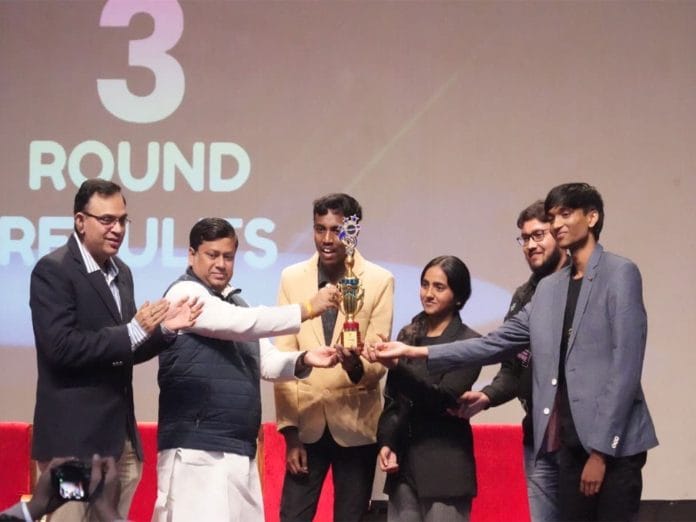
New Delhi [India], January 8: IBDP and Cambridge students develop assistive navigation device through a two-year school design process Students from Keystone High School, Hyderabad, an IB and Cambridge school, secured second place at the 7th edition of the Young Innovators Program, organised by the Indian Institute of Technology Kharagpur. The award was presented at the programme’s prize distribution ceremony, attended by Sukanta Majumdar, Union Minister of State for Education.
The project was undertaken by Keystone High School students from Grades 9-12 as part of the school’s IB and Cambridge academic programmes. Alongside subject coursework and assessment requirements, students participate in long-term design projects guided by the school’s internal learning framework, Idea Loom. The framework structures student work through stages of observation, problem framing, constraint mapping, prototyping, testing, and review, with clear academic checkpoints and documentation expectations.
Over a two-year period, the student team worked on SonoStep Smart Cane, a prototype intended to improve everyday navigation for visually impaired users. As part of their research, the students worked with learners from Devnar School for the Blind, observing mobility challenges and gathering feedback on commonly used assistive tools.
This engagement highlighted a recurring limitation of conventional white canes–the inability to provide advance warning of upcoming steps, puddles, and head-level obstacles. Based on these observations, the students defined “preview” as the central design constraint. The resulting prototype uses a camera module to detect obstacles ahead and communicates alerts through audio or vibration, focusing on anticipation rather than reaction. Project references cite national data indicating that nearly five million people in India are blind, many of whom face injuries and disorientation due to uneven and unpredictable urban infrastructure
Throughout the two-year period, students balanced this work with IB and Cambridge academic requirements, including subject assessments, written work, and examinations. Project milestones were reviewed alongside academic progress, with teachers functioning as academic reviewers who questioned assumptions, assessed feasibility, and required evidence-based revisions. Building for competitions alone was discouraged, with emphasis placed on clarity of thinking, documentation, and alignment with user needs.
“We want students to see that meaningful innovation takes time, persistence, and accountability,” said Srilakshmi Reddy, Founder of Keystone School. “This was not about shortcuts or showpieces it was about building something that actually works for someone, and doing so while honouring the academic depth of IB and Cambridge programmes.”
The recognition places a school-level project among student innovations from across the country and shows how high school students can engage with public challenges such as accessibility while remaining grounded in rigorous academic programmes. For parents and education leaders, it offers a view into how structured design work can coexist with IB and Cambridge curricula when time, review discipline, and clear expectations are built into the school day.
(ADVERTORIAL DISCLAIMER: The above press release has been provided by VMPL. ANI will not be responsible in any way for the content of the same.)
This story is auto-generated from a syndicated feed. ThePrint holds no responsibility for its content.