





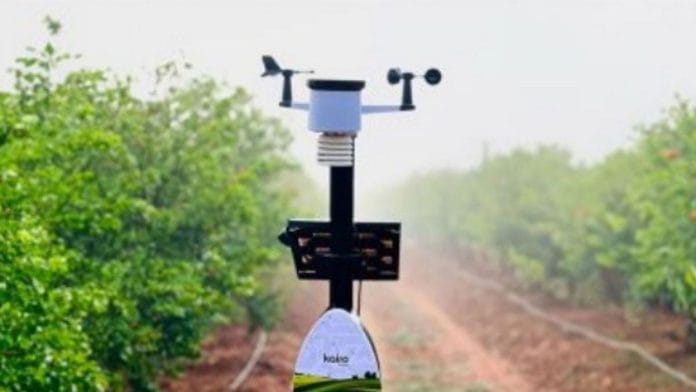



New Delhi: Finance Minister Nirmala Sitharaman, in her Budget speech Sunday, stressed the government’s plan to push AI-driven farming solutions. While the use of technology in agriculture has benefited farmers over the past few years, and the latest initiative is likely to nudge farming toward a “precision-based economy”, kisan union leaders argue that a digital push cannot be a substitute for a fair price.
Sitharaman announced Bharat-VISTAAR, short for Virtually Integrated System to Access Agricultural Resources.
“I propose to launch Bharat-VISTAAR—a multilingual AI tool that shall integrate the AgriStack portals and the ICAR package on agricultural practices with AI systems. This will enhance farm productivity, enable better decisions for farmers and reduce risk by providing customised advisory support,” she said.
The government has allocated around Rs 150 crore for the platform as part of the Major Sectoral Central Scheme. The overall budget for agriculture and allied activities stands at Rs 1,62,671 crore (BE) for FY 2026-27, up from Rs 1,58,838 crore (BE) in FY 2025-26.
With over 70 per cent of India’s rural population being dependent on agriculture for their livelihood, pressure has grown to find new ways to improve farming outcomes. In recent years, a number of agritech startups have entered the sector, especially those using digital tools for precision farming, quality management, supply-chain and market linkages, and traceability.
“The fundamental shift we are seeing in India is how we define a farm input,” said Sudhanshu Rai, co-founder of Fyllo, a startup providing professional agricultural services to corporate farming, exporters, and agri-input companies. “Agriculture has been built on four physical pillars: water, seed, pesticides, and fertilisers. However, we have reached a point where decision-making and digital knowledge must be recognised as the fifth and sixth input.”
Farmer unions, meanwhile, were less buoyed by the Budget. Brijesh Bhati, farmer leader and national spokesperson at the Kisan Mazdoor Sangharsh Morcha, said ground issues have been left largely unaddressed.
“In the Union Budget, what is there for us farmers? There is nothing. This budget is for businessmen, startups, and companies, not farmers,” he said. “The PM made big promises from Lal Qila, but today, a farmer cannot even get insurance if a snake bites them in the field. The government did not increase Kisan Samman Nidhi, or provide pension for farmers over 60. Debt waivers are still unfulfilled. How will AI solve our problems?”
For Abhimanyu Kohar, farmer leader with the Samyukt Kisan Morcha, the real issues were MSP and the MS Swaminathan report.
“They have been completely ignored,” Kohar said. “Year after year, the government allocates a budget, but never actually spends it on farmers. While the government is talking about tech and solving problems with technology, an average Indian farmer is drowning in debt.”
Also Read: These are the Bengaluru startups bringing AI and farmers together
AI for precise farming decisions
The government’s AI thrust for farmers could move agriculture away from a one-size-fits-all model toward a more precision-based economy, according to Rai.
His startup, Fyllo, has signed contracts and deals with governments, incubators, and farmers, and works in 16 states, including Karnataka, Tamil Nadu, and Maharashtra.
By integrating several agri-based companies with real-time AI advisories, the government is turning data into a tangible farm input. This, Rai said, can help smallholder farmers reduce resource waste, mitigate climate risks through hyper-local weather alerts, and boost crop productivity by making scientific, plot-specific decisions that were previously only available to large-scale industrial farmers.
When Fyllo began in 2019, Rai said its Kisan Centre received at least 80 lakh queries from farmers in the first year alone. About 90 per cent of these were basic, urgent questions, ranging from how much water to use to which fertiliser to apply.
“This helped with our research because even if farmers have the best resources, if the decision timing is wrong, the outcome could possibly become a failure. Now, with AI, a lot more complex data-driven problems can be solved into simple solutions,” he said.
Sujay Suvarna, co-founder at BeePrecise, a startup that harnesses IoT and AI for precision beekeeping, said the government’s initiative has come at the right time since farmers are now more receptive to tech solutions.
“Earlier, our barrier was to make farmers aware of AI technology, and the fact that they had to pay for solutions. Unless there was a big brand, they wouldn’t be interested or invested,” he said. “But now, a lot has changed. More distributors have come up. Farmers are open to adopting technology. Now, the goal should be to make it more accessible for farmers from marginalised backgrounds, and work out how last-mile connectivity will function. It won’t happen overnight, but we’re all building for a change.”
Farming-focused AI tools are now being used to predict weather, detect pest attacks, and suggest optimal times for irrigation and sowing. The Ministry of Agriculture and Farmers Welfare is also using AI through initiatives such as Kisan e-Mitra, a virtual assistant that helps farmers access government schemes like PM Kisan Samman Nidhi. The National Pest Surveillance System and Crop Health Monitoring combine satellite data, weather inputs, and soil analysis to provide real-time advice for improving yields and income security.
Also Read: Making ‘champion’ MSMEs, reviving 200 legacy clusters—Budget leans on manufacturing to drive growth
Need for a bottom–down approach
With mobile phones and the internet penetrating deep into rural areas, AI is beginning to make an impact on farming, said Dr Samraj Sahay, an independent researcher who has worked in the agriculture, climate, and adaptation space for over a decade.
“The challenge is to make farmers trust technology. Now, there is growing awareness that AI can help farmers, be it for weather forecasting or irrigation. Farmers in India now have a strong hold on AI through the help of AI startups,” Sahay added.
However, he noted that the government must take a bottom-up approach rather than a top-down one.
“The government should make AI have a context-driven approach. Which land is specific for which crop, which crop will grow in what kind of soil, or even the texture of the soil. The government needs to look into every possible necessity that farmers have, and use AI to tackle those problems,” Sahay said.
(Edited by Asavari Singh)