





Thank you dear subscribers, we are overwhelmed with your response.
Your Turn is a unique section from ThePrint featuring points of view from its subscribers. If you are a subscriber, have a point of view, please send it to us. If not, do subscribe here: https://theprint.in/subscribe/
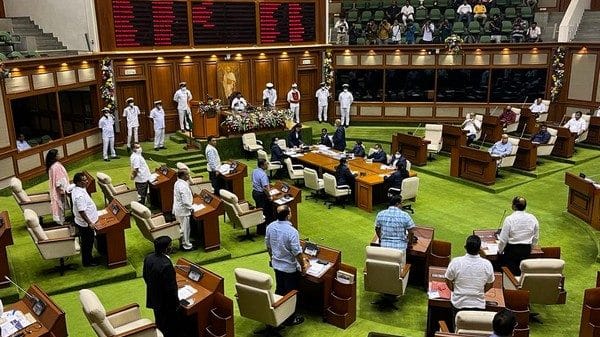
The real politics of Vande Mataram did not unfold on the streets of Goa, nor in the predictable theatrics of fringe outfits. It revealed itself—raw and unsettling—on the floor of the Goa Legislative Assembly, where raised voices replaced deliberation and symbolism was summoned to conceal the absence of governance.
What erupted in the House was not love for the nation.
It was anger weaponised as patriotism.
Legislative assemblies exist to negotiate the material conditions of life—livelihoods, land, ecological survival, dignity, justice. Instead, the Assembly became a ritual arena where Vande Mataram was hurled like a test of loyalty, not offered as a shared sentiment. The demand was not reverence; it was obedience. And that distinction reveals the entire architecture of power at work.
The RSS does not mean Vande Mataram.
The BJP does not believe in Vande Mataram.
They deploy it – especially when cornered.
This is not accidental. Sociologically, this is classic symbolic substitution: when institutions fail to deliver outcomes, they intensify rituals. When governance collapses, the state sacralises itself. When power loses moral authority, it seeks emotional submission.
The Goa debate laid this bare. When questions became uncomfortable—about environmental devastation, land alienation, unemployment, crony tourism, or the slow erosion of Goa’s syncretic social fabric—symbols were invoked. Slogans were demanded. Dissent was reframed as treachery. The CM did not handle the situation with even a scent of statesmanship. It was an obnoxious display of arrogance and a shouting match. No decorum.
He also alleged the AAP leader whether he knew the history of Goa. On the street, the question was where was Sawant in those days. Until today, the public has not witnessed an intellectual discourse that he has initiated. His comments on contemporary politics, and Portuguese history show one and only one thing- his hate for Christians. The vague and unproven allegations that there are ‘conversions’ taking place in remote corners of Goa. He has now announced his intention to introduce an anti-conversion law. For what? What does his sense and understanding of history prove. Sheer prejudice and a severe shortage of historical understanding- past and contemporary. To rule a State, a CM must have a social vision, and an understanding of social formations.
This is not nationalism. It is civil religion, stripped of ethics.
Vande Mataram was never born for this role. Bankim Chandra Chattopadhyay’s words emerged from the 19th-century anti-colonial imagination as a poetic invocation, not a disciplinary instrument. The “Mother” was not a juridical authority demanding compliance, but a metaphor carrying grief, longing, and resistance. It was literature before it became liturgy.
Crucially, the freedom movement understood its limits.
That is why Vande Mataram coexisted with Jana Gana Mana.
That is why Gandhi refused to impose emotional uniformity.
That is why Nehru resisted state-sponsored sentiment.
That is why Ambedkar insisted that the nation be anchored in law, not devotion.
They grasped a truth the present dispensation suppresses: the moment patriotism is coerced, it ceases to be moral and becomes authoritarian. Forced reverence is not unity; it is domination.
What unfolded in the Goa Assembly was therefore not a cultural dispute, but a theological one.
Political theology asks a simple question: What does the state demand worship of when it fails to serve?
In this case, the nation was transformed into a sacred object, and dissenters into heretics. The chant became a loyalty oath. Silence became sin.
But the irony is devastating.
If Vande Mataram were taken seriously—ethically rather than theatrically—it would indict those shouting it the loudest. To invoke the “Mother” while sanctioning ecological plunder, dispossessing fishing and farming communities, eroding labour protections, hollowing out local self-governance, and shrinking democratic space is not devotion.
It is sacrilege.
One cannot worship the land while poisoning its rivers.
One cannot venerate the mother while displacing her children.
One cannot sing of freedom while criminalising dissent.
The nationalism on display in the Goa Assembly was territorial rather than ethical. It venerates soil but neglects people. It absolutizes symbols while trivialising suffering. That is why the slogan is shouted most aggressively precisely where accountability is absent.
Sociologically, this is the logic of authoritarian performance: power demands visible acts of loyalty because it no longer commands trust. The louder the chant, the deeper the insecurity beneath it.
Those who refused to participate in this choreography were not rejecting India. They were rejecting coercion. Legislators who resisted being dragged into symbolic obedience were not anti-national; they were doing something far more radical—they were defending constitutional democracy.
The Constitution does not ask citizens or representatives to chant.
It asks the state to govern justly.
This is why nuance unsettles power.
Why silence alarms it.
Why questions provoke rage.
The Goa Assembly confrontation was never really about Vande Mataram. It was about a regime’s fear—fear of citizens, fear of representatives, fear of those who refuse to perform loyalty on command.
One does not prove love for the nation by shouting in a legislature.
One proves it through care, restraint, justice, equality, and humility.
Until that truth is reclaimed, Vande Mataram will remain what the Goa Assembly tragically revealed it has become in contemporary politics: a slogan of dominance, not a song of belonging.
And history, as always, is unforgiving to those who confuse the sacred with the coercive – and power with love.
These pieces are being published as they have been received – they have not been edited/fact-checked by ThePrint.