





Thank you dear subscribers, we are overwhelmed with your response.
Your Turn is a unique section from ThePrint featuring points of view from its subscribers. If you are a subscriber, have a point of view, please send it to us. If not, do subscribe here: https://theprint.in/subscribe/
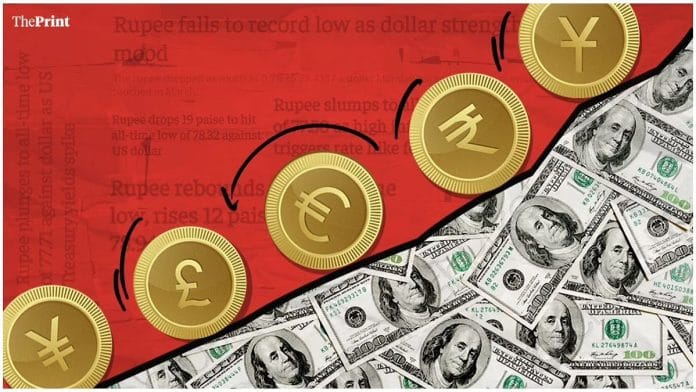
As China pushes the yuan outward and the dollar grows less reliable as a neutral global anchor, Japan and India, Asia’s two major democratic economies, must confront the same uncomfortable reality: currency management is no longer just macroeconomics. It is strategy. And each country has lessons the other can no longer afford to ignore.
A World Where Neither the Dollar nor the Yuan Can Be Taken for Granted
The global financial order that defined the post-Cold War decades is eroding. The US dollar, long considered a neutral reserve currency, is increasingly shaped by sanctions, trade coercion, and domestic political swings. Its failures in Iran and Russia, where sanctions have neither collapsed regimes nor stabilized geopolitical outcomes, have shaken confidence in its permanence.
At the same time, China is pushing the yuan into global circulation with the confidence of a rising power. Through expanded swap lines, the CIPS payment network, and trade settlement diplomacy across ASEAN, Africa, and the Gulf, Beijing is positioning its currency not merely as an economic mechanism but as a geopolitical instrument.
For both India and Japan, this creates a narrowed strategic space. They must now craft monetary policies that protect economic stability, manage domestic pressures, and safeguard geopolitical autonomy in a world where neither dollar dependence nor yuan alignment is risk-free.
Japan’s Stability Playbook: A Lesson in How to Treat Currency as Strategy
Japan has long treated the yen as a stabilising instrument rather than a symbol of national prestige. While political rhetoric in many countries frames currency depreciation as weakness, Tokyo’s approach has always been more sophisticated: stability creates predictability, and predictability builds industrial strength.
In recent years, during the yen’s sharp depreciation, Japan resisted the temptation to mount dramatic interventions. Instead, the Bank of Japan communicated its strategy clearly, maintained credibility, and allowed market expectations, not emotional signalling, to guide the trajectory. This steadied exporters, supported tourism, and kept bond markets anchored.
For India, where political pressure often demands defending the rupee, the Japanese example reveals an important truth. Currency weakness is not national weakness. A controlled, well-telegraphed depreciation can support competitiveness, attract investment, and prevent reserves from being drained in symbolic battles. What markets reward most is not heroics but coherence.
India’s Flexibility Model: A Lesson in How to Build Shock Absorption
If Japan offers India a lesson in stability, India offers Japan a lesson in flexibility. The rupee’s ability to adjust to external shocks has become a strategic asset. During oil price spikes, US rate hikes, or supply-chain crises, India’s currency absorbs pressure rather than transferring the burden entirely to fiscal or monetary policy.
This adaptability has been complemented by India’s exploration of bilateral settlement systems, from Russia to the Gulf and South Asia, which cushions the economy from dollar swings and sanctions volatility. India has not challenged the dollar order, but it has prepared for the day when that order is no longer reliable.
For Japan, heavily exposed to the US financial system, the Indian model offers a path toward resilience. Future yen strategy cannot rely solely on hopes of a US policy return to predictability. Tokyo will need diversified settlement frameworks, greater yuan-risk insulation, and the willingness to allow greater exchange-rate flexibility when geopolitical turbulence demands it.
China’s Currency Ambition: The Shared Strategic Challenge
The rise of the yuan is not a neutral phenomenon for Tokyo or New Delhi. Beijing’s aim is clear: to anchor a regional monetary ecosystem aligned with Chinese power. A yuan-centric block would erode Japan’s and India’s ability to set independent policy, influence global financial governance, and maintain strategic distance.
This ambition is advancing not because the yuan is inherently stronger but because the dollar appears increasingly politicised. The failures of sanctions in Iran and Russia have accelerated the search for alternatives. China is offering one, and using its economic weight to ensure adoption.
For India and Japan, the challenge is identical: how to resist both dollar weaponisation and yuan centralisation without retreating into economic isolationism.
What Both Countries Can Learn From Each Other
Japan’s clarity of communication, disciplined expectations management, and deep capital markets offer India a template for how credibility anchors currency strength. India’s structural adaptability, diversified settlement pathways, and willingness to let the rupee absorb volatility offer Japan a template for how to future-proof monetary sovereignty. Both countries face the same strategic test: how to remain economically open while remaining geopolitically autonomous. Each is strong where the other is vulnerable. Each has built precisely the capabilities the other now requires.
A Joint Playbook for a Fragmented Financial Future
Asia’s next century will be shaped not only by military balances or technological competition but by how its major democracies manage their currencies. The world is moving toward multiple financial spheres, and navigating them will require a blend of stability and flexibility, Japan’s discipline and India’s resilience.
Tokyo and New Delhi do not need identical monetary policies. But they do need complementary ones. The lessons each has learned over decades, Japan’s long game of stability, India’s hard-earned shock absorption, together represent a playbook for navigating an uncertain, multipolar financial landscape.
In a world where currency management is becoming strategy, not just economics, Japan and India must learn not only to adapt, but to learn from each other.
These pieces are being published as they have been received – they have not been edited/fact-checked by ThePrint.
Keen, Unfiltered, Natural, Informative, Meaningful- definitely human-written