





Thank you dear subscribers, we are overwhelmed with your response.
Your Turn is a unique section from ThePrint featuring points of view from its subscribers. If you are a subscriber, have a point of view, please send it to us. If not, do subscribe here: https://theprint.in/subscribe/
Sambhar Lake, once a thriving ecological and economic resource, is now showing visible signs of neglect, as observed during a recent visit.
Sambar lake originated billions of years ago when a natural depression in the Aravalli got filled with rainwater and 5 streams feeding into it. Over time, rock weathering in an arid climate and evaporation resulted in accumulation of salt in it. Pilu, date palm, some prosopis species, specialized algae, bacteria, brine shrimp, zoo plankton inhabited it. Birds like famingoes,pelicans , strokes, and other water fowls made it their second home.
Around 2000 years ago human settlement took place around Sambar Lake and then started salt extraction.
Until mid-20th century, Sambhar Lake was managed under traditional salt-extraction practices with relatively lower ecological stress, but formal legal boundary demarcation was absent and the wetland’s health, though better than today, was shaped by seasonal and human influences rather than strict protection.
By 2019, the lake’s boundaries had shrunk, illegal salt extraction had surpassed government operations, inflow from the five rivers had reduced, human greed had overtaken ethics, and the mass death of around 18,000 flamingoes and other water birds occurred.
The swabs from dead birds revealed Avian Botulism- a severe, often fatal, neuromuscular disease that affects both the birds and the physical and chemical environment of the ecosystem.
Soil bacterium Clostridium botulinum thrives in warm, low-oxygen conditions prevalent in stagnant water with decaying organic matter and it produces neuro toxin that causes paralysed neck, wings and legs leading to painful death.Their carcasses then fuel more toxin production creating an out break cycle.
The government was put in the dock by conservationists, ornithologists, and non-governmental organizations. In response, it announced major conservation initiatives alongside new development plans.
It declared that Sambar Lake’s ecological balance would be restored, the boundary demarcated by erecting pillars around the lake area and buffer zone, salt mining controlled, and tourists informed about dos and don’ts of visiting sambar lake under central schemes like Swadesh Darshan, National Lake Conservation Plan and State Wetland Authority.
During my recent visit in December 2025, I could not see any clearly demarcated boundaries or ongoing revival projects; instead, I observed several loaders operating on the salt pans.
Sambar lake is the largest inland saline wetland of india. It is about 35.5 kilometers long, spanning across Nagaur , Jaipur and Ajmer districts of Rajsthan. Its width varies from 11 kilometers to 3 meters.
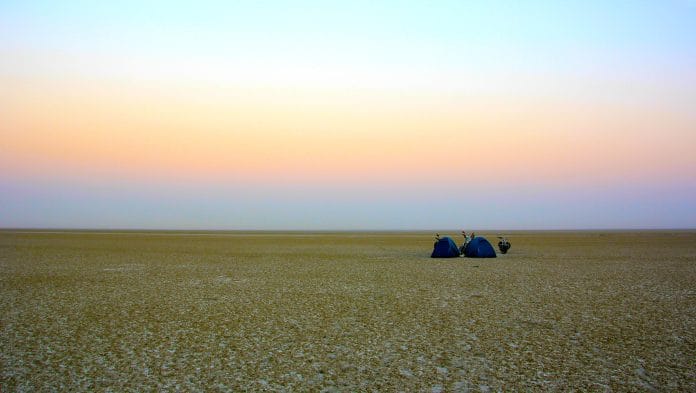
Its significant features have been its surreal landscape, sand stones dam, vast salt pans of greenish blue, orange pink and reddish purple depending upon low, medium or high salinity of water in them.
Bird watching point to observe flamingos, pelicans,water fowls from close quarters.To experience the lake fully, tourists can take a ride on the narrow-gauge railway that circles it.
Ramsar sites are the wetlands of international importance. Ramsar is a city in iran where in 1971 an international treaty to safeguard wetlans was signed by 18 nations. These were belgium, costarica,federal republic of Germany, finland ,gabon , greece, hungry, iceland, iran,ireland , italy, japan , jordan,moritania , morocco, norway, pakistan , portugal, senegal, south africa ,sweden , switerland , uinion of soviet socialist republic,united kingdom of great britain and ireland. In 1982 india signed this treaty, in 1986 usa signed it. At present 173 nations have signed it.
It is a pity that we have failed a natural marvel like Sambhar Lake; urgent, well-planned conservation measures are now imperative.
- Restore natural water inflows and reduce surface runoff. Unobstruct the rivers and streams that feed the lake. Slow water flow through structures such as check dams and silt traps to prevent soil erosion and the transport of pollutants into the lake. Reduce upstream diversion and illegal water extraction to raise water levels and restore ecological balance.
- Manage groundwater by stopping excessive borewell pumping and preventing illegal pipelines that withdraw water from the lake and its catchment. Instead, construct gabions, check dams, silt traps, and johads to minimize environmental impact and costs.
- Enhance bird habitat protection by controling feral threats (like feral dogs predating birds) and limiting disturbance near key bird zones.
- Regular monitoring of water to eliminate future risk of avian butaism or other unseen diseases.
- Restore degraded marshes and salt-tolerant vegetation to filter pollutants naturally and provide feeding/nesting grounds.
- Eliminate untreated discharge in sambar lake and set up decentralized waste collection and recycling systems to prevent dumping into the lake.
- Follow sustainable salt extraction limits.
- Use technology (GIS) to enforce rules against illegal construction and pollution, protecting the wetland’s integrity.
- “Make the train ride affordable and transform it into a moving orientation center that not only familiarizes tourists with Sambar Lake but also inspires them to fall in love with wetlands and appreciate the efforts of wetland and nature conservationists.
- Train and employ local residents in habitat restoration, sustainable salt harvesting, ecotourism, waste management, and environmental monitoring. Empowering communities to build and manage water bodies fosters a sense of ownership and ensures long-term sustainability.
Sambar lake will not wait , neither should we.
These pieces are being published as they have been received – they have not been edited/fact-checked by ThePrint.