




Thank you dear subscribers, we are overwhelmed with your response.
Your Turn is a unique section from ThePrint featuring points of view from its subscribers. If you are a subscriber, have a point of view, please send it to us. If not, do subscribe here: https://theprint.in/subscribe/
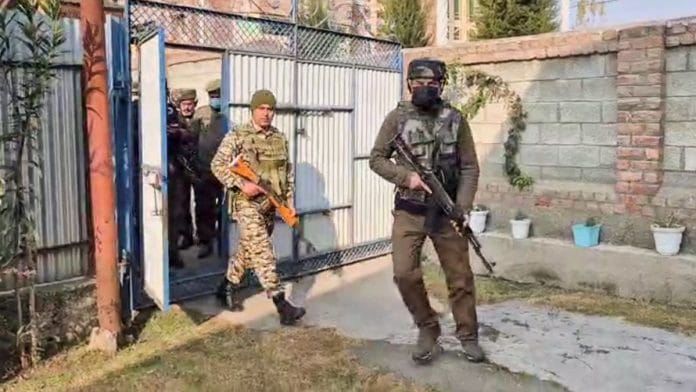
White-collar hybrid warfare has emerged as the most dangerous evolution of militancy in Kashmir after 2019. The threat is no longer the gun-wielding militant hiding in forests; it is the educated professional in a clean shirt, the respected academic shaping opinions, the businessman with foreign linkages, the lawyer exploiting systemic gaps, or the student abroad with access to networks. Militancy today hides behind respectability, influence and information rather than weapons. This shift marks the most refined phase of insurgency—silent, encrypted, deniable and deeply embedded within society.
This transformation did not occur organically. It reflects a deliberate recalibration by Pakistan’s intelligence establishment after the collapse of conventional militancy and street agitation models following the abrogation of Article 370. With recruitment pipelines weakened and public spaces no longer available for mass mobilisation, handlers shifted to a desk-driven, elite-enabled model. Instead of relying on visible separatist blocs or street mobilisers, the focus has moved to professionals who can operate with legitimacy and minimal suspicion. Their education, access and credibility become their operational camouflage.
The new militant does not resemble the older archetype. He may be a doctor quietly running ideological networks, an engineer handling encrypted communication channels, a university academic shaping narratives in subtle but sustained ways, a bureaucratic insider funnelling information, a businessman routing funds, or a student abroad being groomed for logistical roles. Their danger lies not in overt militancy but in their invisibility. They enable the ecosystem by moving money, manipulating emotions, shaping narratives, coordinating logistics and sustaining long-term ideological influence—all without ever appearing on conventional security grids.
White-collar terrorism operates through two core engines: financial networks and radicalisation chains. The financial ecosystem exploits hawala, crypto platforms, business fronts, shell companies, NGOs, real estate, and overseas contribution channels. Transactions are layered to appear legitimate, allowing them to evade routine scrutiny. Radicalisation, meanwhile, has shifted into psychological and academic spaces. Youth in universities, colleges, madrassas and informal ideological groups are targeted through curated propaganda, grievance exploitation and emotional manipulation—long before any physical action is considered.
This architecture is not limited to the Valley. In recent years, Kashmiri students and professionals in countries such as Turkey and Bangladesh have reportedly been approached for ideological grooming under the guise of academic or cultural engagement. This mirrors earlier patterns in which students travelling to Pakistan were gradually absorbed into underground networks. The diaspora’s role is equally significant. Long-standing propaganda outfits in the West continue amplifying selective narratives that align closely with external objectives, reinforcing a curated sense of grievance.
Several cases in India illustrate how deeply this model has penetrated professional spaces. The Al-Falah University module, where a doctor-led network was exposed, revealed how academic institutions can serve as nodes for ideological dissemination. The case involving a Srinagar Municipal Corporation official linked to the Kashmirfight intimidation group showed how administrative insiders can be leveraged. Arrests of advocates, political workers and bureaucratic functionaries for terror-linked roles underline that the new militancy thrives precisely where legitimacy historically offered protection.
Post-370, the battlefield has shifted dramatically. The conflict now unfolds in encrypted chats, digital spaces, academic circles and business channels rather than forests and public squares. The loudest radicalisation no longer emerges from protest sites but from online networks, campus conversations and curated ideological groups that shape perception with quiet persistence. This academic and digital shift allows handlers to maintain influence while remaining distant and deniable.
White-collar terrorism represents the most insidious phase of Kashmir’s militancy. It corrodes institutions silently, turning professionals into operatives, campuses into recruitment hubs, businesses into financial conduits and offices into covert access points. Its practitioners wear suits instead of uniforms, speak the language of progress instead of rebellion, and move through society without triggering traditional counter-insurgency alarms. Their strength lies in their respectability—and their threat in their ability to bypass every conventional security filter.
About the Author:
Murtaza Ali, Counter Terrorism & Counter Intelligence Analyst. He writes on grassroots governance, defence strategy, and counter-insurgency developments in Jammu and Kashmir.
Twitter Handle id : @Themurtazabhat
These pieces are being published as they have been received – they have not been edited/fact-checked by ThePrint.