




Thank you dear subscribers, we are overwhelmed with your response.
Your Turn is a unique section from ThePrint featuring points of view from its subscribers. If you are a subscriber, have a point of view, please send it to us. If not, do subscribe here: https://theprint.in/subscribe/
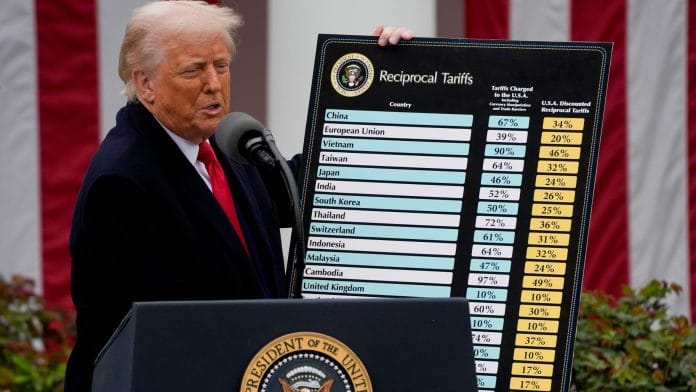
A 500% tariff threat is not trade policy.
It is a signal of impatience dressed up as power.
The recent rhetoric from Washington—centred on claims that Donald Trump applied overwhelming pressure and that Narendra Modi refused to yield—has been framed as a test of resolve. In reality, it was something far less heroic and far more revealing.
This was not a tariff dispute.
It was a secondary-sanctions warning, crudely inflated to look intimidating.
The issue was never Indian exports.
The issue was India’s continued purchase of discounted crude from Russia.
Unable to decisively cripple Moscow through direct sanctions, the United States has increasingly leaned on a blunt workaround: penalise those who refuse to enforce isolation on its behalf. When persuasion fails, numbers get exaggerated. When leverage thins, threats get louder.
A 500% tariff is not meant to be implemented.
It is meant to frighten.
And fright only works on those who still believe the party making the threat can afford to carry it out.
That assumption no longer holds.
A tariff of that magnitude would not punish India in isolation. It would rebound straight into the American economy. Tariffs are taxes—paid by domestic consumers. Indian pharmaceuticals, specialty chemicals, auto components, engineering goods, and industrial inputs are embedded in U.S. supply chains. Multiply their cost fivefold and inflation does not hesitate; it accelerates.
Supply chains fracture. Costs spike. Voters notice.
Which is why threats of this scale are typically floated as rhetoric and quietly diluted, delayed, or abandoned once arithmetic intrudes. Markets have a way of humiliating bravado.
India understood this from the outset. That is why there was no dramatic response, no counter-threat, no emotional escalation.
India did not need to “stand tall.”
It merely needed to stand still.
India today is not a peripheral exporter dependent on Western indulgence. It is a market of 1.4 billion people, a manufacturing alternative the West urgently needs, and a strategic hinge in the Indo-Pacific. Washington may posture, but it cannot afford a rupture. The U.S.–India relationship is not charity; it is mutual necessity.
So New Delhi did what mature states do when confronted with inflated threats.
It said little.
It escalated nothing.
It quietly recalibrated energy options.
And it waited.
No speeches. No symbolic defiance. No chest-beating.
Just patience.
That restraint is often misread as passivity. It is not. It is leverage exercised without noise. When one side negotiates in decibels, the other side’s silence becomes the pressure point.
And here lies the deeper misunderstanding—one that Washington, and many Western capitals, repeatedly stumble over.
India is not merely a nation-state.
It is a civilization.
A civilization that has existed for over ten thousand years. One that has seen empires arrive convinced of permanence, issue ultimatums with confidence, extract resources with efficiency, preach morality with zeal—and then disappear into footnotes.
India has been bullied, patronised, sanctioned, partitioned, lectured, “disciplined,” and periodically told to behave by powers certain of their historical mission. None lasted. India did.
Cheap, bulky tactics are not new to India.
They are ancient.
Pressure, coercion, and public threats have been tried for millennia. They fail because India does not respond to noise. It responds to incentives, time, and balance.
This is not ideology. It is civilizational memory—a muscle developed over centuries. An instinct embedded so deeply that bluster barely registers. India absorbs shocks the way old civilizations do: by waiting them out.
That is why intimidation bounces.
That is why tantrums fall flat.
And that is why this episode was never going to end the way its authors imagined.
This is not anti-Americanism. It is post-dependency realism.
The West still commands narrative influence.
It no longer commands automatic obedience.
The world has shifted. Large states now operate on a colder logic: align where interests converge, resist where sovereignty is threatened, hedge relentlessly, and never mortgage energy security to someone else’s geopolitical morality play.
That reality is deeply uncomfortable for Washington, which still equates credibility with volume. In truth, credibility today depends on follow-through—on whether threats can survive contact with markets, voters, and arithmetic.
This one could not.
Donald Trump’s negotiating style assumes someone always blinks.
India’s response came from a far older instinct: civilizations do not blink on command.
There was no victory declared. No defeat conceded.
But something far more significant occurred.
A boundary was quietly asserted.
Tariffs alone no longer frighten major powers.
Noise alone no longer substitutes for leverage.
And intimidation alone no longer moves a civilization that has already seen it all.
India Didnt Budge
Not out of pride.
Out of memory embedded in the Indian gene.
And that—far more than any tariff threat—is what unsettled Washington.
Mohan Murti
Advocate & International Industry Arbitrator
Former Managing Director- Europe
Reliance Industries Ltd, Germany
These pieces are being published as they have been received – they have not been edited/fact-checked by ThePrint.