




Thank you dear subscribers, we are overwhelmed with your response.
Your Turn is a unique section from ThePrint featuring points of view from its subscribers. If you are a subscriber, have a point of view, please send it to us. If not, do subscribe here: https://theprint.in/subscribe/
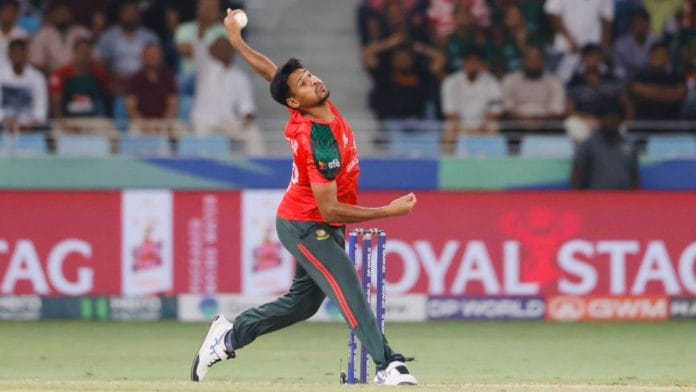
The recent dropping of Mustafizur Rahman of Bangladesh (BD) from KKR for the upcoming IPL has created a furore of sorts. For two days,TV channels, with experts of all hues and colours, weighed in on the subject, besides the social media buzz it generated. In retaliation (though BD did not say as much), the BD Cricket Board has refused to play in India, citing ‘security concerns’ and asked the ICC for a change of venue to Sri Lanka for their T 20 WC games scheduled in Mumbai and Kolkata .The jury is still out on this. However, given the short notice and logistics problems that change of venue would involve,eg, travel, accommodation, tickets, TV coverage etc,it seems implausible as of now. They have also instructed their I&B ministry to stop IPL telecast in BD.
An argument which most purists put forth – and it is not misplaced – is that politics and sports should not be mixed. Indeed they should not be…but history, our own and the world’s, seems to suggest otherwise. I argue here that this contention, even as it is ‘politically’ correct, is specious and tenuous. The two always have been interwoven and sadly, will possibly always be. I reinforce this with a few examples from world sports.
Way back in 1936, in the Berlin Olympics Nazi Germany used ‘Aryan Supremacy’ as propaganda to promote and legitimize Hitler’s regime. The legendary Jesse Owens’ four gold medals undermined this superficial racial ideology. Later, in the 1968 Mexico City Olympics, some US athletes raised black-gloved fists during the medal ceremony to protest against racial injustice and were expelled from the Olympic Village. The 1972 Munich Olympics, where 11 Israeli athletes were killed by the Palestinian group, Black September, put the spotlight on the age-old Israel-Palestine conflict and changed Olympics security cover forever.
Still later, in the 1980 Moscow Olympics, US led a boycott
in response to the Soviet invasion of Afghanistan. As a result, almost 60 countries turned their backs; athletes lost their chance to compete. The Soviet Union and its allies retaliated and boycotted the 1984 Los Angeles Olympics. This brought into sharp relief how Cold War politics dominated global sports. As recently as 2022, in the Beijing Winter Olympics, many nations declared a boycott over China’s Human Rights record. South Africa’s isolation from international sports from the 60s to 90s due to apartheid forced their government towards reforms, which held them in good stead over time. Later Mandela used the 1995 Rugby World Cup (after apartheid), as a statement to bolster racial reconciliation.
Football presents its own templates. Many would know that in the 1998 FIFA WC in France, political debates surfaced about immigration and cultural integration when France’s multiracial team represented a new national identity. The 2018 FIFA World Cup saw some Croatian players’ political statements related to wartime slogans creating controversy. The 2022 WC Football in Qatar ignited the “sportswashing” controversy, where allegedly the host country used the tournament to paper over its HR and migrant labour conditions to enhance its global image. And so it goes on in international sports.
Closer home, we have the perpetual Indo-Pak cricket matches, forever mired in controversy, influenced more by political,diplomatic and military dimensions, than by ‘sporting’ reasons.
To dwell a bit more on intra-national sports, the “Black Lives Matter” protests in 2020 led to the NBA games being paused…players screamed political messages emblazoned on their jerseys.
In the NFL(USA) in 2016, a popular player sparked a big political debate and backlash, when he knelt during the national anthem to protest against racial discrimination and police brutality. And so the sordid saga goes on…
Diplomatic friction too has had a role to play in sports. Taiwan having to compete as ‘Chinese Taipei’ is one example. Russia’s ban from international sports from 2016 due to alleged state supported doping and subsequently their Ukraine invasion, has led to their athletes competing under neutral flags or their exclusion.
Even as more instances of a close, albeit undesirable, connection between sports and politics/international relations can be cited, the larger point would have got home, viz, the two cannot be fully de-coupled.
Reverting to BD, their stance appears unreasonable and purely retaliatory, following Rahman’s ouster from IPL.It should not be forgotten that BD became Associate ICC member in 1977 and full member in 2000 with active support of India. To aver that their cricket has grown largely on India’s back would not be incorrect. In the event of their non participation in the WC and blocking of IPL telecast, it is they who would hurt more than the others. Severing cricket ties with India would not be the smart thing to do, despite the turbulence in bilateral relations.In all this,Rahman is collateral damage and also stands to lose considerable money.
The next Olympics in LA are already under a cloud due to the ongoing debate on immigration,visas to US etc.
To sum up, politics and sports will continue to be inextricably interwoven…and perhaps, given political volatility across the globe, may even get worse. This is not good news for sports lovers. Solutions? Feedback welcome.
These pieces are being published as they have been received – they have not been edited/fact-checked by ThePrint.