





Thank you dear subscribers, we are overwhelmed with your response.
Your Turn is a unique section from ThePrint featuring points of view from its subscribers. If you are a subscriber, have a point of view, please send it to us. If not, do subscribe here: https://theprint.in/subscribe/
In July 2003, Mayor of Seoul city, decided to remove a functioning elevated expressway to restore a stream. The Cheonggyecheon stream is a re-routed channel from the Han River. It was a seasonal waterway in the 17th century, but was narrowed down to an encroached sewerage canal during industrialisation. Soon an elevated expressway was built in 1976 with the dual purpose of hiding the filthy stream and aiding commuters.
So why dismantle a working expressway?
Seoul, the capital of South Korea experienced recurring urban flooding, with epicentre being the dense urban footprint of Cheonggyecheon stretch. Therefore, the Seoul Metropolitan Government spent $281 million (₹ ~3,500 Cr. as of 2026) to widen flood corridor, construct multi-tier embankments, and create control overflow zones.
The faced initial criticism but when Seoul faced severe rainfall of 259 mm (24 hours) in 2010 and in 2011 nearly 587 mm (3 days), in a city where 350 mm is the wettest monthly total. The resorted stream absorbed excess flow efficiently, ensuring 118 mm/hr drainage rate with no structural failure. The once notorious Cheonggyecheon stretch was safe this time from being the flood epicentre.
Therefore, urban floods are no longer climatic events but “stress test” for local government capacity.
Now, what about Indian Cities?

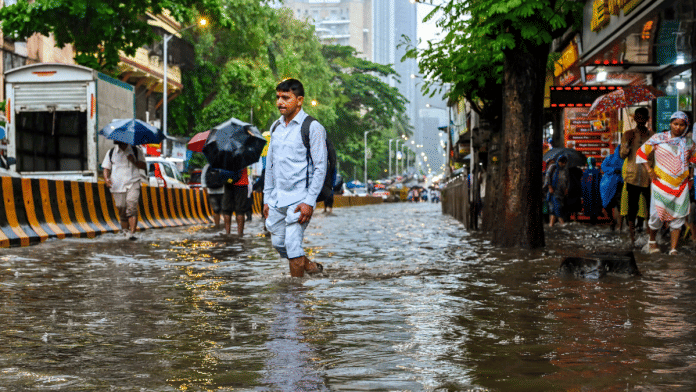
Mumbai, for instance, faced urban floods in 2005 when the city was flooded with 944 mm (24 hrs) of rainfall, i.e. 39 mm/hr (drainage capacity = 25 mm/hr), 1094 lives were lost, and the city faced substantial economic damage. The Brihanmumbai Municipal Corporation (BMC) reinitiated the once shelved ₹1200 Cr. stormwater plan named BRIMSTOWAD in 2007. In 2017, severe rainfall caused rampant flooding with water levels reaching 468 mm within 12 hours. Although fatality rates were under control this time, the city was still inundated with stalled economic activity.
Chennai 2015 floods, on the other hand, caused economic loss of ₹50,000-₹100,000 crores, one of the costliest natural disasters in the world. The Greater Chennai Corporation (GCC) soon implemented a ₹4000 Crores integrated stormwater drainage project. In 2023, catastrophe took place when cyclone Michaung caused torrential rainfall and flooding at a rate of 19 mm/hr, but this time the reported fatality was under control with a relatively lower financial loss.
So, Flood Reforms may suggest better Local Government Performance
To examine whether Indian cities learn from past flooding events, two major flooding events of same Indian metropolitan city was compared. Also, two factors were measured separately, flood impact and infrastructure preparedness. Flood impact combines rainfall intensity, deaths and inflation-adjusted economic losses. Infrastructure Preparedness measures drainage capacity relative to peak rainfall, drainage expenditure as a share of municipal budgets and drainage length per capita.
The difference between the two factors produced a Governance Flood Performance score (GFPS). If preparedness outweighed impact, the score was positive and vice versa. Comparing the two flood events gave an improvement percentage, that quantified the institutional learning.

Mumbai and Chennai showed measurable improvement in subsequent events. While neither city eliminated flood risk, both reduced fatalities and lowered economic damage relative to previous disasters. Kolkata, Delhi and Bengaluru displayed stagnation, rainfall intensity declined in later events, yet damage persisted, indicating limited structural correction. In Patna, Surat and Hyderabad, later floods proved equally or more damaging, reflecting either inadequate reform or persistent structural gaps. The pattern is clear that floods trigger reform, but implementation depth determines resilience.
These outcomes highlight governance pattern
Major reform promise resilience but lethargic implementation stalls progress
In 1985, the BMC appointed British consultants to prepare a plan to tackle 50 mm/hr rainfall. So, Brihanmumbai Storm Water Drainage (or BRIMSTOWAD) report was formulated, its implementation languished until 2017, when only 50% of the work was completed, which made way for disasters such as 2017 floods and persistent water logging in 2019 and 2021.
Authorities focus on short term Infra-upgrade instead of understanding the hydrological ecosystem
In India, reforms involve engineering-heavy solutions with reductionist methods rather than holistic ones. Priority is given to visible, short-term infrastructure upgrades without fully understanding the ecological system. Mumbai spends huge amounts on water pumps each year but at high tides reverse flow defeats their purpose. Local government fails to recognise that riverine and poor drainage-based flood risks require different approach to solve them.
Basic improvements in zoning regulation, removing encroachments along waterbodies, unclogging drainages, checking illegal urban expansion, and consolidating responsibilities can mitigate major flood losses and save many lives, with no need of capital-intensive flood control projects. Highlighting the fact that urban flood resilience is a visible indicator of local institutional capacity.
These pieces are being published as they have been received – they have not been edited/fact-checked by ThePrint.