




Thank you dear subscribers, we are overwhelmed with your response.
Your Turn is a unique section from ThePrint featuring points of view from its subscribers. If you are a subscriber, have a point of view, please send it to us. If not, do subscribe here: https://theprint.in/subscribe/
Welcome to the new world where the resolution of international issues, diplomacy, wars, and peace negotiations, among many others, will be corporatized. The United Nations Organisation and its subsidiaries, which have been in a deep slumber, bordering on a stupor, for a long time now, can continue to do so. Sooner or later, UNO will need the services of an epitaph writer. As it stands, many members wonder why they pay so much money to keep the UNO going when it can hardly boast of any impartial and fair results or successes in the last few decades.
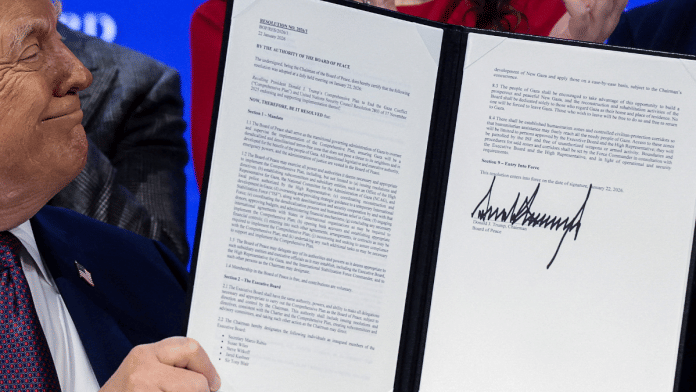
US President’s call for a Board of Peace initiative to resolve conflicts globally, among plans to address many other international issues under Mr. Trump’s lifetime chairmanship, sounds like a corporate version of the UNO. Board members have already been nominated. A permanent membership for select nations will be through invitation, subject to an investment of USD one billion in the new entity. Nations that cannot or do not pay this fee will only enjoy a three-year temporary membership, through invitation, in line with the independent directors of a business entity. Invitations have already been sent to 60 nations for membership.
The executive members of the Board for Peace, under Mr Trump, have already nominated and include the US Secretary of State and Mr. Trump’s son-in-law, Jared Kushner. There are no prizes for guessing who will be the next Chairman of the board for life. Some concerns have been voiced about this Board undermining the work of the UN, ignoring the fundamentals of the UN charter, and how it may lead to a ‘Trump United Nations’. Internationally, there has been no worthwhile opposition to this Board or Mr. Trump until now.
The list of major wars and conflicts that have been continuing around the world for many years is long and widespread, with the UN being a mute spectator. It includes the Russian-Ukrainian war, the Israeli-Hamas war, Chinese threats to Taiwan, a host of clashes and small-scale wars in the Middle East region, and other countries like Armenia/Azerbaijan, Chechnya, and the Tajik Civil War. Countries like North Korea write their own rules in more ways than one.
Some African nations, including Sudan, DR Congo, South Sudan, Mali, and Burkina Faso, continue to oppress and kill their own people. In South America, countries like Colombia, Venezuela, Brazil, and Ecuador frequently have high violence levels, often linked to crime, gang activity, and political instability. Haiti, El Salvador, Honduras, and Guatemala in Latin America also fall in the same category. The UNO is neither in a position of authority nor really interested in resolving any of these problems. It just passes vague resolutions from time to time or issues statements of intent without any intent, which reach the dustbin faster than one can blink one’s eyes.
On the economic and poverty issues, the less said the better. Once again, the UNO, whose own officials and staff live opulent lifestyles on the funds contributed by member nations, most societies across the continents that need its attention and humanitarian services remain devoid of any assistance. Despite the United Nations (UN) and its agencies (FAO, UNICEF, WFP, WHO, UNDP) setting ambitious goals, such as the 2030 Agenda for Sustainable Development, they have faced significant challenges and failures in tackling poverty and malnutrition, with global hunger levels recently returning to 2005 levels.
After 2014, the pace of poverty reduction slowed, and in 2020, extreme poverty increased for the first time in decades. In 2024, approximately 700 million people were still living in extreme poverty. The UN’s efforts to guide and support the poor and vulnerable nations during the COVID-19 pandemic fell woefully short of expectations. Its performance in other areas, including climate control, health, sanitation, hunger, child malnutrition, and quality of life, among others, has been lacklustre.
For the record, a mandate for a Board of Peace to address the Gaza conflict was authorised by the UN Security Council in November last year, with a validity till 2027. Both Russia and China abstained from voting on this resolution, but a more important and concerning question is what other members of the Security Council have done? They have willingly written an epitaph for the UNO to please Mr Trump. The fact that neither Russia nor China vetoed this resolution is baffling. Surprisingly, the media too failed to discuss this development. Perhaps vested interests deliberately suppressed it from the media glare, but surely China or Russia could have highlighted this development.
UN Secretary General’s spokesperson, in an answer to a question on this issue, stated that ‘The UN will continue its mandated work and member states are free to associate in different groups’. Does this mean resolving conflicts across the world, in this case, Gaza, is not a mandated work of the UNO? The UN General Assembly President has stated that the UN is the only institution with moral and legal ability to bring together every nation, big or small. If we question that, we fall back on very dark times. Yet, there is no call for a UN General Assembly session to debate this matter or a protest.
The achievements of the UNO and its other arms hardly inspire confidence, but to abdicate its responsibilities to another body with no credentials as of date is something to worry about for all nations. This is particularly dangerous as the new entity will be chaired for life by Mr Trump, whose disdain for established diplomatic protocols and international norms is well known. The US President’s unilateral military action and kidnapping of the country’s President to seek a forced regime change in that country, the demand for bringing Greenland, a sovereign territory of another nation, under the control of the USA, a dubious role in the Ukraine war, and military threats to Iran ring serious alarm bells about his intentions.
The US’s widespread use of tariffs is seen by many as a projection of economic power to secure domestic advantages, by destabilizing the global rules-based system and increasing costs for the rest of the world. Can someone so self-centred, egoistic, and consumed with the national interests of his nation be entrusted with the crucial job of resolving conflicts and other international disputes?
Mr. Trump’s distrust of multilateral institutions, including the UN, is no secret, as he believes that they fail to serve US interests. This whole issue smacks of an abject surrender by the UNO to the ego of the US President, the negative impact on the world body notwithstanding. In an official statement on behalf of the new Board, it has been stated that the Board will start by addressing the Gaza conflict and then expand to deal with other conflicts.
The Board, in a Trump-style move, has already extended its mandate much beyond the Gaza conflict and term unilaterally, notwithstanding the UNSC resolution’s stipulations. The revised mandate includes governance capacity building, regional relations, investment attraction, reconstruction, and capital mobilisation.
Considering that Mr. Trump has less than three years left in office, it implies that he will continue to hold the mandate and power, even after he relinquishes office, to resolve or interfere in international conflicts and other matters. By default, it implies that sovereign countries that are members of the Board would work under the chairmanship of a non-entity, Mr. Trump. Will this not lead to the demise of international protocol, diplomacy, and inter-nation relationships?
In the future, will the heads of nations, including future Presidents of the USA, look to Mr. Trump or the future Chairmen of the Board of Peace for decisions on key international issues? The big question today is: What will India’s and the Indian Prime Minister’s response be?
These pieces are being published as they have been received – they have not been edited/fact-checked by ThePrint.