





Thank you dear subscribers, we are overwhelmed with your response.
Your Turn is a unique section from ThePrint featuring points of view from its subscribers. If you are a subscriber, have a point of view, please send it to us. If not, do subscribe here: https://theprint.in/subscribe/
Reflecting an age-old relationship of mutual dependence, India’s forests are living
tapestries where trees, tribals, and tigers are bound together. Trees sustain
biodiversity and tribal livelihoods, while tigers, as indicator species, mirror the overall
health of these vital forests. Together they symbolise both ecological richness and
the challenges of conservation. However, the path toward a balanced coexistence is
both inspiring and demanding, as the successes of one element often create
unforeseen challenges for the others, posing continuous dilemmas for people and
policymakers.
Trees under threat
India’s forest cover presently ranges between 21-22 % of its land area, showing little
growth, ranging between 0.2% to 0.7% per year since 1980 and facing continued
pressures both due to anthropogenic factors and climate change. The recent FSI
report highlights a 1,445 square Km increase in total forest and tree cover, driven by
a marginal gain of 156 square KM in forest cover and a 1,289 square KM increase
in tree cover. This unusual trend—where tree growth seems to be; fleeing from the
forests; and flourishing more outside designated forest zones—raises pressing
questions about efficacy of forest management policies. We have about 1.3 million
hectares of forest under encroachment and 1.5 million hectares diverted for
development projects by 2020, Over 40,000 square kilometres of dense forests,
crucial for wildlife survival, suffered degradation between 2011 and 2021. Combined
with threats from climate change, wildfires, and grazing, this is hampering forest
regeneration and destabilising ecological balance vital for sustainable forestry.
Tribes at Crossroads
Comprising more than 8.6% of India’s population, the country’s tribal communities
have doubled from 51.6 million in 1981 to over 104 million and have long been the
silent stewards of its forests and biodiversity. Covering about 15% of India’s land,
they have coexisted with nature for centuries, their traditional knowledge vital for
sustaining healthy ecosystems and protecting tiger habitats. While government
initiatives aim to uplift these communities, a deeper, more complex reality persists
beneath the surface.
It is ironic that conservation laws, though meant to protect forests, often push away
local people despite legal safeguards. Many times, relocation of villagers for the
creation of protected areas or any project suffer from inadequate or delayed
compensation, severs cultural ties and dismantles traditional livelihoods which in turn
hastens forest degradation and biodiversity loss. A true conservation always honours
people by ensuring harmony between forest health and community well-being and
their survival.
Tigers on top, challenges ahead
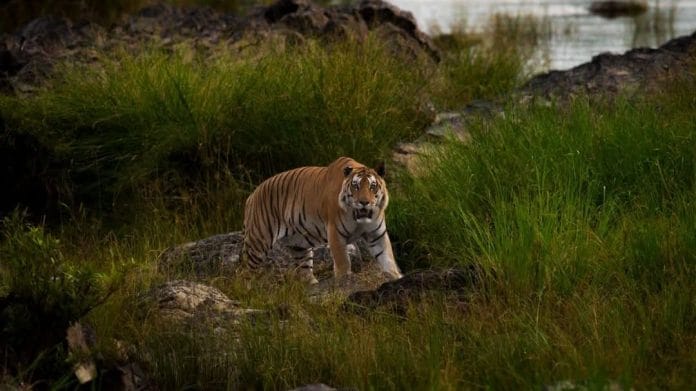
India is recognized globally for making tiger conservation a remarkable success
story, beginning with the launch of Project Tiger in 1973. Home to more than 75%
of the world’s wild tiger population, the country now holds 3,682 tigers, a
dramatic rise from just 1,411 in 2006—an increase of nearly 160%. This
achievement is the result of a comprehensive conservation model combining strict
anti-poaching laws, habitat expansion, community engagement through livelihood
programmes, and the strong political will of successive governments. Spread across
58 Tiger Reserves spanning nearly 8.45 million hectares and managed with rigor by
the National Tiger Conservation Authority, India’s successful doubling of its tiger
population ahead of schedule has reversed historical declines, established national
leadership in tiger conservation, and motivated similar global initiatives.
Yet, the challenges to wildlife conservation in India remain serious and deeply
complex. Persistent habitat loss and fragmentation are isolating animal
populations, eroding genetic diversity, and pushing wildlife out of forests into human-
dominated landscapes, causing crop damage, livestock predation, and attacks on
humans. From 2019–2024, India recorded 2,727 human deaths caused by
elephants and 349 by tigers, highlighting its severity.
These conflicts often provoke retaliatory killings and have even now culminated in
contentious policy debates, most prominently the Kerala government’s proposal to
amend the Wildlife Protection Act. This move has stirred widespread ecological,
constitutional, and social concerns, signalling new tensions in balancing
conservation priorities with human safety. Further, cases of wildlife entering human
zones create condition like an ecological traps where resource-rich yet risky
habitats like garbage piles and herds of cattle may trigger dangerous behavioural
changes and health problems. Illegal poaching and wildlife trafficking are threatening
conservation goals.
Way forward
The success of Project Tiger showcased the power of united efforts in governance,
science, and community engagement, especially among the tribes, which
underscores the need to mobilize integrated efforts addressing challenges and
recognition of the vital links. Let’s not forget that trees, tribals, and tigers are not
three separate pillars—they are a single structure. Break one, and the others
collapse. This triad is facing interconnected challenges of forest degradation, wildlife
decline, and socio-economic struggles. Emphasising community participation,
livelihood support, conservation-driven development, and capacity building are
essential. By fostering harmony between nature and people, India can create a
resilient, diverse future where all thrive together sustainably.
These pieces are being published as they have been received – they have not been edited/fact-checked by ThePrint.