





Thank you dear subscribers, we are overwhelmed with your response.
Your Turn is a unique section from ThePrint featuring points of view from its subscribers. If you are a subscriber, have a point of view, please send it to us. If not, do subscribe here: https://theprint.in/subscribe/
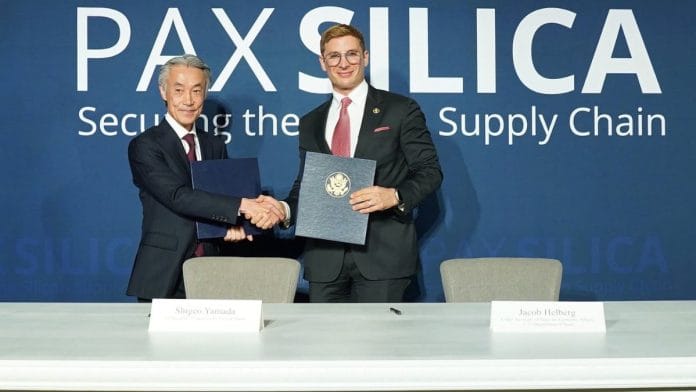
During a lot of the time after the Cold War, globalization was based on an unspoken deal: open markets, connected supply chains, and the belief that efficiency would win out over politics. That deal is already falling apart. Instead, there is a new strategic logic called Pax Silica that is becoming popular in policy and technology circles. In this model, controlling silicon, data, and AI infrastructure is as important to power as oil and land used to be.
Pax Silica is not a formal agreement or institution like other world systems that were based on military alliances or trade regimes. This is a strategic situation. A simple but important change is at the heart of it: industrialized economies and big countries no longer see digital infrastructure and important supply chains as neutral business areas. They are now seen as important for national security.
Three realities that are coming together are causing this change. To begin with, artificial intelligence has become a general-purpose technology that has effects on the military, the economy, and politics. Artificial intelligence systems are used in modern public administration, logistics, health systems, financial markets, intelligence analysis, and defense planning. The person or group that owns the data, computing power, and semiconductor supply chains that make AI possible has both an economic and a strategic advantage. Second, recent global shocks like COVID-19, the war in Ukraine, shipping problems in the Red Sea, and the US-China technical decoupling have shown how weak hyper-concentrated supply chains are. Some places are now so important to the stability of whole economies that they are called “geographical choke points.” What used to seem like efficiency now seems like weakness. Third, technology has become a battleground for global politics. Export restrictions on advanced semiconductors, limited access to AI models, monitoring of foreign cloud providers, and the securitization of data flow are now commonplace. They are the new normal.
These things together make up the basis of Pax Silica, a world order based on controlling technology strategically instead of free trade.
Silicon as a plan.
This change is all about semiconductors. Advanced CPUs power artificial intelligence models, self-driving cars, and high-performance computers. However, their production is concentrated in certain areas, requires advanced technology, and is politically sensitive. Taiwan, South Korea, Japan, the United States, and parts of Europe are in charge of different parts of this value chain.
This concentration has turned semiconductor manufacturing plants, equipment suppliers, and even design software into important tools. The US CHIPS and Science Act, the EU Chips Act, and similar programs in Japan and South Korea are more than just plans for businesses. They are security ideas that are put into words in terms of money. States are no longer happy to be “efficient participants” in global technology markets under Pax Silica. They want supply chains that are reliable, friendly, or made in their own country, even if they cost more, because resilience is more important than marginal efficiency.
AI and the Logic of Control
This logic is sped up by AI. Advanced AI systems depend on three limited inputs: large datasets, high-end computing infrastructure, and specialized chips. This is different from older digital technologies. You can control, limit, or refuse each of these inputs.
Because of this, AI governance has quietly moved from ethical to strategic talks. “Who gets access” is now as important as “how should AI be used.” Export restrictions on AI-capable chips, limits on model deployment, and limits on data flow across borders all suggest that AI is seen as a strategic tool rather than a neutral new technology.
This has big effects on inequality around the world. Countries that don’t have modern computers or reliable supply chains might miss out on the next wave of productivity growth. Pax Silica could make technology hierarchies stronger instead of making innovation more open to everyone if it isn’t managed properly.
The New Strategic Order
Pax Silica is not the end of globalization; it is the next step in its evolution. Interdependence is no longer absolute. To help with economic integration, trust, alignment, and resilience are being used. This new hierarchy is still changing. It is setting its own rules through export controls, investment screening, technological standards, and cooperation based on alliances instead of big treaties. But its direction is clear: AI and supply chain security have moved from being technical policy issues to being at the center of statecraft.
The question isn’t if Pax Silica will have an effect on world politics; it already does. The main question is whether it will lead to a world that is broken and excludes people or one that is stronger and more balanced. India and other countries must not only adjust to this new system but also help shape it. In the age of silicon geopolitics, strategy will be just as important as new ideas.
About the author:
Anusreeta Dutta is a columnist and climate researcher with experience in political
analysis, ESG research, and energy policy.
These pieces are being published as they have been received – they have not been edited/fact-checked by ThePrint.