





Thank you dear subscribers, we are overwhelmed with your response.
Your Turn is a unique section from ThePrint featuring points of view from its subscribers. If you are a subscriber, have a point of view, please send it to us. If not, do subscribe here: https://theprint.in/subscribe/
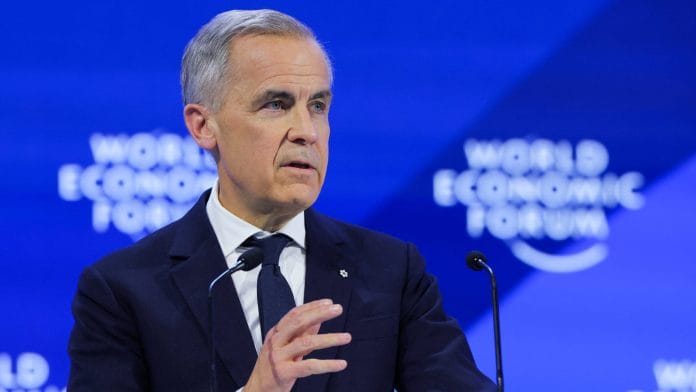
At Davos this year, Mark Carney gave voice to a quiet truth many capitals have been privately acknowledging: the global order has fractured. Alliances once sold as permanent are now conditional, transactional, and occasionally disposable. The promise that great powers would act as predictable anchors has weakened, replaced by a world where commitments flex with domestic politics, election cycles, and economic stress. This is not a collapse of diplomacy, but the end of its comforting illusions. What Carney articulated was less a warning than a diagnosis, sobering, overdue, and refreshingly honest.
The End of the Reliable Ally Myth
For decades, middle powers were encouraged to “choose sides,” reassured that loyalty would be rewarded with security and market access. Recent history tells a harsher story. Trade partners impose tariffs overnight. Security guarantors hedge, hesitate, or disengage. Moral language expands and contracts depending on who is speaking. Carney’s argument, that large powers are no longer structurally reliable allies, cuts against the romanticism of post-Cold War internationalism. It also explains why nations increasingly plan for abandonment as a baseline scenario rather than a contingency. In this environment, faith is not a strategy; flexibility is.
Issue-Based Alignment as Rational Statecraft
Carney’s most compelling proposition was that middle powers must pivot toward issue-based alliances, coalitions formed around specific goals rather than permanent ideological blocs. Climate here, supply chains there, technology standards somewhere else. This is not opportunism; it is realism adapted to fragmentation. Such alliances are modular, reversible, and pragmatic, allowing states to cooperate without surrendering autonomy. In a volatile system, durability comes not from rigid loyalty but from diversified partnerships. Ironically, this approach is now being hailed as innovative precisely because it departs from Western alliance orthodoxy.
India’s Long-Practiced “New” Idea
What made Carney’s remarks quietly amusing, if you happen to be Indian, is that this “new” strategy sounds remarkably familiar. India has pursued issue-based alignment for decades, long before it acquired respectable branding. From strategic autonomy to multi-alignment, India has balanced competing powers across defence, energy, technology, and trade, often simultaneously. This posture was regularly dismissed as fence-sitting or moral evasiveness. Today, it is being reintroduced under a sleeker vocabulary, minus the scepticism once reserved for those who practiced it first.
The Cost of Being Early
India’s approach did not come cheap. It attracted ridicule, especially from Western commentators who preferred loyalty to nuance. Canada, among others, frequently framed India’s refusal to align fully with any one camp as a failure of values rather than a calculation of interests. The irony is sharp: the same capitals now praise flexibility as wisdom. Being early meant absorbing criticism; being right just took longer. Carney’s intervention is welcome precisely because it validates what many middle powers learned through experience, not theory.
Western Hypocrisy, Rebranded Thought
There is a familiar rhythm here. Ideas born of necessity in the Global South are ignored, then tolerated, and finally celebrated once repackaged in Western language. Strategic autonomy becomes “hedging.” Non-alignment becomes “issue-based coalitions.” Multipolar pragmatism becomes “resilience.” The substance remains unchanged; only the accent shifts. This is not malicious, merely habitual. But it matters, because acknowledging intellectual provenance is the first step toward a genuinely plural global conversation, one where wisdom is not geographically gated.
Why This Moment Still Matters
To Carney’s credit, his speech did more than rename a concept; it legitimized it within Western policy discourse. That matters because validation changes behaviour. Middle powers no longer need to justify flexibility as a deviation; it is now the default. The rules of engagement are being rewritten to reflect reality rather than nostalgia. In that sense, the speech was less about economics or alliances and more about intellectual humility, an admission that the old playbook no longer works.
A Quiet Convergence, Not a Revelation
The emerging order will not be built on grand camps but overlapping interests. Climate coalitions will include rivals. Supply chains will cross political divides. Security partnerships will be narrower but deeper. This is not fragmentation; it is adaptation. India and many others have lived this reality for years. The West is only now catching up, and calling it insight. Carney’s speech deserves praise for saying the quiet part aloud. The rest of the world deserves credit for having practiced it all along.
These pieces are being published as they have been received – they have not been edited/fact-checked by ThePrint.