




Thank you dear subscribers, we are overwhelmed with your response.
Your Turn is a unique section from ThePrint featuring points of view from its subscribers. If you are a subscriber, have a point of view, please send it to us. If not, do subscribe here: https://theprint.in/subscribe/
By a fortunate mistake, I once found myself at a university campus in Dubai during placement season. The hall was expansive and buzzing with anticipation. Hundreds of MBA students sat waiting to meet potential employers, their faces reflecting the same mixture of hope and anxiety that young people everywhere carry when they stand at the edge of professional life.
Each company had been assigned a table. To my left sat Mercedes-Benz, the iconic German luxury automobile maker. To my right was Halliburton, the global oilfield services and energy engineering giant. Across the hall were other global corporations, their logos instantly recognisable, their reputations unquestioned. I was the only representative of a small, unbranded enterprise.
I did not belong there.
My company had written to the university seeking fresh graduates for a new media venture. Instead, I had been invited to an employer pitch session, where each organisation was given three minutes to explain why students should choose them. For most recruiters, no explanation was required. Their name cards spoke louder than any pitch.
When my turn came, I knew I could not compete on brand power. I chose honesty instead.
I spoke about the energy I saw in the room and the quality of education the students had received. Then I paused and asked a simple question: did they want to join an ever-growing pool of job seekers, or did they want to begin the journey of becoming job creators?
I explained that I was an entrepreneur with three decades of experience in global trade and investment, running a modest but growing business with teams spread across three offices. I made no promises of security. I offered something else—exposure, responsibility and the opportunity to build something from the ground up.
The response surprised me.
Within minutes, my previously quiet table was surrounded. Conversations began. Résumés appeared. Several students asked not about salaries, but about internships and learning opportunities. A spark had been lit, not by certainty, but by possibility.
That moment stayed with me because it reaffirmed a belief I have carried for years. Entrepreneurship is rarely learned in classrooms. It is absorbed through proximity. It spreads when young people encounter those who have turned uncertainty into enterprise.
A Young Nation with Old Expectations
India needs this shift in thinking now more than ever.
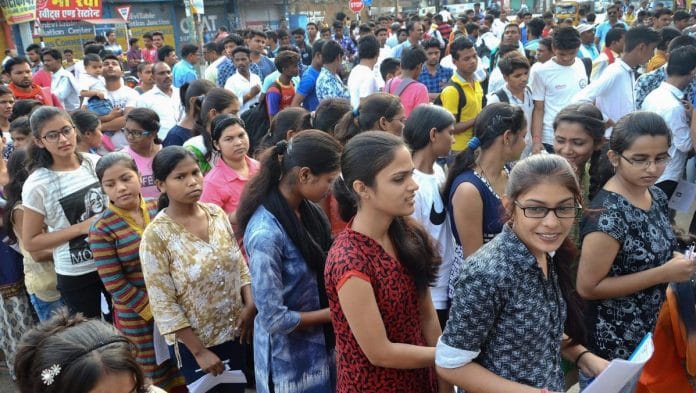
We are the youngest large nation in the world. Nearly two-thirds of our population is below the age of thirty-five, and more than a crore young Indians enter the workforce every year. Even the most efficient government cannot generate jobs at that scale indefinitely. This is not a failure of policy. It is a demographic reality.
If this vast youthful energy is channelled into creation, innovation and enterprise, India’s rise will be unstoppable. If it remains trapped in endless competition for limited salaried roles, frustration will follow. History reminds us that unemployed or underemployed youth is not merely an economic problem. It is a social one.
Yet our cultural conditioning still favours safety over initiative.
I grew up in West Bengal, steeped in ideas and institutions, where entrepreneurship was rarely celebrated. Stories of business failure were shared far more often than stories of enterprise. Schools trained us to follow instructions rather than question them. Families encouraged careers in engineering, medicine or government service. Stability was treated as the highest virtue.
When I was considering marriage, my mother asked a question that echoes in millions of Indian households even today. She wanted to know whether my job was permanent.
I replied, half in jest, that the job might be permanent, but the company never is. I am not sure what she understood, but she accepted the answer. Six months after marriage, I left that job. Two years later, the company itself shut down. Had I stayed, my sense of security would have collapsed overnight. Instead, I had already stepped onto an independent path.
That decision taught me a lasting lesson. Stability is often an illusion. Control is not. Passengers and Drivers
The difference between employment and entrepreneurship can be explained simply.
The employee is a passenger on a long journey. Instructions come from the front. Do this. Do that. Follow this route. Perform well and you are rewarded. Deviate and you are corrected. Over time, routines settle in. Salaries arrive. Status grows. Plans are made. Then, sometimes without warning, the journey ends.
The entrepreneur, on the other hand, sits behind the wheel. The road is uncertain and the vehicle may be small, but direction and decisions are personal. Mistakes are costly, but lessons are immediate.
Success, when it comes, is deeply earned.
Both paths involve risk. One disguises it. The other confronts it.
After the Dubai event, a young man from Benin, a West African country striving to turn its agricultural strength into global trade, approached me quietly. He had completed two MBAs in two different countries, yet he was dissatisfied.
“They taught me how Coca-Cola became global,” he said. “How luxury brands scaled. But no one taught me how to export products from my own country. I want to sell groundnuts from Benin. I need a roadmap, not history.”
We spoke at length. We broke the challenge into steps. He left not with guarantees, but with confidence. Today, he is pursuing his own entrepreneurial journey.
That is why I say entrepreneurship is contagious. Belief travels faster than instruction. Entrepreneurship as a Creative Act
India’s economic future will not be built by multinational corporations alone. It will be built by millions of small and medium enterprises. Globally, small and medium enterprises (SMEs) account for more than ninety percent of businesses and over half of total employment. In Germany, family-run Mittelstand companies anchor industrial strength. In India, micro, small and medium enterprises (MSMEs) employ over 110 million people, often with far fewer resources than their multinational counterparts.
Yet they remain under-celebrated.
To become an entrepreneur, one does not need to be extraordinary. One needs aspiration, integrity, resilience, curiosity and the courage to recover from failure. These qualities are widely distributed across Indian society.
Business, in this sense, is a creative act.
Artists transform emptiness into meaning. Musicians turn silence into emotion. Entrepreneurs identify gaps and convert ideas into tangible solutions. All follow a difficult zero-to-one journey. All fail often. All depend on teams. All deserve recognition.
In 2012, we identified such a gap in the Arabian Gulf region. The six-nation Gulf Cooperation Council (GCC) imports most of what it consumes. Ukraine was a major exporter of sunflower oil, yet had no brand presence in the market. We stepped in. It took months to place the first bottle on a Dubai shelf. Years of effort followed. Today, the product is established across multiple markets.
That success was built the same way a work of art is built, through imagination, discipline and persistence.
Our media celebrates actors, athletes and musicians, all of whom are independent earners and job creators. They did not wait for pay cheques. They built value. Small business owners deserve the same respect.
You do not need to build an empire. If your business survives for three years, you have already contributed to nation-building.
We live in uncertain times. Wars disrupt trade. Technology reshapes work. Young people feel unanchored. The answer is not dependency. It is ownership.
India’s future will be shaped by those who choose to create rather than wait. The choice is simple, but its consequences are profound.
Job seeker.
Or job creator.
Suvra Chakraborty is a global trade entrepreneur with three decades of experience building international businesses and export ecosystems.
These pieces are being published as they have been received – they have not been edited/fact-checked by ThePrint.