





Thank you dear subscribers, we are overwhelmed with your response.
Your Turn is a unique section from ThePrint featuring points of view from its subscribers. If you are a subscriber, have a point of view, please send it to us. If not, do subscribe here: https://theprint.in/subscribe/
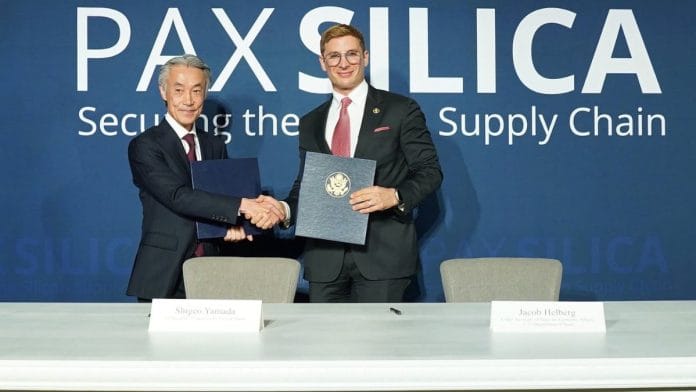
India’s absence from the United States’ emerging Pax Siliconica – the tightly knit technology and semiconductor alliances Washington is building with select partners—has predictably been read in some quarters as a diplomatic slight. The omission may not signal a collapse of India–US relations. But to dismiss it as inconsequential would be equally mistaken. India’s exclusion matters—not because of wounded prestige, but because it reveals deeper structural limits in India’s current economic, technological, and political trajectory.
The Pax Siliconica is not a treaty, nor a formal club with membership cards. It is an architecture of trust, supply-chain security, regulatory convergence, and technological depth. It brings together countries that can co-produce advanced semiconductors, safeguard intellectual property, align export controls, and withstand geopolitical pressure from China. At its core are the United States, Japan, South Korea, Taiwan, and increasingly parts of Europe. These are not merely allies; they are nodes in a high-trust ecosystem where capital, talent, data, and design circulate with minimal friction.
India, despite its size and strategic importance, is not yet such a node.
This is uncomfortable to acknowledge because New Delhi has invested heavily in the optics of technological ascent. We speak the language of digital sovereignty, of being a “trusted partner,” of becoming a semiconductor hub. We point to fabrication incentives, MoUs, and summit declarations. And yet, the Pax Siliconica is built less on declarations and more on delivery. It rewards those who already possess dense industrial ecosystems, long institutional memory in advanced manufacturing, and regulatory cultures that inspire confidence among global capital and governments alike.
India’s semiconductor ambition is real, but it is nascent. Fabrication plants take decades to mature, not electoral cycles. They require uninterrupted power, water security, specialised logistics, stable taxation, and—most critically—human capital trained at scale in microelectronics, materials science, and precision engineering. India has islands of excellence, but not yet the continental depth that this ecosystem demands. The US understands this. Its decision-making here is pragmatic, not personal.
There is also the matter of trust—not in intent, but in consistency. The Pax Siliconica is as much about political alignment as it is about technology. It rests on shared assumptions about rule of law, regulatory predictability, and insulation of economic policy from ideological turbulence. India’s recent years have raised questions, not least through abrupt policy shifts, retrospective taxes, constraints on civil society, and an increasingly centralised state that often privileges loyalty over competence. None of this makes India an adversary. But it does make partners cautious when the stakes involve trillion-dollar supply chains and technologies that underpin military and economic power.
Importantly, India’s non-alignment—or what now passes for “multi-alignment”—also plays a role. New Delhi wants strategic autonomy: access to US technology without full alignment to US containment strategies against China; trade with the West alongside energy and defence ties with Russia; participation in QUAD without treaty obligations. This balancing act has served India well in many respects. But Pax Siliconica is not a neutral platform. It is explicitly geopolitical. It is designed to ring-fence critical technologies away from adversaries. Partial alignment is insufficient here. From Washington’s perspective, ambiguity is risk.
This does not mean India has been sidelined altogether. On the contrary, the US continues to court India as a market, a military partner, and a counterweight to China in the Indo-Pacific. Technology cooperation continues in areas like defence manufacturing, space, AI, and telecommunications. What India is excluded from is the innermost sanctum of semiconductor co-production and design governance. That inner circle is small by design.
The danger lies not in exclusion, but in denial. India risks telling itself a comforting story – that it has chosen not to join, that moral superiority or civilisational uniqueness excuses structural gaps, that slogans can substitute for supply chains. This self-deception is far more damaging than any external omission.
There is also a deeper irony. India’s greatest strength—its vast pool of engineers and its democratic potential – should make it a natural candidate for Pax Siliconica. But the quality of education has been steadily hollowed out, research funding remains inadequate, and universities are increasingly sites of ideological policing rather than intellectual risk-taking. Innovation does not flourish in atmospheres of fear or conformity. Semiconductor ecosystems thrive on open inquiry, failure, and dissent – values that sit uneasily with hyper-nationalist governance.
Moreover, India’s manufacturing push remains trapped between ambition and execution. “Make in India” has too often translated into assembly rather than value addition, into subsidies without accountability, into cronyism masquerading as industrial policy. The Pax Siliconica countries built their ecosystems through painful, long-term investments in public research, worker training, and industrial planning. They did not rely on spectacle.
So yes, India’s exclusion is not a snub per se. It is an assessment. And assessments can change.
But, if India wishes to matter in this emerging technological order, it must do more than sign agreements and host summits. It must rebuild trust in its institutions, protect academic freedom, invest seriously in science, and accept that technological sovereignty cannot coexist with intellectual repression. It must also decide whether strategic autonomy is compatible with deep technological integration – or whether it is willing to pay the price of standing just outside the room where the future is being designed.
The Pax Siliconica will shape global power as decisively as oil once did. India can still enter this architecture, but only by confronting uncomfortable truths about itself. The question is not whether the door is closed. It is whether India is willing to change enough to walk through it when it opens.
These pieces are being published as they have been received – they have not been edited/fact-checked by ThePrint.