





Thank you dear subscribers, we are overwhelmed with your response.
Your Turn is a unique section from ThePrint featuring points of view from its subscribers. If you are a subscriber, have a point of view, please send it to us. If not, do subscribe here: https://theprint.in/
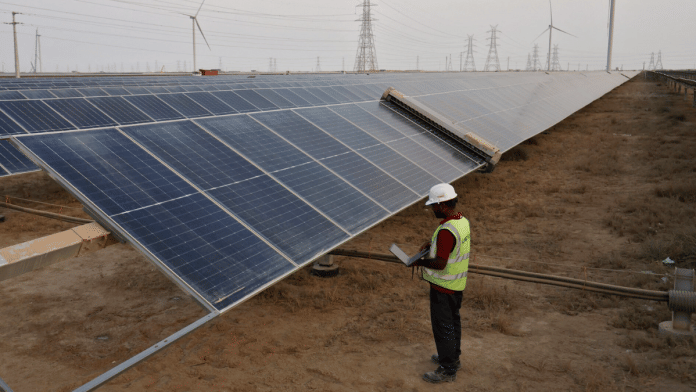
The US Inflation Reduction Act, Europe’s Carbon Border Adjustment Mechanism, and China’s dominance in the clean energy industry have all been at the center of the global debate over “green protectionism.” But in the last few months, India has quietly begun its own era of green protectionism, changing its industrial policy through tariffs, localization rules, and conditions for receiving subsidies. The transition is small but important. It shows a change from relying on cheap imports, especially from China, for decades to a plan that sees domestic manufacturing as the key to the country’s clean energy transition. India is changing the way it plans to combine climate action with industrial growth. New tariffs on solar modules, cells, components, lithium-ion materials, and some green-tech systems are not just ways to raise money.
India’s push for green energy used to rely a lot on supply chains from other countries. Launching the National Solar Mission in 2010, the government procured solar cells, modules, inverters, and wafers from various countries. China’s large volume, fast shipping, and government support for manufacturing made imports cheap and easy. This strategy of importing goods led to India’s solar capacity growing quickly for ten years. But it also meant that the country relied too much on one country. More recently, higher taxes on parts and restrictions from the Approved List of Models and Manufacturers (ALMM) have made it even harder to import. The government seems determined to keep this barrier in place, even though renewable energy developers say that domestic production is still not enough. From an industrial strategy point of view, the argument is clear: Indian businesses can’t grow fast enough to compete globally without protection.
India’s green protectionism also has an effect on geopolitics. China’s control over the solar value chain is so strong that almost every major manufacturing country, including the US and EU members, has put up barriers, quotas, and localization rules. India’s position is part of a bigger change happening around the world. India’s policy, on the other hand, is based on more than just competition. It is also based on energy security. The government thinks that making solar panels, hydrogen, and batteries are important national assets, not just for businesses. When you stop depending on one foreign source, it becomes a matter of strategic stability.
India’s position, on the other hand, is more measured than aggressive. It has stayed out of the aggressive subsidy fights that happen a lot in the West. Instead, it is creating a limited but open space where foreign companies are encouraged to make things in India instead of sending them there. Because of this predicted tariff wall, companies from the US, Europe, and even China are looking into making things in India. India is using protectionism not to keep markets out, but to bring supply chains to its shores.
But there are still problems. India’s renewable energy commitments for 2030 require that the country install more solar panels each year than it can currently make. The upstream ecosystem, which includes polysilicon, wafers, and ingots, is still weak and depends a lot on imports. The production of batteries and green hydrogen is still in its early stages, and costs are a big problem. Developers may have to deal with long-term limits if tariffs stay high without improvements in scale or quality. India’s green protectionism will only work if businesses in the country can come up with new ideas, grow quickly, and compete in markets outside of their own.
The second question is what India’s trading partners would do. As part of its carbon border rules, Europe is already looking into India’s import policy. The US has expressed concern about India’s industrial policy, which relies heavily on localization in a number of sectors. But India’s green protectionism is carefully wrapped up in the words “energy security” and “climate change,” which makes it harder to fight in the World Trade Organization. Green protectionism is morally and developmentally right, unlike traditional protectionism, which is only about market interests.
The success of this plan will depend on how quickly Indian businesses grow and whether policymakers can change tariffs and incentives to match what is happening in the market. But one thing is clear: India is no longer happy to sit back and watch as other countries run green supply chains. It is now trying to build them, and the government seems willing to pay the price of green protectionism to do so.
——————————————————————————————————About the author:
Anusreeta Dutta is a columnist and climate researcher with experience in political analysis, ESG research, and energy policy.
These pieces are being published as they have been received – they have not been edited/fact-checked by ThePrint.