





Thank you dear subscribers, we are overwhelmed with your response.
Your Turn is a unique section from ThePrint featuring points of view from its subscribers. If you are a subscriber, have a point of view, please send it to us. If not, do subscribe here: https://theprint.in/subscribe/
The slow, sanctioned destruction of the Aravalli Hills exposes the hidden costs of growth and the politics behind it.
The erosion of the Aravalli Hills is often discussed as an environmental issue, occasionally as a regulatory failure, and rarely as a political choice. Yet what has unfolded across this ancient mountain system over the last three decades cannot be understood without recognising the economic priorities and power structures that made its destruction not only possible but profitable. The Aravallis were not lost by accident. They were surrendered.
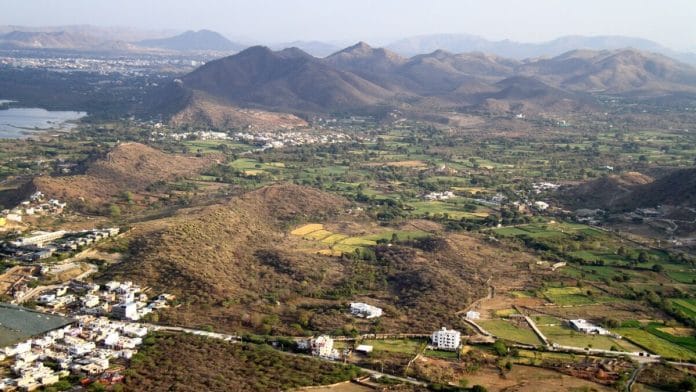
Running across western and northern India, the Aravalli range predates the Himalayas by hundreds of millions of years. It performs ecological work that no policy intervention can replicate: absorbing dust and heat, replenishing groundwater, moderating climate, and preventing desert expansion. These functions were never unknown. What changed was the balance of interests that determined whether they mattered.
From the early 1990s onwards, land in and around the Aravallis began to be viewed less as a shared ecological system and more as dormant economic potential. Mining leases, construction projects, and real estate ventures multiplied, especially in Rajasthan and Haryana. What could not be openly permitted was gradually enabled through reclassification, selective enforcement, and bureaucratic manoeuvre. Hills became “wastelands” on paper. Forests ceased to be forests through administrative interpretation. Illegality was normalised by repetition.
This was not simply a story of individual corruption. It reflected a deeper transformation in governance, where the state increasingly functioned as a facilitator of private accumulation rather than a guardian of public goods. Environmental protections remained on the statute books, but their application became negotiable, contingent on political alignment and economic interest. The law did not disappear; it bent.
The beneficiaries of this process were few but influential. Mining operators fed the construction boom. Developers capitalised on proximity to Delhi-NCR. Infrastructure projects supplied cement, stone, and contracts at scale. Each layer of extraction produced revenue, employment figures, and growth statistics—while the ecological costs were deferred, dispersed, and rendered invisible.
Those costs, however, have not vanished. They have surfaced in the form of collapsing groundwater levels, intensifying heat, dust storms, and unlivable air. The degradation of the Aravallis has played a direct role in Delhi’s environmental crisis, yet the response has consistently targeted symptoms rather than causes. Citizens are urged to change habits; vehicles are rationed; seasonal bans are imposed. Meanwhile, the structural dismantling of natural safeguards continues largely unchallenged.
This disconnect reveals a political convenience. Addressing individual behaviour is safer than confronting entrenched interests. It preserves the appearance of action without disrupting the economic arrangements that drive ecological harm. In this framing, pollution becomes a collective moral failing rather than the outcome of specific decisions made in corridors of power.
There is also a deeper contradiction at work. Contemporary political discourse frequently invokes heritage, civilisation, and continuity. Yet one of the subcontinent’s most ancient geological formations has been treated as expendable. Cultural pride coexists with ecological erasure. The language of inheritance is deployed selectively, honouring monuments while flattening mountains.
Public attention, meanwhile, has been carefully managed. Debates over identity, history, and symbolism have dominated the political imagination, leaving little space for sustained scrutiny of land use, extraction, and environmental governance. While passions are mobilised elsewhere, landscapes quietly change hands. The spectacle distracts; the transfer proceeds.
Judicial interventions have periodically punctured this arrangement. Courts have acknowledged illegal mining, regulatory evasion, and ecological damage in the Aravallis. Yet enforcement has been uneven, delayed, or diluted by subsequent policy adjustments. Legal victories have proven fragile in the absence of political will. The result is a cycle of acknowledgement without correction.
What makes the Aravalli story particularly disturbing is its ordinariness. There was no singular catastrophe, no moment of rupture. The destruction unfolded incrementally, normalised by time and repetition. Each violation appeared minor in isolation; together they produced irreversible loss. This is damage that announces itself only when repair is no longer possible.
At its core, the dismantling of the Aravallis exposes the limits of a development model that treats nature as raw material and restraint as an obstacle. It reveals an economy that measures success through immediate returns while discounting long-term survival. Such a model does not fail suddenly; it degrades steadily, eroding the very conditions that make life and production possible.
To question this is not to reject development, but to ask whose interests it serves and what it consumes in the process. Growth that undermines water security, air quality, and climate stability is not progress. It is postponement—of reckoning, of responsibility, of accountability.
The Aravalli Hills cannot be restored by token conservation or cosmetic interventions. Their fate demands a more honest reckoning with how land is valued, how power is exercised, and how decisions are made. It requires recognising ecological systems as non-negotiable public trusts, not bargaining chips in economic expansion.
Ultimately, the hills tell a story beyond themselves. They stand as evidence that environmental collapse is rarely caused by ignorance. It is enabled by priorities—by choices that elevate profit over protection and convenience over care. The Aravallis were sacrificed not because their worth was unknown, but because it was outweighed by the returns their destruction promised to a narrow set of interests.
What remains is a ledger written into the landscape: depleted aquifers, rising heat, poisoned air. It is a record of what happens when the future is treated as expendable. Whether that ledger is acknowledged—or merely inherited—will determine what kind of development lies ahead.
These pieces are being published as they have been received – they have not been edited/fact-checked by ThePrint.