





Thank you dear subscribers, we are overwhelmed with your response.
Your Turn is a unique section from ThePrint featuring points of view from its subscribers. If you are a subscriber, have a point of view, please send it to us. If not, do subscribe here: https://theprint.in/subscribe/
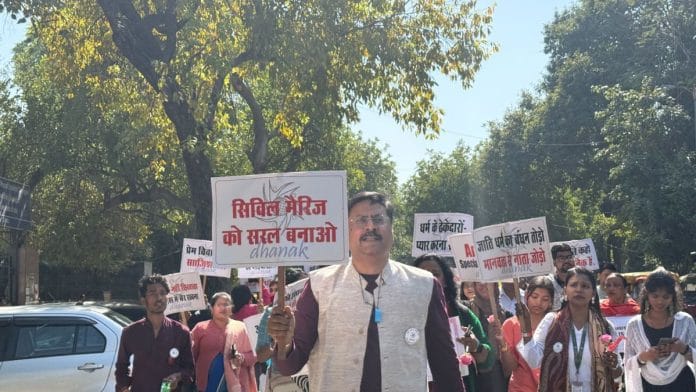
Valentine’s Day brings smells of roses, promises chocolates, and pervades the surroundings with a sense of love in all its manifestations. Amid debates over public morality and cultural norms in India, this auspicious Day occasionally finds itself at the crossroads of happiness and controversy. However, the Constitution of India offers an interesting perspective. Valentine’s Day reminds us that love is a constitutional promise rather than a personal choice in a country where social customs and planned weddings largely influence relationships. It respects individuals’ right to express their feelings and questions regressive concepts.
Love: A Constitutional Right
Valentine’s Day is about celebrating love—a feeling strongly connected with the fundamental liberties ingrained in the Indian Constitution. Article 21, which grants the right to life and personal liberty, includes the freedom to love and tie a knot with a person of one’s choice. Two significant decisions rendered by the Hon’ble Supreme Court of India support this.
A landmark ruling against honour killings and a strong confirmation of the right to choose one’s life partner is the Shakti Vahini case (Shakti Vahini v Union of India, (2018) 7 SCC 192). The Supreme Court declared Khap Panchayats illegal and stripped them of the power to interfere in personal relationships. This decision highlighted the importance of the right—protected by Article 21 of the Indian Constitution—to select one’s spouse.
Furthermore, in the Hadiya case (Shafin Jahan v. Ashokan K.M., (2018) 16 SCC 368), a significant legal debate over religious freedom and personal liberty is closely connected to Valentine’s Day and the Indian Constitution. The Supreme Court’s ruling upheld the right to choose a life partner, a right closely associated with the spirit of Valentine’s Day.
Both cases are important because they illustrate the legal and social struggles involved in defending the core of love and the right to express it. As a result, they endorse the constitutional safeguarding of personal freedom in matters of the heart.
Freedom of Love and Public Morality
It is contended that celebrating Valentine’s Day undermines social morals and hence conflicts with Indian values. The Constitution provides a suitable answer. Article 19(1)(a) assures freedom of expression and speech, which includes the right to celebrate and show love in public, with some restrictions provided under Article 19 (2).
The Supreme Court has repeatedly emphasized that public morality should not be used to restrict personal freedoms. In the Navtej Singh Johar case (Navtej Singh Johar v Union of India, (2018) 10 SCC 1), which decriminalized consensual homosexual relationships, a broader understanding of Valentine’s Day emerges. The Court’s key point is that constitutional morality—based on individual liberty and equality—must override social morality, which can often be influenced by prejudice and tradition. In other words, societal norms should not violate anyone’s fundamental rights, as constitutional morality values societal diversity. Valentine’s Day exemplifies this principle by supporting the right to express and celebrate love in all its forms, regardless of sexual orientation or gender identity. The ruling confirms that same-sex couples’ expressions of love are entitled to the same legal protections as those of heterosexual couples, reinforcing the fundamental right to love and openly share that love free from societal constraints.
Love: The Cornerstone of an Inclusive Democracy
Ironically, a day devoted to love often runs across opposition in a country whose Constitution is firmly anchored in ideas of fraternity and unity. The Preamble ensures everyone has “Liberty of thought, expression, belief, faith, and worship.” Valentine’s Day fits quite well with these basic principles in its most natural form and encourages love as a uniting tool across boundaries and divisions. In a diverse democracy, love has to go beyond mere affection to become a compass for social interaction.
Therefore, Valentine’s Day becomes more than just a celebration of romantic love within a diverse democracy like India; it affirms our commitment to pluralism. It is a day to recognise and celebrate the many expressions of love that enrich our society, and to reaffirm our commitment to building a nation where everyone feels valued and respected, regardless of who they love or how they express it.
Love and Law: A Bond for a Happy Future
The Indian Constitution aims to create a society based on justice, liberty, and equality. Love, in its purest form, encapsulates these principles. Valentine’s Day reminds us of the power of love to bridge differences in a world often divided by hatred and prejudice. It is a day to celebrate romantic love and love for humanity, diversity, and freedom. By doing so, we honour the spirit of the Indian Constitution, which, at its heart, celebrates love in all its forms. After all, as the Constitution reminds us, love is not just a feeling; it is freedom.
These pieces are being published as they have been received – they have not been edited/fact-checked by ThePrint.