




Thank you dear subscribers, we are overwhelmed with your response.
Your Turn is a unique section from ThePrint featuring points of view from its subscribers. If you are a subscriber, have a point of view, please send it to us. If not, do subscribe here: https://theprint.in/subscribe/
India loves theatrics. We toss rockets at the Moon, drop Mars references in every speech, and wave around our “indigenous 4.5-gen fighter” like a birthday party prop. Then reality intervenes—without mercy.
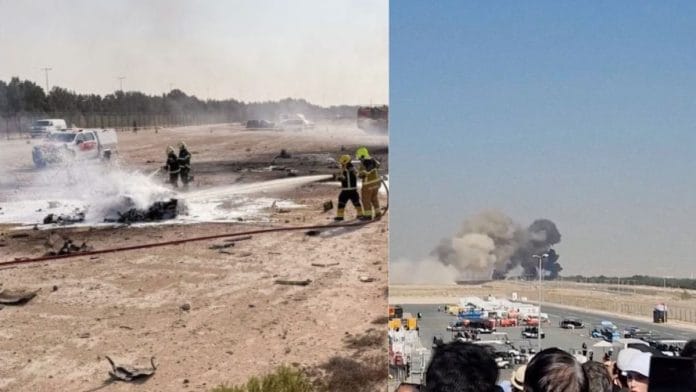
In Dubai last week, it intervened with a fireball.
The crash of the HAL Tejas Mk-1 during a low-altitude display wasn’t a mishap. It was a global verdict. Before the world’s toughest buyers, it exposed what India prefers to ignore: our aerospace ecosystem suffers a credibility gap—and HAL sits at the centre.
As a private pilot with over 50 years of flying and 3,000 hours in my logbook, let me say plainly: no disciplined pilot attempts a full loop at that altitude in a single-engine fighter. A low-level roll is acceptable; a low-level loop is reckless. Even before the inquiry ends, the manoeuvre raises harsh questions about judgement, display discipline and HAL–IAF coordination.
But Dubai is bigger than one manoeuvre or one jet. It is a judgement on India’s aerospace pretensions.
A Crash Heard Around the World
The Dubai Air Show isn’t a weekly bazaar or a subzi mandi ! It’s where aircraft win or lose billion-dollar clients in seconds. Buyers in Asia, Africa and Latin America—exactly the markets India courts—judge platforms by one metric: performance, credibility & confidence. Not slogans or PowerPoints. And not “Atmanirbhar Bharat” banners.
Credibility vanishes the moment a fighter crashes in front of them.
This was Tejas’s second crash in 20 months. For a fleet with barely 12,000 flying hours, that alone alarms any air force. Worse, it revives India’s old baggage: the Dhruv–Ecuador fiasco, where four of seven HAL helicopters crashed, Ecuador cancelled the deal, and India endured global embarrassment. Ecuador blamed mechanical failures; HAL blamed Ecuadorian maintenance. Buyers concluded only one thing: not reliable.
Dubai has now amplified that memory.
HAL: A Mindset Problem Wearing a Manufacturing Mask
HAL is hailed as a “Maharatna”. In truth, it is a protected monopoly supplier to a monopsony customer—the Government of India. Profitability inside this walled garden means little. HAL isn’t winning global tenders. It isn’t beating rivals. It survives because taxpayers have no choice.
HAL began in 1940 as a promising private enterprise. By 1942, government control converted it into a bureaucratic department with wings. Decisions today crawl at file speed, not aerospace speed.
Every major programme—Tejas, IJT, HTT-40, Dhruv—shares the same pathology:
- Chronic delays
- Diffuse accountability
- Over-promising, under-delivering
- Design by committee
- Fluctuating quality
- Excuses instead of excellence
When the CAG says the LCA is 10+ years late, each agency produces a justification—changing specs, sanctions, budgets. India’s classic formula: shared responsibility → zero responsibility.
You cannot be an Aircraft Nation Without Building Engines
Tejas is called “indigenous”. Yet its engine is imported, early radars imported, many avionics imported. Paint it in tricolour—dependency stays.
Let’s stop deceiving ourselves. A country still struggling to fix potholes cannot claim aerospace supremacy because we bolted a foreign engine onto a local airframe and sent probes to the Moon.
Aviation respects one thing: performance, not propaganda.
Even the IAF Has Lost Patience
At Aero India 2025, the Air Chief openly said he had “no confidence” in HAL and that the company was “not in mission mode.” HAL had promised 11 Tejas Mk-1A fighters by February—not one was ready.
That is not delay. It is a credibility collapse.
When your only customer publicly doubts you, you don’t have a PR problem—you have structural rot. The Dubai crash now sits atop that distrust like a flashing red beacon.
If India Wants Aerospace Respect, HAL Must Face Heat
India cannot keep cushioning HAL. If we want global credibility, three shifts are essential:
-
Open aerospace to genuine private-sector OEM competition
Not subcontracting—OEM competition. Let Tata, Mahindra, L&T, Kalyani and others compete directly. Monopoly breeds comfort; competition breeds capability.
-
Demand transparency, not opacity
Aviation advances through open data and honest root-cause analysis. We need credible investigations—not bureaucratic fog.
-
Build the engine
Without an indigenous jet engine, talk of a “fully Indian fighter” is premature. Propulsion defines aerospace maturity.
Dubai Should Be a Turning Point
India has talent. Our engineers are gifted. Our test pilots are exceptional. But they operate inside a system clogged with bureaucratic inertia, PSU entitlement and protected mediocrity.
The Dubai crash wasn’t just humiliation.
It was a diagnosis.
If India embraces accountability, competition and engine development, Dubai can be a turning point. If we sink into denial, Tejas will become another symbol of our widening gap between ambition and ability.
HAL doesn’t need sympathy.
HAL needs a shock.
And India must stop mistaking dreams for arrival.
Mohan Murti, FICA, Advocate & International Industry Arbitrator, Former Managing Director-Europe, Reliance Industries Ltd. Germany
These pieces are being published as they have been received – they have not been edited/fact-checked by ThePrint.