




Thank you dear subscribers, we are overwhelmed with your response.
Your Turn is a unique section from ThePrint featuring points of view from its subscribers. If you are a subscriber, have a point of view, please send it to us. If not, do subscribe here: https://theprint.in/subscribe/
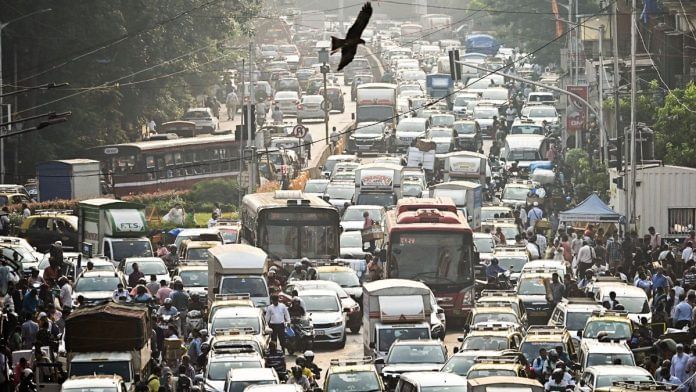
India’s traffic disorder is not a new subject of debate, yet the scale and character of the chaos today has reached a point that should alarm every citizen. It is not simply that our cities are congested, our road networks outdated, or our population dense. Many countries face these constraints and still manage to maintain some semblance of order. What sets India apart is something more troubling: a widespread and growing disregard for rules, for fellow citizens, and for the very idea of a shared public space.
Among the many manifestations of this civic breakdown, none is as dangerous—or as symbolic – as the epidemic of wrong-side driving. What was once an occasional violation committed by a hurried scooter rider has now evolved into a normalized behavior across cities, towns, highways, and even expressways. Cars, motorcycles, auto-rickshaws, buses, and sometimes even heavy trucks routinely barrel down the wrong side of the road, turning every commute into a gamble with fate.
Wrong-Side Driving: A Daily Assault on Safety
If one stands at any junction in a metro like Delhi, Bengaluru, Pune, Hyderabad, or Chennai, it takes no more than a minute or two to witness someone approaching from the opposite direction. It is not just an act of breaking a rule; it is an open challenge to the basic logic on which roads function. It says, “My time is more important than your safety.”
The phenomenon has spread with shocking audacity. Drivers take U-turns over concrete medians. Vehicles enter “exit-only” ramps on flyovers. Others, when encountering a short traffic hold-up, simply reverse course and drive back as though the entire road network exists solely for their personal convenience. On expressways—designed for high-speed, unidirectional movement – vehicles can be seen creeping against the flow of traffic because they “missed the exit.” These are not rare exceptions. They are becoming everyday norms.
Where Is the State?
What makes this trend even more disheartening is the muted response from authorities. Despite the obvious danger—wrong-side driving is a major contributor to fatal accidents—there is minimal enforcement. In many cities, traffic police are understaffed, underequipped, or sometimes simply resigned. Cameras are placed in limited spots and are often oriented only toward revenue collection for overspeeding, not for behavioral violations like wrong-side driving or lane indiscipline.
The problem appears to be one of priority and will. Infrastructure expansion receives attention because it is politically visible. But enforcing discipline—consistent, everyday enforcement that corrects behavior – is less glamorous, less headline-friendly, and therefore often neglected. The silence of authorities on an issue that costs thousands of lives every year sends an unintended message: that chaos is acceptable, rules are optional, and civic responsibility is merely theoretical.
A Mirror to Society
The crisis on our roads is not merely a logistics issue. It is a social indicator.
Road behavior is often society’s most visible expression of its values. When people violate rules even in situations where the violation offers minimal benefit, it reflects deeper fractures – impatience, mistrust in institutions, and an erosion of collective consciousness. The attitude seems to be: If everyone else breaks the rules, why shouldn’t I? This spiral quickly transforms into a culture of normalized lawlessness.
Every act of wrong-side driving sends a subtle but powerful signal: “I do not feel accountable to the community.” Over time, this mindset spills into other spheres—queue breaking, bribery, tax evasion, corruption, vandalism, and the general indifference that corrodes institutions. Roads, in that sense, are not the problem; they are the symptom.
Why Do People Do It?
The reasons are complex but interconnected:
- Impunity:
There is little fear of consequence. Violators rarely face fines, and even when they do, many find ways around them. - Social acceptance:
When rule-breaking becomes ubiquitous, it no longer appears shameful. Young riders imitate what they see around them. - Poor road design:
Lack of proper signage, badly placed dividers, and sudden closures do push some drivers into improvisation – but design flaws alone cannot explain the sweeping contempt for order. - Lack of civic education:
Most Indian drivers learn from friends or family, not professional instructors. Traffic rules remain theoretical and are seldom internalized.
What Can Be Done?
Reversing this trend requires a combination of enforcement, education, design, and cultural change.
- Zero tolerance enforcement:
Cities like Singapore and parts of Europe have shown that strict, consistent policing – especially automated camera-based enforcement – creates long-term behavioral change. - Engineering for discipline:
Road design must discourage violations: physical barriers, one-way channelizers, and protected medians can greatly reduce opportunities for wrong-side driving. - Public awareness that actually resonates:
Campaigns must go beyond slogans and address the psychology behind violations. Emotional storytelling, survivor accounts, and hard-hitting visuals can reshape norms. - Civic education from school level:
Traffic discipline should be taught as a component of citizenship – not merely a technical subject.
A Call for Collective Introspection
India’s road crisis is not inevitable. It is a man-made disorder, and we have the capacity to correct it. Infrastructure alone will not save us. Technology alone will not save us. What will save us is the willingness to recognize that public spaces belong to all, not just to the boldest or the most aggressive.
Every time someone drives on the wrong side, jumps a red light, or overtakes from the left, they are not just breaking a rule. They are eroding the social contract that allows millions to coexist peacefully in crowded cities.
These pieces are being published as they have been received – they have not been edited/fact-checked by ThePrint.