





Thank you dear subscribers, we are overwhelmed with your response.
Your Turn is a unique section from ThePrint featuring points of view from its subscribers. If you are a subscriber, have a point of view, please send it to us. If not, do subscribe here: https://theprint.in/subscribe/
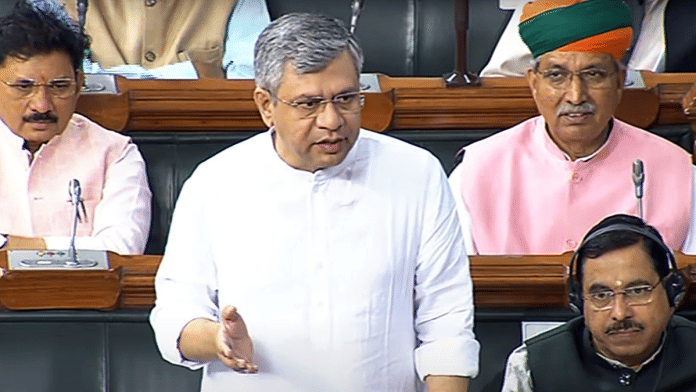
When Railway Minister Ashwini Vaishnaw announced the discontinuation of the black prince coat—popularly known as the bandhgala—for railway officials, he framed it as another decisive strike against colonial hangovers. “We have to find every trace of colonialism and banish them,” he declared, invoking a language that has become familiar in today’s India: cleansing, purging, erasing. The British may have left nearly eight decades ago, but in official imagination they apparently still lurk in wardrobes, file covers, and architectural arches.
The announcement was met with predictable applause in sections of the media. Another relic gone. Another symbolic victory. Another chest-thumping declaration of cultural sovereignty. And yet, the moment one pauses to think, the entire exercise begins to look less like decolonisation and more like theatre—performative, shallow, and conveniently misdirected.
Because colonialism was never about coats.
Colonialism was about extraction, hierarchy, control, and the systematic dismantling of indigenous capacities. It was about railways built not to serve Indians but to move raw material to ports. It was about laws designed to discipline subjects, not empower citizens. It was about bureaucracy as an instrument of distance, not service. If these structures remain intact—if they have merely changed masters—then changing uniforms does nothing except flatter a nationalist vanity.
The irony is especially stark in the case of the Indian Railways. The rail network was one of the British Empire’s most effective tools of control. It enabled economic plunder, troop movement, and administrative surveillance. Post-Independence, the railways were repurposed—at least in principle—into a public good, a lifeline connecting the poorest Indian to the rest of the country at an affordable cost. That transformation had nothing to do with uniforms. It had everything to do with political intent.
What, then, does it mean to “decolonise” the railways today?
Is it decolonisation when passenger fares rise quietly while corporate freight concessions expand? Is it decolonisation when safety budgets shrink but station “redevelopment” projects balloon, often prioritising malls over waiting halls? Is it decolonisation when contractual labour replaces permanent jobs, eroding both worker security and institutional memory?
If anything, what we are witnessing is not the dismantling of colonial structures but their mutation. The colonial railway served imperial commerce; the present railway increasingly serves corporate capital. The language has changed—from empire to development—but the logic of top-down decision-making remains remarkably intact.
The obsession with symbols is not accidental. Symbols are easy. They are inexpensive. They require no confrontation with entrenched interests. Removing a coat costs nothing. Reforming procurement systems, labour practices, safety oversight, and accountability mechanisms costs political capital—and risks discomfort.
There is also something deeply selective about this sudden sensitivity to colonial residue. The same state that frets over British-era uniforms has no discomfort retaining colonial-era laws like sedition (even if rebranded), preventive detention statutes, or draconian policing frameworks. The same establishment that wants to purge visual reminders of the Raj continues to govern through an inherited bureaucratic culture that is secretive, hierarchical, and hostile to dissent.
Decolonisation, if taken seriously, would require the state to ask far more unsettling questions. Why does public infrastructure increasingly feel inaccessible to the poor? Why are grievances met with indifference or force rather than redressal? Why is participation reduced to spectacle—flag-waving, slogan-chanting—rather than democratic engagement?
The bandhgala itself is a curious target. Over decades, it ceased to be a colonial marker and became a distinctly Indian formal wear, worn by politicians, diplomats, judges, and even freedom fighters in the post-Independence era. It was appropriated, indigenised, stripped of its original imperial meaning. To now declare it “colonial” is to misunderstand how cultures evolve. By that logic, should we also discard the railways themselves, the English language, parliamentary democracy, or the legal system—all colonial inheritances that India reworked for its own purposes?
But of course, those are too foundational to question. So we settle for costumes.
There is a deeper political psychology at play here. The current ruling imagination is far more comfortable fighting the past than confronting the present. Colonialism becomes a convenient external villain, even when its structures have long been domesticated and repurposed by Indian elites. By constantly invoking the British, today’s failures can be framed as historical burdens rather than contemporary choices.
It also allows a sleight of hand. Real decolonisation would involve decentralisation, empowering local communities, protecting public assets from privatisation, and ensuring that institutions serve citizens rather than discipline them. That kind of project would inevitably clash with neoliberal policy priorities and majoritarian political control. Symbolic decolonisation, on the other hand, is perfectly compatible with centralisation and authoritarian drift.
The tragedy is that the language of decolonisation once carried radical promise. It spoke of reclaiming dignity, autonomy, and justice. Today, it is increasingly reduced to a cultural aesthetic—what to wear, what to rename, what to erase from textbooks—while economic and political power becomes more concentrated than ever.
If the Railways Minister truly wishes to honour the spirit of decolonisation, he could begin elsewhere. He could speak about restoring affordable travel as a right, not a privilege. He could commit to transparency in contracts and safety audits. He could ensure that railway workers are treated not as disposable labour but as the backbone of a national institution. He could reimagine the railways as a public service first, not a monetisation platform.
Until then, the removal of a coat remains exactly what it is: a gesture without substance.
Colonialism did not survive in fabric. It survived in power relations. And those, inconveniently, cannot be tailored away.
About the author
Dr. Ranjan Solomon has worked in social justice movements since he was 19 years of age. After an accumulated period of 58 years working with oppressed and marginalized groups locally, nationally, and internationally, he has now turned a researcher-freelance writer focussed on questions of global and local/national justice. Since the First Intifada in 1987, Ranjan Solomon has stayed in close solidarity with the Palestinian struggle for freedom from Israeli occupation, and the cruel apartheid system. He has initiated solidarity groups in India, Afro-Asia-Pacific alliance, and at the global level. Ranjan Solomon can be contact ranjan.solomon@gmail.com