




Thank you dear subscribers, we are overwhelmed with your response.
Your Turn is a unique section from ThePrint featuring points of view from its subscribers. If you are a subscriber, have a point of view, please send it to us. If not, do subscribe here: https://theprint.in/subscribe/
Goa stands at a difficult crossroads where faith, politics, economics, and the environment intersect in ways that will define its future. The government’s proposal to construct a massive ₹134-crore temple in Bicholim is being advertised as an act of cultural pride and spiritual revival. But to understand the deeper implications, we must go beyond the language of devotion and look at the consequences for Goa’s plural identity, its fragile ecology, its public finances, and its political climate.
When the project was announced, it was clear that this was not simply a temple meant to serve its surrounding community. It is projected to be one of the largest in western India, spread across acres of land with monumental structures, vast parking zones, visitor infrastructure, and the weight of State endorsement behind it. It is an attempt to monumentalise religion, not to nurture spirituality. Much like the 77-foot statue of Lord Ram unveiled by Prime Minister Modi on 28 November, these constructions belong to a new national landscape where size becomes the measure of devotion and gigantism substitutes for ethics.
Spiritual traditions have always honoured Lord Ram for his embodiment of dharma, loyalty, courage, simplicity, and unwavering commitment to truth even at enormous personal cost. Grand statues and gigantic temples do not inspire these values. Instead, they risk turning profound moral ideals into spectacles, diverting public resources from human development into monumental displays designed to impress rather than transform. The crux of the concern is: how does a temple of such magnitude deepen spirituality, or help communities live better, more harmonious lives?
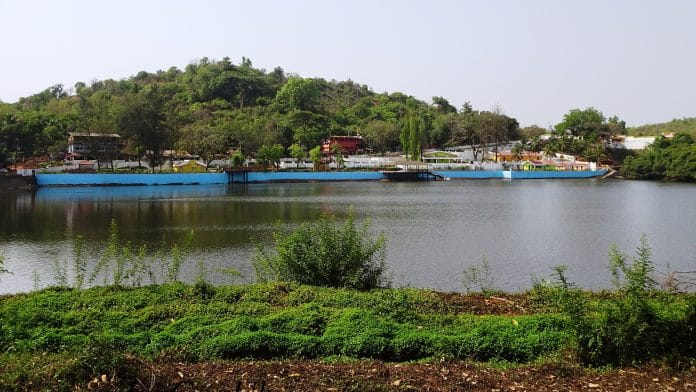
Bicholim, where the temple is proposed, is one of Goa’s most ecologically fragile sub-districts. It contains forested slopes, agricultural land, water bodies, and biodiverse patches that are already vulnerable due to mining, unregulated construction, and climate-induced stresses. The land earmarked is part of an ecological system that sustains livelihoods. Forest cover absorbs runoff, water bodies support agriculture and household needs, and agricultural land sustains families that have lived on it for generations. A sprawling complex of concrete and steel will rupture this delicate balance. Forest patches will be cut, water flows diverted, and the soil compacted to the point where regenerative agriculture becomes difficult or impossible. Once biodiversity is destroyed, no amount of spiritual rhetoric can resurrect it.
True spirituality is inseparable from reverence for the natural world. The environmental cost of the Bicholim project alone contradicts the very essence of faith, which teaches us to protect creation, not exploit it. By pushing this project without a transparent Environmental Impact Assessment and without engaging the local community, the government demonstrates that it values spectacle over sustainability. Residents who depend on agriculture, forest resources, and small-scale livelihoods face uncertainty, while outsiders will benefit from the contracts, the tourism, and the political gains.
Spirituality is not brick and mortar. Spiritual tourism is fundamentally about soulful discovery, self-care, purpose and intangible cultural experiences rather than just physical places, even though it uses tangible sites like temples and ashrams; it blends physical travel with profound personal transformation, promoting living culture and local economies through experiences.
There is also the disturbing reality that massive public funds are being poured into religious monumentalism at a time when Goa struggles with tangible social needs. Rural infrastructure remains uneven. Healthcare is overstretched. Public schools need attention. Employment opportunities are shrinking, especially for youth. At such a moment, dedicating 134 crores to a single religious project reflects a distorted sense of governance priorities and will ultimately fall on taxpayers who never consented to it. The voices of Bicholim’s residents, who are most affected, remain peripheral to decision-making. Spirituality cannot be financed by a public already burdened with unmet basic needs.
Over the past decade, India has witnessed the strategic use of monumental religious structures to send political messages. Temples and statues are built at unprecedented scale while being promoted by political leaders as symbols of cultural revival. Goa, with its layered heritage shaped by Hindu, Catholic, Muslim, tribal, and indigenous cultures, cannot afford the narrowing of its identity into a single dominant narrative. Temples, churches, mosques, and gurudwaras have long existed side by side in Goa’s towns and villages, each serving its community quietly and without fanfare. They served their purpose precisely because they were intimate, local, and rooted in everyday spiritual needs.
The State’s championing of monumental Hindu structures, while simultaneously accusing Christian communities of “forced conversions” without presenting evidence, is indicative of a political strategy. These accusations cause humiliation, generate mistrust, fuel a divisive politics that pits communities against one another while presenting the construction of mega-temples as acts of cultural protection. Faith becomes weaponised. And when faith and power intertwine, what thrives is not spirituality but domination.
Goa’s strength has always been its pluralism. Its landscape is dotted not with gigantic monuments but with community shrines, small temples, humble chapels, neighbourhood mosques, and local places of prayer where people gather without spectacle. These are the places that anchor spirituality in daily life. They remind us that religion is about love, peace, kindness, forgiveness, truth, and human service that cannot be captured in concrete and granite. When the State promotes one path as superior through monumental architecture, it undermines the very foundation of secularism.
In the end, the Bicholim temple project must be evaluated not only through environmental, fiscal, or cultural lenses but through a moral one. Does this project deepen spirituality or reduce it to a tourist attraction? Does it honour Goa’s plural heritage or overshadow it? Does it promote ecological balance, human dignity, and community well-being, or does it erode them?
Goa’s soul can only be measured in coexistence, compassion, and conscience where people can pray, reflect, and build community not spectacles that drain the environment, divide society, and dilute the essence of worship. Small, humble, community-rooted places of worship are what nurture spiritual depth. They teach us truth, humility, and human service – the three virtues that matter most.
*Ranjan Solomon is a political commentator and peace advocate who writes on faith, governance, and the moral questions of development.
These pieces are being published as they have been received – they have not been edited/fact-checked by ThePrint.