





Thank you dear subscribers, we are overwhelmed with your response.
Your Turn is a unique section from ThePrint featuring points of view from its subscribers. If you are a subscriber, have a point of view, please send it to us. If not, do subscribe here: https://theprint.in/subscribe/
Rakshasas, in the Vedic age, were never a race or a community; they were a mindset. They were recognised by conduct—those who disrupted peace, mocked what others revered, poisoned harmony, and thrived on provocation. They did not reform civilisation; they harassed it. And they were never defeated by noise or fury, but by dharma asserting itself—quietly, lawfully, and without apology.
That description feels alarmingly contemporary.
Only the venue has changed—from the deep forest to Fort St. George.
In present-day Tamil Nadu, the State appears to have misplaced its sense of proportion. Failing Law & order, incompetent governance, rising unemployment, collapsing hospitals, failing schools, poisoned hooch, and infrastructure that dissolves with the first monsoon barely merit urgency.
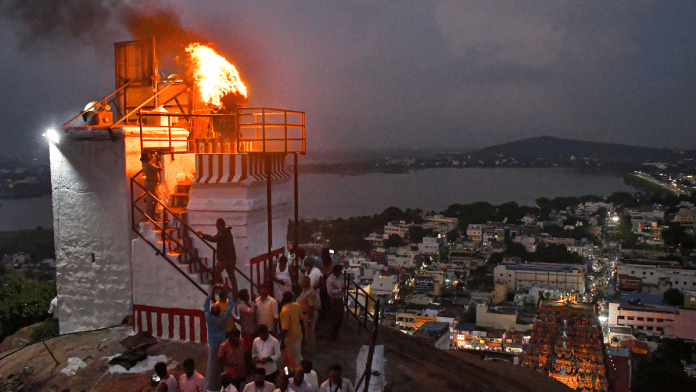
Instead, the government has identified a far graver threat to public order: a lamp. A small flame, lit peacefully for centuries, is now treated as if it were an act of sedition.
If this sounds absurd, it is because governance has given way to ideological hysteria.
The Karthigai Deepam controversy was never about law and order. It was about control—about who gets to approve memory, certify tradition, and decide which practices are permitted to exist. When a government begins to fear voluntary, non-violent rituals, the problem is not religion. It is authority that no longer trusts itself.
Rationalism is offered as the fig leaf. But rationalism does not mean bullying history or criminalising belief.
What is on display is state-sponsored contempt for anything that predates the ruling ideology. A government that claims intellectual superiority but panics at the sight of a flame is not brave. It is pathetically insecure.
Then came the real scandal. When the court intervened, the State had every legal remedy available—appeal, review, or compliance under protest. Instead, it chose something far uglier: it questioned the judge, not the judgment. The moment governments start insinuating ideological bias in judges, they are no longer governing. They are intimidating institutions.
That is not dissent.
That is constitutional vandalism.
Courts are not party offices. Judges are not expected to echo political slogans. The Constitution does not answer to Dravidianism, Hindutva, socialism, or any other ideological fashion show. It stands above all of them—and that stubborn independence is deeply inconvenient to regimes addicted to control.
The irony borders on farce. A party that mocks superstition behaves with near-primitive fear when confronted by a ritual it cannot regulate. A government that lectures citizens on rational thought panics before a lamp it cannot extinguish.
If authority trembles before a wick and oil, the darkness is not in tradition—it is in governance.
This is not reform. It is manufactured antagonism—conflict created to mask failure. When ideology replaces competence, heritage becomes the enemy, courts become obstacles, and institutions become targets.
The Vedic warning was clear. Civilisations do not fall only to invaders. They erode when those in power mistake contempt for courage, derision for intellect, and hostility to belief for progress.
Governments come and go.
Ideologies flare and burn out.
But lamps keep getting lit.
And that calm persistence—unimpressed by power, untouched by theatrics—is what unsettles insecure authority the most.
Because rakshasas have always feared one thing above all else: dharma that refuses to be intimidated.
Mohan MURTI, FICA
Advocate & International Industry Arbitrator
Former Managing Director-Europe
Reliance Industries Ltd. Germany
These pieces are being published as they have been received – they have not been edited/fact-checked by ThePrint.