





Thank you dear subscribers, we are overwhelmed with your response.
Your Turn is a unique section from ThePrint featuring points of view from its subscribers. If you are a subscriber, have a point of view, please send it to us. If not, do subscribe here: https://theprint.in/subscribe/
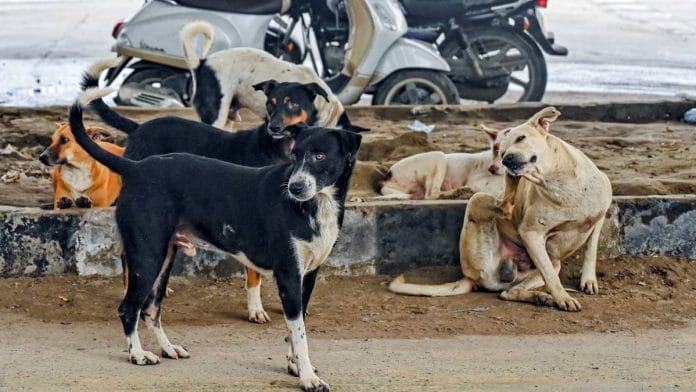
In recent weeks, India has witnessed a deeply troubling turn in its handling of stray dog populations — and not just a public-health crisis, but a moral one. Our highest court, charged with interpreting justice under the Constitution, is caught between ensuring human safety and protecting the lives of voiceless animals. The result? A set of decrees and counter-decrees that reflects more about our collective fear than our humanity.
On 7 November 2025, a three-judge bench of the Supreme Court directed all states and union territories to “remove” stray dogs from institutional spaces — schools, hospitals, railway stations — and relocate them to shelters after sterilisation and vaccination. The court’s order explicitly states that these dogs should not be returned to the same places.
This marks a disturbing departure. Under India’s Animal Birth Control (ABC) Rules, 2023, framed under the Prevention of Cruelty to Animals Act, the guiding principle is catch-neuter-vaccinate-release (CNVR): once sterilised and immunised, dogs are to be released back into their locality. But the court’s November order seems designed to sideline that very framework.
Why the shift? The court cited an “alarming rise” in dog-bite incidents and systemic failures in fencing or securing public premises, calling this “a fundamental right to life and safety” for citizens, especially children, under Article 21. At face value, that argument is compelling — but the bigger question is at what moral and legal cost.
To its credit, the Supreme Court has moderated its original, harsher ruling. In August 2025, a bench ordered that all stray dogs in the Delhi-NCR be rounded up into shelters — permanently. Six weeks later, a new three-judge bench scaled back that blanket mandate: now, only rabid or aggressive dogs will be held in shelters; the rest, once sterilised, vaccinated, and dewormed, may be returned.
The court also banned public feeding outside of designated “feeding zones,” threatened legal action against obstructors, and extended the case’s scope nationwide, transferring similar pending high court petitions to itself. Even NGOs and individual feeders responding to the case were asked to deposit money — Rs 2 lakh for NGOs, Rs 25,000 for individual feeders — to fund stray-dog infrastructure.
From one viewpoint, these moves are welcome: the court retains CNVR, insists on humane treatment, and warns that aggressive culling would be unlawful. From another, the tone is punitive and authoritarian.
Animal-rights groups have raised serious concerns. They warn that the court’s “no release” clause (in its earlier order) challenged the legal norm and endangered dogs with nowhere to go. As one advocate put it, without a watertight definition of what constitutes “aggressive behaviour,” nearly any dog could be disqualified for return.
Consider this: India is reported to have over 50 million stray dogs. What does it mean, practically, to shelter large swathes of them? Inadequate infrastructure, overcrowding, and resources will surely follow. The court themselves acknowledged that their first order was “too harsh” and practically unworkable, given the scale involved.
And the moral dimension is deeply unsettling. When we speak of “removal,” what are we really talking about? Capturing and warehousing sentient beings because they are inconvenient, even after sterilisation and vaccination? That impulse reflects not just a public-health anxiety but a kind of human-centered cruelty.
Let us be clear: dogs are not pests. They are part of our shared ecosystem. Many are “community” or “free-ranging” dogs — not strays in the sense of unwanted trash, but beings who live alongside us, thrive on our peripheries, and form real social bonds. The Supreme Court itself has said as much: “we are sympathetic to their lives as well.”
The court’s August 2025 judgment went so far as to warn of strict institutional consequences. It said that shelter authorities must not overcrowd, that dogs must not suffer neglect, and that any infraction would risk prosecution for responsible officials. That is morally right. But how many shelters in India are genuinely equipped — financially, logistically, and ethically — to guarantee that level of care for tens of thousands of animals?
Those demanding mass removal or culling of strays often veer into a chilling argument: if something threatens us, it must be destroyed. Yet this is not just about fear. It is about the failure of governance, infrastructure, and compassion. Instead of investing in humane shelters, in large-scale sterilisation programs, in feeding zones, and in rabies vaccination drives, we gravitate toward displacement or confinement — as if reflexively choosing a cage over coexistence.
Some high courts, including in Kerala, have pushed back. In July 2025, the Kerala High Court deferred a government order that would have permitted euthanasia of diseased or injured stray dogs. The court emphasised that the ABC Rules of 2023 must be respected. This kind of legal resistance is not just defense of dogs — it’s a defense of conscience.
Our duty as a society must be threefold:
- Protection, not persecution: We must uphold the ABC Rules. Sterilisation, vaccination, and release must remain central until better infrastructure is built.
- Infrastructure investment: Governments must fund and maintain shelters, pounds, and care centers that are humane, not punitive.
- Feeding compassionately: Designated feeding zones are a start — but they must be accessible, well-managed, and not used to criminalize individual feeders.
And for those calling for the “elimination” of stray dogs — pause and reflect: What does that say about us? If we elect to cage, relocate, or worse, kill, because these animals are perceived as dangerous, then the real danger lies within our own society.
The most brutal species on this planet is not the stray dog. It is the human being who kills out of indifference, who punishes out of fear, who values convenience over compassion.
If India is to be judged on a moral arc, let it bend toward kindness — not the kind that sequesters and silences, but the kind that builds, cares, and coexists.
These pieces are being published as they have been received – they have not been edited/fact-checked by ThePrint.