








By Parisa Hafezi
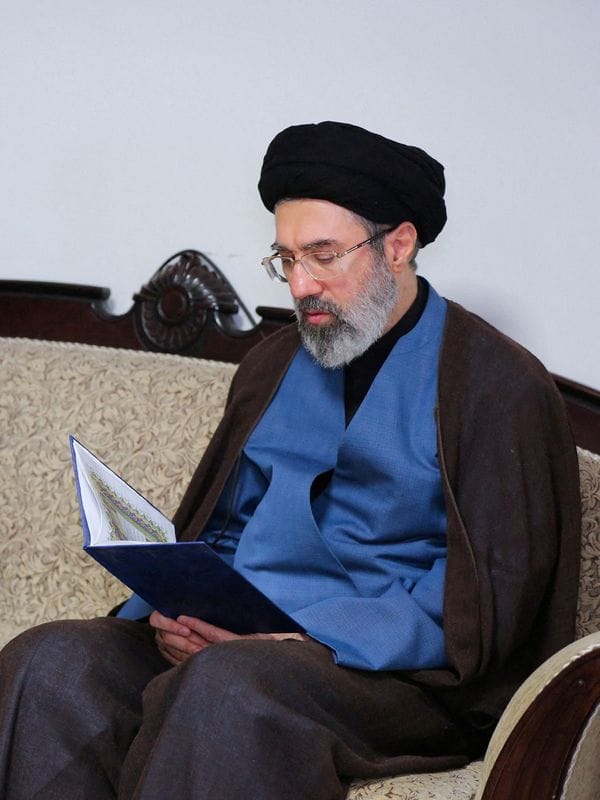
March 9 (Reuters) – Ayatollah Ali Khamenei’s son Mojtaba was chosen by Iran’s Assembly of Experts to succeed his late father as supreme leader, in a sign that hardliners were still firmly in charge.
The clerical body named the 56-year-old mid-ranking cleric, who has survived the U.S.-Israeli air war on Iran, as successor more than a week after Ayatollah Ali Khamenei was killed in an air strike, Iranian media reported.
A member of the council, Ayatollah Mohsen Heidari Alekasir, said in a video on Sunday that a candidate had been selected based on Khamenei’s guidance that Iran’s top leader should be “hated by the enemy”.
“Even the Great Satan (U.S.) has mentioned his name,” Heidari Alekasir said of the chosen successor, days after U.S. President Donald Trump said Mojtaba was an “unacceptable” choice for him.
FATHER’S “GATEKEEPER”
Mojtaba amassed power under his father as a senior figure close to the security forces and the vast business empire they control. He has opposed reformers seeking to engage with the West as it tries to curb Iran’s nuclear programme.
His close ties with the elite Revolutionary Guard Corps (IRGC) give him added leverage across Iran’s political and security apparatus and he has built up influence behind the scenes as his father’s “gatekeeper”, sources familiar with the matter said.
“He has strong constituency and support within the IRGC, in particular amongst the younger radical generations,” said Kasra Aarabi, head of researching the IRGC at United Against Nuclear Iran, a U.S.-based policy organisation.
The supreme leader has the final say on matters of state, including foreign policy and Iran’s nuclear programme. Western powers want to prevent Tehran developing nuclear arms. Iran says its nuclear programme is for civilian purposes only.
Mojtaba could face opposition from Iranians who have shown they are ready to stage mass protests to press their demands for greater freedoms despite bloody crackdowns by the authorities.
He was born in 1969 in the holy Shi’ite city of Mashhad and grew up as his father was helping lead the opposition to the Shah. As a young man, he served in the Iran-Iraq war.
Mojtaba studied under religious conservatives in the seminaries of Qom, Iran’s center of Shi’ite theological learning, and has the clerical rank of Hojjatoleslam.
He has never held a formal position in the Islamic Republic’s government. He has appeared at loyalist rallies, but has rarely spoken in public.
His role has long been a source of controversy in Iran, with critics rejecting any hint of dynastic politics in a country that overthrew a U.S.-backed monarch in 1979.
US SANCTIONS
The U.S. Treasury Department imposed sanctions on Mojtaba in 2019, saying he represented the supreme leader in “an official capacity despite never being elected or appointed to a government position” aside from working in his father’s office.
Its website said Khamenei had previously delegated some of his responsibilities to Mojtaba, who it said had worked closely with the commander of the IRGC’s Quds Force and the Basij, a religious militia affiliated with the Guards, “to advance his father’s destabilising regional ambitions and oppressive domestic objectives”.
Mojtaba was a particular target for criticism by protesters during unrest over the death of a young woman in police custody in 2022, after she was arrested for allegedly breaching the Islamic Republic’s strict dress codes.
In 2024, a video was widely shared in which he announced the suspension of Islamic jurisprudence classes he was teaching at Qom, fuelling speculation about the reasons.
Mojtaba bears a strong resemblance to his father, and wears the black turban of a sayyed, indicating his family traces its lineage to the Prophet Mohammad.
Critics have said Mojtaba lacks the clerical credentials to be supreme leader – Hojjatoleslam is a notch below the rank of Ayatollah, the position held by his father and Ruhollah Khomeini, who founded the Islamic Republic.
But he has remained in the frame, particularly after another leading candidate for the role – the former President Ebrahim Raisi – died in a helicopter crash in 2024.
A U.S. diplomatic cable written in 2007 and published by WikiLeaks cited three Iranian sources describing Mojtaba as an avenue to reach Khamenei.
Mojtaba was widely believed to have been behind the sudden rise of hardliner Mahmoud Ahmadinejad, who was elected president in 2005.
Mojtaba backed Ahmadinejad in 2009 when he won a second term in a disputed election which resulted in anti-government protests that were violently suppressed by the Basij and other security forces.
Mehdi Karroubi, a moderate cleric who ran in the election, wrote a letter to Khamenei at the time objecting to what he alleged was Mojtaba’s role in supporting Ahmadinejad. Khamenei rejected the accusation.
Mojtaba’s wife, who was killed in last Saturday’s airstrikes, was the daughter of a prominent hardliner, the former parliament speaker Gholamali Haddadadel.
(Writing by Tom Perry, Michael Georgy and Parisa Hafezi; Editing by Timothy Heritage, Alexandra Hudson)
Disclaimer: This report is auto generated from the Reuters news service. ThePrint holds no responsibility for its content.