








By Andrew MacAskill and Bo Erickson
SHANGHAI/WASHINGTON, China, Jan 30 (Reuters) – Prime Minister Keir Starmer said on Friday it would be foolish for Britain not to engage with China, rejecting an assertion from U.S. President Donald Trump that it was dangerous to get into business with Beijing.
Starmer is the latest Western leader to visit China seeking an economic and geopolitical hedge against Trump’s unpredictability, angering the U.S. leader. Last week, Trump threatened to impose tariffs on Canada after Prime Minister Mark Carney struck economic deals with Beijing.
Starmer’s three hours of talks with President Xi Jinping on Thursday resulted in China agreeing to cut tariffs on UK whisky and to relax visa rules, as well as what Britain said was progress on market access for its professional services sector.
“It would be foolhardy to simply say we will ignore (China),” Starmer told the BBC in an interview in Shanghai, highlighting French President Emmanuel Macron’s recent visit and a planned trip by German Chancellor Friedrich Merz.
“For the UK to be the only country that refuses to engage would not be in our national interest.”
TRUMP OPPOSES CLOSER TRADE TIES WITH CHINA
The main investment deal of the trip, however, flowed in the opposite direction. British drugmaker AstraZeneca committed to invest $15 billion in China, although some smaller Chinese investments in Britain were also announced.
In Washington, replying to questions about closer UK-China ties, Trump said: “Well, it’s very dangerous for them to do that.” He did not elaborate.
Starmer said the UK-U.S. relationship was very close and that Washington had been made aware of his visit.
Trump himself plans to travel to China in April.
China’s foreign ministry did not immediately respond to requests for comment on Trump’s remark.
Starmer’s centre-left Labour government has struggled to fulfil promises to boost growth since taking power in July 2024, and has made improving relations with the world’s second-largest economy a priority.
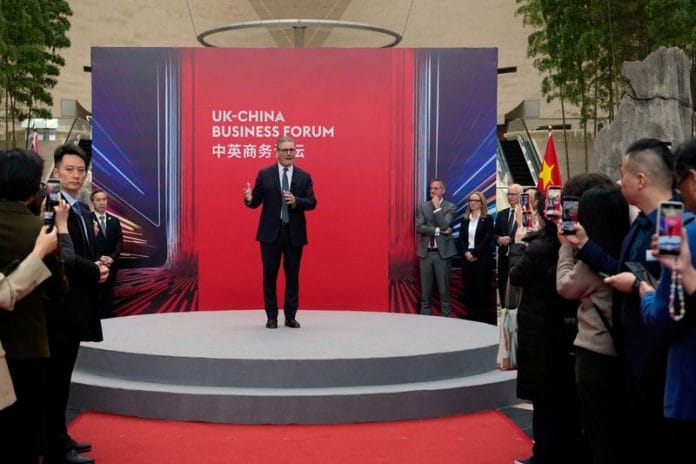
“This visit has been a real success, particularly in opening up the market,” he told the BBC on the final day of his visit.
“We have a business delegation of 60 leaders and you only need to spend five minutes with them to see what a difference it will make to our economy back home.”
STARMER MORE WILLING TO DEFY TRUMP
Earlier, he met Chinese business leaders including Yin Tongyue, chief executive of carmaker Chery, which plans to open a research and development centre for its commercial vehicle arm in Liverpool, a city official said.
Starmer also said China had agreed to remove travel restrictions on a group of British lawmakers who had been critical of China’s policies on security and human rights.
Starmer has previously insisted London will not have to choose between the U.S. and China, highlighting Trump’s visit to Britain in September where 150 billion pounds ($200 billion) of U.S. investment were announced.
Starmer, who normally avoids criticising Trump, has been more willing to defy the U.S. president in recent weeks.
Last week, he urged Trump to apologise for “frankly appalling” remarks that some troops from Washington’s NATO allies had avoided frontline combat in Afghanistan, and said he would not support Trump’s demands to annex Greenland from NATO ally Denmark.
Before Trump’s comments on closer British-Chinese ties, U.S. Commerce Secretary Howard Lutnick was asked if Trump would threaten Britain with tariffs as he did Canada.
Lutnick replied: “Unless the prime minister of Britain sort-of takes on the United States and says very difficult things, I doubt it.”
(Reporting by Bo Erickson in Washington and Andrew MacAskill in Shanghai; Writing by John Geddie and William James; Editing by Kevin Liffey)
Disclaimer: This report is auto generated from the Reuters news service. ThePrint holds no responsibility for its content.