








HANOI, Jan 19 (Reuters) – Hundreds of delegates from Vietnam’s ruling Communist Party will gather Monday under tight security for a congress that will select the single-party country’s top leader and set economic goals for the remainder of the decade.
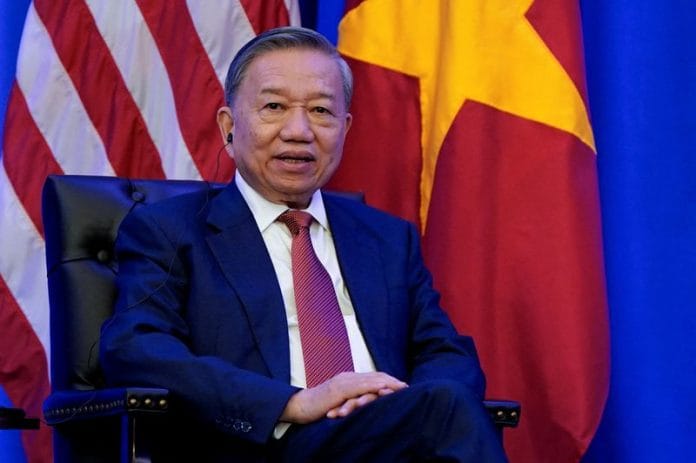
The week-long event, which operates under opaque rules and convenes every five years, could cement and possibly expand power for the party’s current general secretary, To Lam, who has launched sweeping bureaucratic reforms at home and become Vietnam’s public face overseas.
About 1,600 delegates will elect a 200-person Central Committee, which then will pick up to 17 to 19 members of the Politburo from which the general secretary is chosen.
Lam is seeking to retain his role and possibly take on the state presidency, which has recently been held by a military leader, officials briefed on the matter said.
The congress is likely to confirm him as general secretary, according to multiple officials, although surprises cannot be ruled out, while the decision about the presidency is expected to be made at a later meeting where the outcome is even less clear.
After the congress, the Politburo will nominate the heads of state, government and Parliament. Parliamentary elections will take place only after leaders are chosen by the party.
RISK-TAKING LEADER
Lam, 68, has launched several major reforms during his brief tenure as party chief, the country’s most powerful job. He ascended to the position following the death of his predecessor, Nguyen Phu Trong, in July 2024.
Widely viewed as a risk-taker, Lam introduced the most significant administrative reform in decades when he cut tens of thousands of jobs in an effort to speed up decisions. The impact has yet to be fully assessed as officials adapt, but approval timelines for some investment projects have shortened.
That acceleration is tied in part to the scaling back of a sweeping anti‑corruption drive launched under Trong, an effort that Lam helped lead as public security minister. The campaign, which was meant to combat systemic bribery, at times paralysed government decision‑making and led to the downfall of senior figures – including two presidents – clearing Lam’s path to the top.
Lam has also launched economic reforms and a burst of infrastructure projects, winning favour with foreign investors while stoking concerns about favouritism and waste.
In a country that allows no opposition, Lam has presided over a strengthening of the security forces and a tightening of controls over media and dissidents.
ECONOMIC GROWTH, SECURITY TOP NEXT FIVE-YEAR AGENDA
The congress’ delegates represent 5.6 million party members in a country of 100 million.
Under tight security – mobile phones will be jammed in the Hanoi building where the congress will take place – they will also refine the text of a resolution to be approved by the end of the congress, which is scheduled to wrap up on January 25.
A party draft released in October on the party’s website suggests the final text will prioritise security and ambitious growth, targeting at least 10% annually over the next five years, from the 6.5% to 7.0% target that was missed in the first half of the decade.
The draft mentions security dozens of times and highlights the importance of diplomacy and defence in a “more dangerous” world. The party intends to increase its defence forces, especially in border areas, the draft text says.
Environmental protection, which has been increasingly debated recently in the heavily polluted country, has also gained prominence, according to Politburo member Nguyen Xuan Thang.
(Reporting by Francesco Guarascio; Editing by Josh Smith and Thomas Derpinghaus)
Disclaimer: This report is auto generated from the Reuters news service. ThePrint holds no responsibility for its content.