





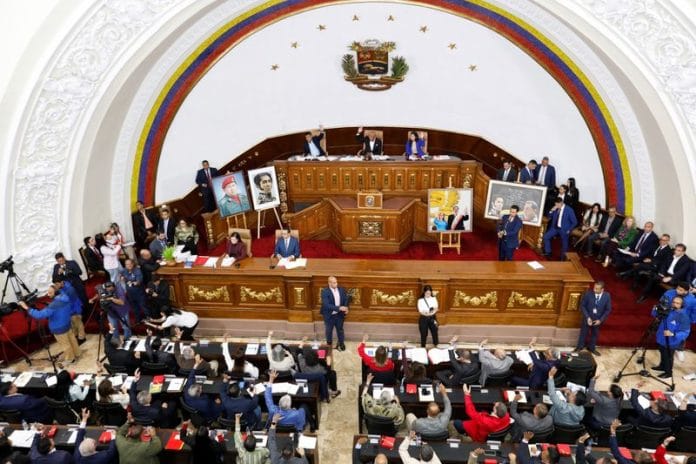



Feb 19 (Reuters) – Venezuela’s ruling party-controlled legislature on Thursday approved a limited amnesty bill that human rights organizations say falls short of offering relief for hundreds of political prisoners in the country, as some family members of detainees completed a fifth day on hunger strike.
Interim President Delcy Rodriguez, who took power last month after the U.S. ouster of President Nicolas Maduro, has bowed to Trump administration demands on oil sales and released hundreds of people who human rights groups class as political prisoners, as part of a normalization in relations between the two countries.
The government has always denied holding political prisoners and says those jailed have committed crimes.
The law was approved after a second debate in the legislature, headed by Rodriguez’s brother Jorge Rodriguez.
The approved law provides amnesty for involvement in political protests and “violent actions” which took place during a brief coup in 2002 and demonstrations or elections in certain months of 2004, 2007, 2009, 2013, 2014, 2017, 2019, 2023, 2024 and 2025. People convicted of “military rebellion” for involvement in events in 2019 are excluded.
The law does not detail the exact crimes which would be eligible for amnesty, though a previous draft laid out several – including instigation of illegal activity, resistance to authorities, rebellion and treason.
It also does not return assets of those detained, revoke public office bans given for political reasons or cancel sanctions against media outlets, as at least one previous draft would have.
Many members of the opposition and dissident former officials live in other countries to escape arrest warrants they say are politically motivated.
Though the law allows people abroad to appoint a lawyer to present an amnesty request on their behalf, they would have to appear in person in Venezuela to have it granted and the law will only cover “people who have ceased the execution of the actions which constitute crimes,” a specification which may leave out many who have continued their activism from other countries. The law removes international arrest warrants for those granted amnesty.
Tribunals must decide on amnesty requests within 15 days, according to the law.
(Reporting by Reuters)
Disclaimer: This report is auto generated from the Reuters news service. ThePrint holds no responsibility for its content.