








By David Lawder and Ariane Luthi
WASHINGTON/ZURICH, Feb 26 (Reuters) – The U.S. Treasury handed Swiss private bank MBaer Merchant Bank AG a potentially crippling blow on Thursday by threatening to sever its access to the U.S. financial system on the grounds it had breached sanctions against Iran, Russia and Venezuela.
The Treasury alleged MBaer and its employees had facilitated corruption linked to Venezuelan and Russian money laundering in addition to money laundering and terrorist financing on behalf of Iran’s Islamic Revolutionary Guard Corps and its Quds Force, which are subject to U.S. sanctions.
The rare move unleashes the strongest tool in the sanctions enforcement powers of the United States against MBaer.
MBaer said it would comment on the U.S. announcement after consulting with its U.S. lawyers.
TREASURY SECRETARY PUTS BANKS ON NOTICE
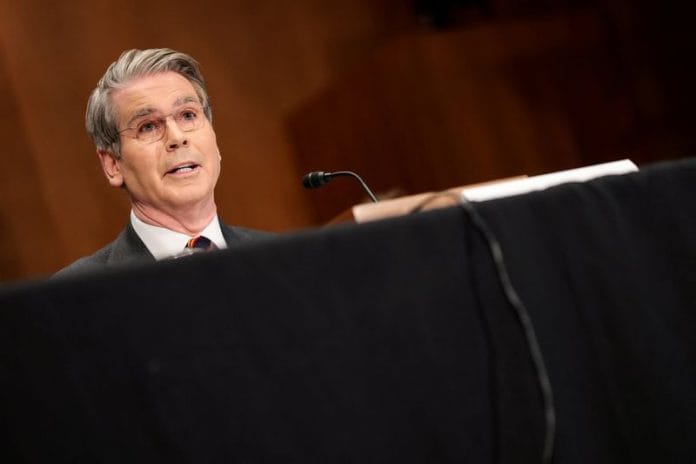
“MBaer has funneled over a hundred million dollars through the U.S. financial system on behalf of illicit actors tied to Iran and Russia,” U.S. Treasury Secretary Scott Bessent said in a statement. “Banks should be on notice that the U.S. Treasury will aggressively protect the integrity of the U.S. financial system using the full force of our authorities.”
Swiss market regulator FINMA said it was in contact with the bank and U.S. authorities and concluded its own enforcement proceedings against MBaer three weeks ago.
Due to an MBaer appeal, FINMA was unable to implement its own measures but has appointed an audit agent as a monitor at the bank, it said.
MBaer said it is cooperating fully with Swiss authorities and supports the auditor’s work. It said it continues to have a solid capital and liquidity base and is proceeding with its business activities to the extent possible. “The interests of its clients and compliance with regulatory requirements are MBaer Merchant Bank AG’s highest priorities,” it said.
Professor Michael Levi, an expert on international money laundering at Cardiff University, said the U.S. announcement was a “strategic signal not to help the U.S.’ enemies.”
He said going after the bank of a G10 country reinforced the message, although MBaer’s small size meant any collateral damage would not be significant. “The variety of ‘bad actors’ specified or alleged makes it politically easier, but questions will still be raised for the Swiss regulators,” Levi told Reuters.
Data published by the Treasury’s Financial Crimes Enforcement Network anti-money-laundering bureau, or FinCEN, suggests it is the first time the U.S. has threatened to apply such a measure, which came into force after the 9/11 attacks, to a Swiss bank.
A Treasury spokesperson was not immediately available for further comment.
Washington has long watched Swiss banks for their compliance with sanctions, and the Trump administration hit Switzerland with the highest trade tariffs in Europe last year.
However, Bern and Washington late last year cut a deal to reduce those tariffs in line with European Union levels. The United States wants to finalise that accord by the end of March.
MBaer was established in 2018 by Michael Baer, a former executive board member at the far bigger Swiss private bank Julius Baer, which was founded by his great-grandfather.
In an interview with Michael Baer published in October 2023, Swiss news site Finews indicated the bank had 3.5 billion Swiss francs in assets under management.
PROPOSED RULE CHANGE
The Treasury proposed a rule change that, if finalised, would prohibit covered U.S. financial institutions from opening or maintaining a correspondent account for, or on behalf of, MBaer.
The United States is the world’s most powerful regulator chiefly because it can sever a bank’s access to the dollar, a cornerstone of international finance.
The last bank in Europe to suffer such a fate was Latvia’s ABLV, which was shut in 2018 after U.S. authorities accused it of money laundering and U.S. sanctions breaches.
FinCEN published a notice of proposed rulemaking that invites written comments for 30 days on the plan to cut off MBaer from the U.S. dollar-based financial system.
FinCEN said the bank had used shell companies to conceal the people behind such transactions, highlighting money movements linked to Venezuelan state oil company PDVSA from 2020.
It said that money was linked to the sale of millions of barrels of Venezuelan crude oil, breaking U.S. sanctions.
Neither PDVSA nor the Venezuelan government immediately responded to requests for comment.
FinCEN highlighted the dominance of Russians among the bank’s clients, including those subject to sanctions, saying that “accounts belonging to Russian persons likely represent the largest portion of its assets under management.”
FinCEN linked the Swiss bank to “illicit activities,” including money laundering, for Russian and Ukrainian politicians and businessmen with ties to the Kremlin.
(Reporting by Daphne Psaledakis and David Lawder; Ariane Luthi, John O’Donnell, Tommy Reggiori Wilkes, Oliver Hirt, Dave Graham and Vivian Sequera; Editing by David Ljunggren, Rod Nickel)
Disclaimer: This report is auto generated from the Reuters news service. ThePrint holds no responsibility for its content.