








By Andreas Rinke, Tom Balmforth and Steve Holland
BERLIN/WASHINGTON, Dec 15 (Reuters) – The United States has offered to provide NATO-style security guarantees for Kyiv as U.S. and European negotiators reported progress in talks on Monday to end the war with Russia, but a deal on territorial concessions remained elusive.
Envoys sent by U.S. President Donald Trump made the unprecedented offer at talks with Ukrainian President Volodymyr Zelenskiy in Berlin, U.S. officials said, but warned such a deal would not be on the table forever.
The talks in the German capital have sparked some optimism from European leaders on a path to end Europe’s deadliest conflict since World War Two. However, Moscow is yet to agree to any of the changes discussed in Germany and has not indicated any willingness to do so.
“We’re trying to get it done,” Trump said of an agreement to end the war, speaking at the White House after he called into a dinner involving the key officials in Berlin. “We had numerous conversations with President Putin of Russia, and I think we’re closer now than we have been ever and we’ll see what we can do,” Trump added.
The U.S. is also leaning on Ukraine to withdraw its forces from the eastern Donetsk region, an official familiar with the matter said, in what would be a massive concession that could cause a ferocious backlash in Ukraine.
Calling the issue of territorial concessions “painful”, Zelenskiy told reporters later: “Frankly speaking, we still have different positions.” But he said he believed U.S. mediators would help find a compromise.
Kyiv’s negotiators will continue consultations with U.S. counterparts, he said, adding that Ukraine needed a concrete understanding on security guarantees, including the monitoring of a ceasefire, before making any decisions related to the war’s front lines.
“I do not think that the (U.S.) has demanded anything,” Zelenskiy said.
“I see us as strategic partners, so I would say that we have heard about the issue of territories in relation to Russia’s vision or Russia’s demands from the (U.S.) We see this as demands from the Russian Federation.”
U.S. officials told reporters by conference call they had secured agreement on 90% of the issues. Though longstanding territorial issues remain, one said, “we’ve got multiple different solutions to bridge the gap that we are suggesting to them”.
Ukraine has said previously it would not cede territory to Russia, which has taken almost 20% of the country in its east and south since its full-scale February 2022 invasion.
A European source briefed on the latest talks said Russia had not yet budged on its territorial demands. “The atmosphere is good but the goals remain quite far apart on the core.”
UKRAINE UNDER TRUMP PRESSURE TO MAKE CONCESSIONS
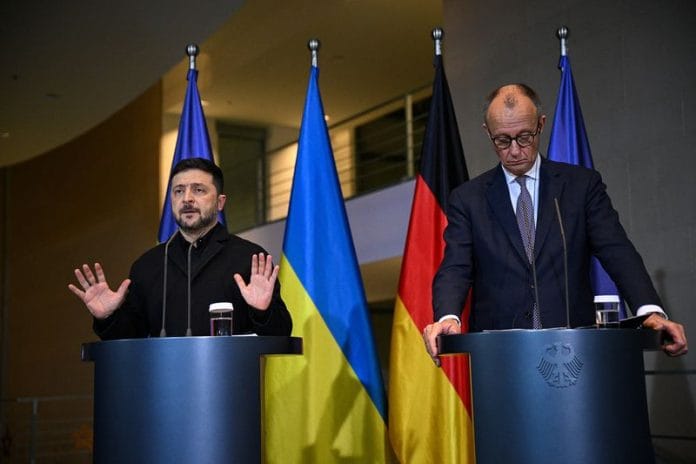
Zelenskiy has been holding talks in Berlin with U.S. envoy Steve Witkoff and President Donald Trump’s son-in-law Jared Kushner as well as European leaders.
Kyiv is under intense pressure from Trump to make concessions to Russia.
“For the first time since the war began, the possibility of a ceasefire is conceivable,” said German Chancellor Friedrich Merz, who hosted the meetings, in a post on X.
A U.S. official told reporters later that, under the deal being discussed in Berlin, Ukraine would receive security guarantees similar to those provided in Article 5 of the NATO treaty, which requires the alliance to come to the defence of any member that comes under attack.
Another U.S. official said Russia was open to Ukraine joining the European Union and that Trump wanted to prevent Russia from encroaching further westwards in Europe.
One official said security guarantees, including deconfliction and oversight of any deal, were the major focus of Monday’s talks and that an Article 5-like guarantee was something Trump believed he could get Moscow to accept.
Working groups are expected to meet in the U.S. during the coming weekend, possibly in Miami, one of the officials said. “Are we prepared to go to Russia if needed? Absolutely,” the official added.
A joint statement by leaders of several European countries including Germany, France and Britain, said there was a “strong convergence” with the U.S. and stated a list of goals for both sides to work towards.
These included commitments to supporting Ukraine’s armed forces, a European-led peacekeeping force and guarantees to use force if Ukraine came under attack again, as well as support for Ukraine to join the EU.
FOR ZELENSKIY, CONCESSIONS UNPOPULAR AT HOME
Ukraine said on Sunday it was willing to drop its ambition to join NATO in exchange for Western security guarantees. But it was not immediately clear how much the talks in Berlin could persuade Russia to agree to a ceasefire.
In Moscow, Kremlin spokesman Dmitry Peskov told reporters that Russia’s demand that Ukraine not join NATO was a fundamental question in talks on a possible peace settlement. He said Russia expected an update from the U.S. after the negotiations in Berlin.
Zelenskiy is treading a difficult line between appearing flexible and reasonable to the Trump administration while also not making concessions that the Ukrainian people would reject.
Underscoring the challenge he faces, a poll published on Monday showed three-quarters of Ukrainians reject major concessions in any peace deal.
The poll, by the Kyiv International Institute of Sociology, found that 72% of Ukrainians were prepared for a deal that froze the current front line and contained some compromises.
However, 75% believed a Russia-friendly plan that included Ukraine ceding more territory or capping the size of its army without receiving clear security guarantees was “completely unacceptable”.
Monday’s talks come at the start of a pivotal week for Europe, with an EU summit on Thursday set to decide whether it can underwrite a massive loan to Ukraine with frozen Russian central bank assets.
Europe has come under fire from Washington over its policies on migration, security and regulating big tech. The European Union and national governments have struggled to find a unified response to the U.S. criticism.
(Reporting by Andreas Rinke, Anne Kauranen, Olena Harmash, Lili Bayer, Bart H. Meijer, Dan Peleschuk, Yuliia Dysa, Anna Pruchnicka, John Irish, Steve Holland, Jeff Mason; Writing by Matthias Williams, Gareth Jones and Mark Heinrich; Editing by Joe Bavier and Daniel Wallis)
Disclaimer: This report is auto generated from the Reuters news service. ThePrint holds no responsibility for its content.